With guided learning, document tools and Search-to-Video already available, iAsk’s next chapter is taking shape around what people do after their first answer.
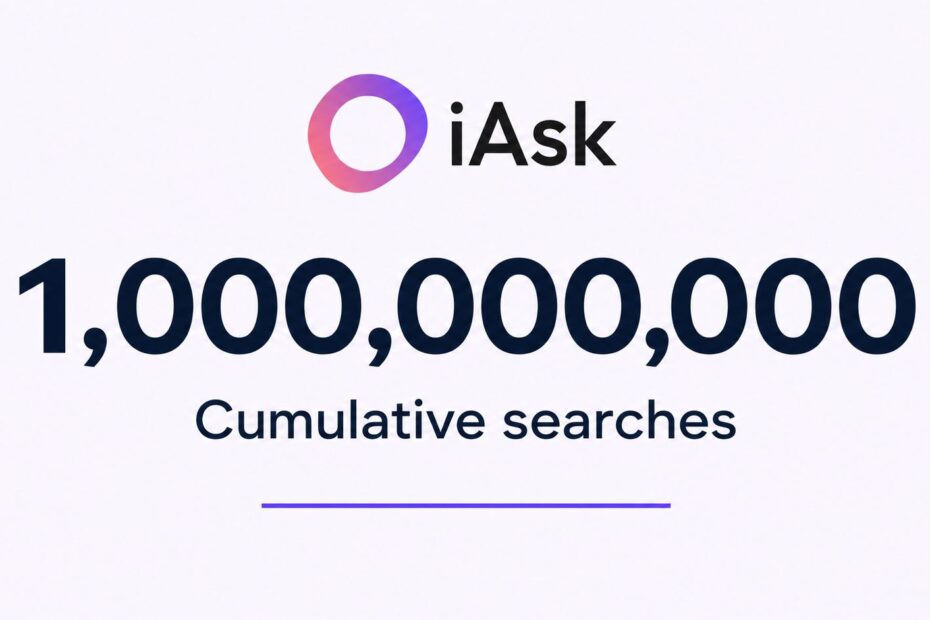
One billion searches, as reported by Ai Search Inc. Graphic supplied by iAsk.
Reaching one billion searches gives iAsk a milestone to announce. It also puts a larger product question in view: once people have an answer, what gives them a reason to keep working in the same place?
Ai Search Inc. announced on November 2 that its iAsk AI search engine had passed one billion searches since its 2023 launch. Its recent additions point toward a broader role: helping people work through material, ask more specific questions and choose how an explanation is presented. That direction is visible in features already available today.
One example begins with a photographed worksheet. In the company-provided exchange below, iAsk reads x² + 7x − 2 = 0 from an uploaded image and identifies a quadratic equation. It then asks which method or formula the learner would use. The photograph becomes the beginning of a conversation.
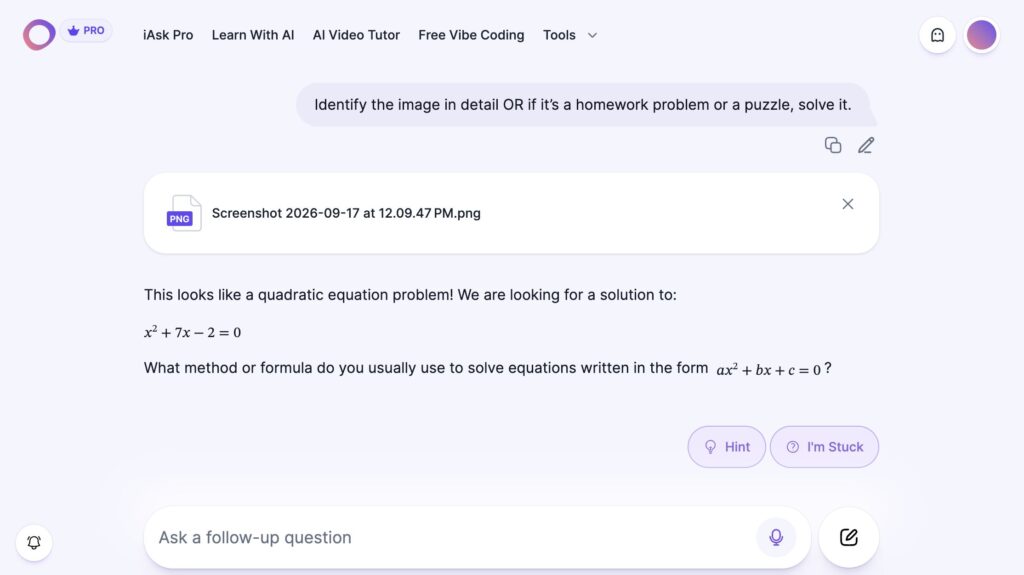
First screen: iAsk identifies the equation in an uploaded image and asks the learner how to approach it. Screenshot supplied by iAsk.
Later, the learner is asked to identify a, b and c. The response is “a=2 b=7 c=-2”. Two values are right; the first is not. The coefficient of x² is 1, even though no numeral is written in front of it.
The guided AI homework helper responds to that specific mistake. It acknowledges the correct values for b and c, then asks the learner to look again at the x² term. The next action is small and concrete: identify the number multiplying it.
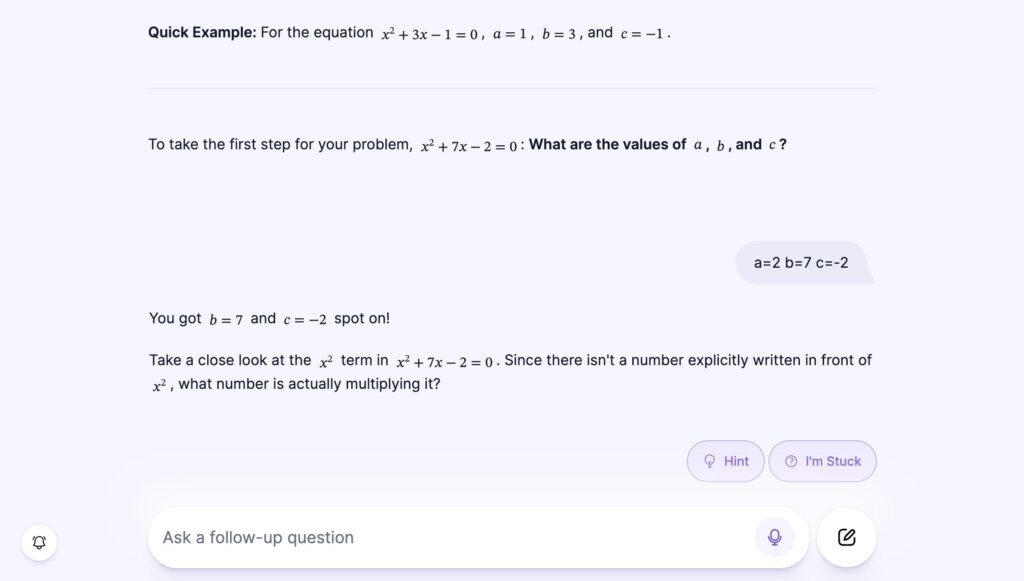
Second screen: the learner enters a = 2; iAsk confirms b and c, then prompts a closer look at the implicit coefficient of x². Screenshot supplied by iAsk.
The exchange shows how a search product can become a place to work through a problem. The learner’s attempt shapes the next response. It is a useful demonstration of the interface, although two screenshots cannot establish long-term learning outcomes.
For a startup expanding beyond its original search function, that distinction matters. Adding an answer format is one kind of development. Giving a person a clear next action is another. Here, the next action is to reconsider one coefficient, rather than abandon the exercise or start a new search.
The next chapter is already taking shape
The expansion also reaches people working with longer material. The document analysis tool lets users ask questions about an uploaded file. Its AI summarizer condenses material into bullet points. These tools bring an existing source into the interaction, making room for tasks that begin with something more substantial than a blank search box.
Search-to-Video, announced on October 26 and available to everyone, adds another route. Users can request a generated tutorial video when submitting a question, then watch the explanation alongside the written answer. Someone who needs to see a process explained can move between formats within the result.
Together, these additions suggest where iAsk’s broader product is heading: a question can lead to a guided exercise, a closer examination of a document or a video explanation. These are current capabilities, rather than promises from an unreleased roadmap. The next test is whether the growing range of tools feels coherent to the person using it.
The billion-search figure measures activity across the service’s history. It is company-reported and does not reveal how many individual users returned, which features they used or whether they completed their tasks. Those distinctions will matter when judging the business beyond the milestone.
For iAsk, the opportunity after a billion searches is to make more of those questions the start of useful work. Its recent releases give that ambition a concrete shape. Whether a user is untangling a report or correcting an algebra mistake, the product has to make the next step worth taking.

Author: Kokou Adzo
Kokou Adzo is the editor and author of Startup.info. He is passionate about business and tech, and brings you the latest Startup news and information. He graduated from university of Siena (Italy) and Rennes (France) in Communications and Political Science with a Master's Degree. He manages the editorial operations at Startup.info.