
Abstract
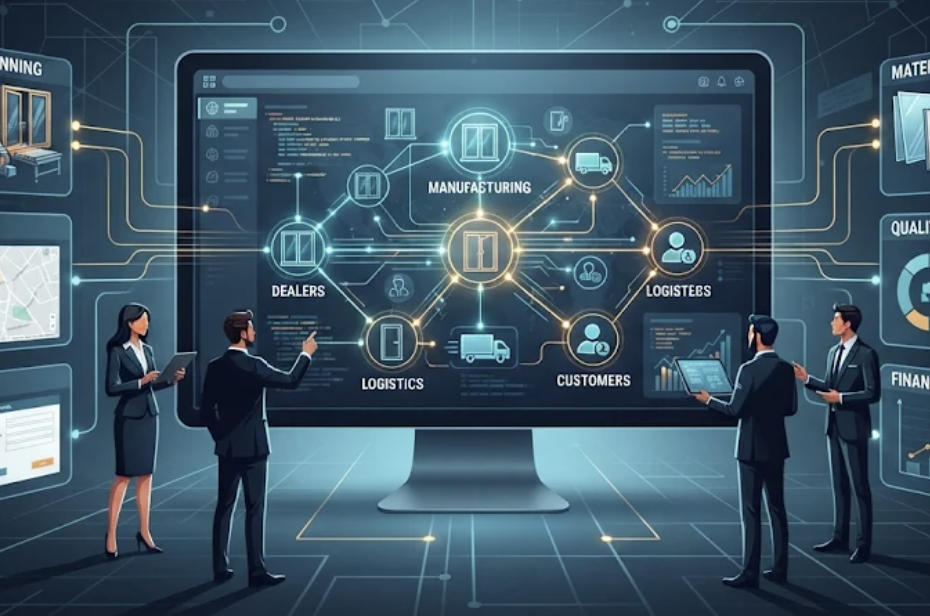
This paper examines the specifics of automating dealer networks in fenestration manufacturing using customized ERP systems. It analyzes the mechanisms for integrating sales and production, the automation of order calculation, pricing, and debt control. Special attention is given to the risks of ERP implementation, the adaptation of systems to industry-specific requirements, and the prospects for the digitalization of manufacturing processes. The study concludes that customized ERP systems enhance management efficiency, reduce manual operations, and contribute to the sustainable development of the enterprise.
Relevance of the Topic and Industry Statistics
Fenestration manufacturing is an industry with high demands for calculation precision, nomenclature flexibility, and seamless interaction between sales and the production shop floor. The manufacturing of translucent structures is inherently parametric: every product features a unique geometry, as well as a specific combination of profiles, hardware, and glazing. Dealer networks serve as the primary business growth driver, enabling plants to expand their sales footprint and scale operations.
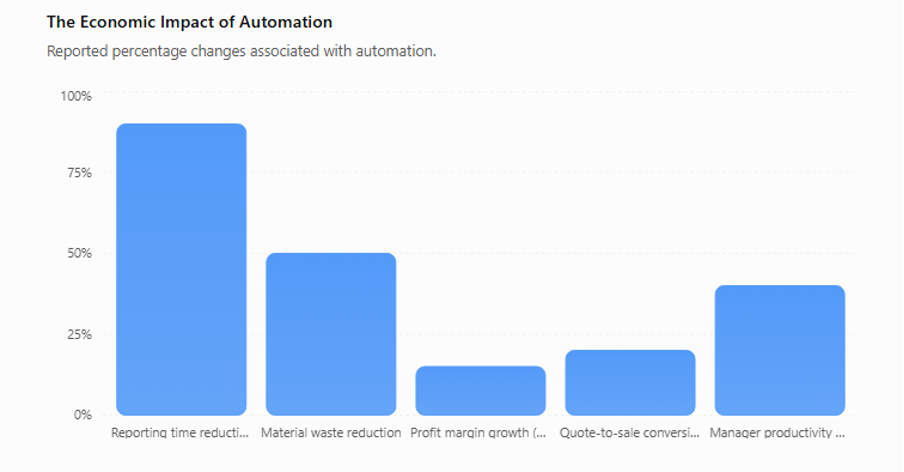
Developing a partner network without a unified digital platform leads to process desynchronization. Manual specification exchanges and chaotic debt tracking create bottlenecks that hinder scalability. Implementing specialized services establishes a single digital workspace for partner organizations. The economic impact of automation is supported by industry data:
- Order calculation speed: The time required to generate an estimate is reduced from days to mere minutes.
- Reporting preparation: Data collection labor is cut by 90%—dropping from three days to less than four hours and 10 minutes.
- Raw material savings: Profile optimization reduces scrap volume by 50%.
- Margin and sales growth: Optimized pricing yields a 10%–15% increase in profit margins, a 15%–20% boost in quote-to-sale conversion rates, and a 30%–40% increase in manager productivity.
- Deployment timelines and ROI: Rolling out core modules takes anywhere from 10 days to 6 months, with a return on investment (ROI) achieved in under 8 months.
These metrics confirm that the digital integration of sales is a foundational requirement for increasing the profitability of fenestration businesses. However, project success ultimately depends on mastering dealer network management mechanisms.
Dealer Network Automation Mechanisms and Their Integration with Production
Organizing operations between a fenestration manufacturer and its dealers entails unique industry specifics. The ERP framework divides network management into two core areas: attracting new partners and servicing the current accounts.
Regarding acquisition, the system tracks communication pipelines, reasons for lost deals, and negotiation histories, while also segmenting partners. When servicing the existing network, the platform enables autonomous sketch creation: a built-in configurator allows dealers to calculate structures directly on-site, and offline-first support makes it possible to generate orders without internet access, followed by automatic synchronization. The system also supports differentiated pricing by assigning partner tiers based on specific volume thresholds and calculating corresponding discounts and bonuses. To maintain financial discipline, the ERP tracks outstanding balances and blocks new orders if credit limits are exceeded.
A critical component is the end-to-end integration of the front-office calculator with the ERP manufacturing module. Direct data transfer eliminates manual specification entry and human error. On the plant side, the ERP calculates raw material requirements for profiles, hardware, and double-glazed units. Additionally, the system generates shift assignments and consolidates components from multiple batches for optimal cutting. Paperless manufacturing utilizing digital workstations across assembly, glazing, and quality control stations, supplemented by comprehensive barcode tracking, ensures real-time control over order progression. Building this operational framework requires flexibility, as standard out-of-the-box ERP functionality does not always align with a specific plant’s operational algorithms.
What Hinders Automation: Risks, Pitfalls, and ERP Customization Experience
Automating fenestration manufacturing operations inherently involves certain risks. System failures typically stem from organizational missteps and methodological miscalculations.
Common barriers include inadequate planning, excessive system customization, weak employee engagement, data migration errors, and insufficient training. Attempts to implement accounting and management in isolated “silos” lead to manual workarounds—such as relying on standalone Excel spreadsheets—that undermine system integrity. Conversely, trying to rewrite ERP source code to match legacy, archaic workflows unnecessarily complicates long-term system maintenance. Failing to establish focus groups breeds employee resistance, while migrating unverified or dirty data causes inaccurate information to accumulate within the system. Ultimately, a lack of comprehensive user training frequently leads to active user sabotage.
Overcoming these barriers requires tailoring the ERP platform specifically to the enterprise’s operational needs. Real-world project experience highlights the necessity of customizing and refining the following key modules
- Cost accounting and material reversal: Digital workstations that enable dynamic adjustments to production cost allocations and retrospective cost corrections.
- Tiered and cumulative discounts with automated limit controls: Mechanisms that verify volume acquisition against partner agreements, automatically shifting pricing tiers if thresholds are exceeded.
- Splitting large orders while preserving allocations: Specialized workstations designed to distribute product reserves between warehouses and sales managers without losing booking holds during long-term contracts.
- Procurement and tender management: Consolidating material requests into a unified interface with supplier grouping and automated approval workflows.
Understanding these risks and applying targeted customization practices provides a clear roadmap for the continued evolution of industry information systems.
Future Outlook and Insights from Practical Cases
Analyzing ERP-based automation projects in fenestration manufacturing highlights the key success factors of digital transformation. Moving beyond chaotic growth is only possible by establishing a unified information ecosystem that links the commercial department, warehouse logistics, shop-floor equipment, and management accounting.
Practical experience demonstrates that a hybrid management methodology is most effective. Combining traditional project planning (requirements baseline, RACI matrix) with an iterative Agile approach ensures the launch of a Minimum Viable Product, followed by the release of new functional capabilities every 2–3 weeks. This allows enterprises to see results early on and respond swiftly to changes.
The evolution of fenestration ERP systems is shifting toward advanced analytics and end-to-end integrations. Key growth areas include integrating with BI systems for predictive capacity planning and raw material inventory management, implementing vendor rating and dispatching systems for customer service and warranty maintenance, developing knowledge bases to train new employees, and digitalizing quality management with real-time tracking of defect causes at each assembly stage.
Conclusion
Ultimately, a customized ERP system becomes the strategic backbone of the business. Enterprises that build a transparent operational loop—from the dealer calculator to the paperless shop floor—gain distinct advantages in speed, operational precision, and profit margins. This establishes a solid foundation for sustainable growth in the market.
References:
- “Dealer Order: Online Calculation of Windows and Facades.” Oknosoft. (https://www.oknosoft.ru/zd/)
- “Ready-Made Solution: Window Sales: Dealer Network.” Altec LLC. (https://altec.ru/solutions/prodazha-okon-dilerskaya-set/)
- “Implementation and Custom Configuration of an ERP System for the OSZ Plant.” WeJET Group. (https://www.sostav.ru/blogs/278769/56415)
- “Pitfalls in ERP Implementation.” VIANT IT Company. (https://viant.ru/blog/oshibki_pri_vnedrenii_erp/)
- “How X24 Helped ‘NETFNET’ Reduce Manual Labor, Streamline the Production Cycle, and Implement Piece-Rate Pay.” X24 Cloud. (https://x24.cloud/cases/x24-erp-netfnet-effektivnost-proizvodstva)
- “Successful Automation Case Study of a Plastic Window Manufacturing and Sales Company.” 1С. (https://v8.1c.ru/ka/poleznye-materialy/cases/)
- “Window Manufacturing Automation Software.” Okna Plan. (https://oknaplan.ru/about/avtomatizacia.php)
- “Optima WIN: Window Calculation Software for Cost Estimation, Price Quotations, and Production Documentation.” Altec LLC. (https://altec.ru/products/programma_rascheta_okon/)
- “Software for Calculating Plastic Windows, Doors, Aluminum and Wooden Structures, as well as Manufacturing Automation.” SuperOkna. (https://www.superokna.ru/)

Author: Sergei Ivchenko
Expert in Digital Automation (ERP) and Industrial Infrastructure Development for the Construction Materials and Fenestration Manufacturing Industry