
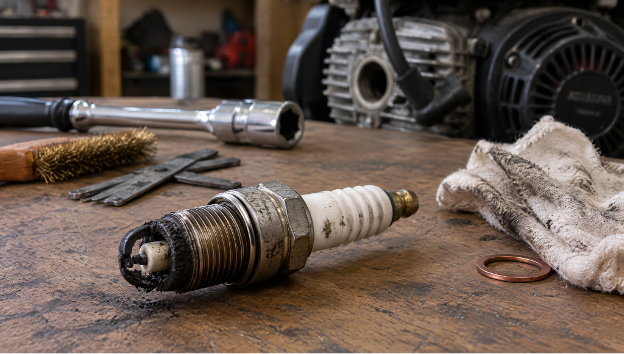
Is your mower sputtering? Losing power? Hard to start? A fouled spark plug could be behind it. Pull the plug and look at the firing tip. You will often see carbon, fuel, or oil buildup there. These deposits weaken the spark. At the same time, they tell you something about the engine. The deposits may also hint at trouble in the fuel system or other parts.
What the Buildup on Your Spark Plug Means
A good spark plug looks clean. Its firing end is light tan or grayish-brown. If the color is off, the buildup type can help you find the problem.
Dry, black carbon: This usually means the fuel mix is too rich. Common causes include a clogged air filter. The choke may have been left on too long. The carburetor may also be poorly adjusted.
Wet, gas-smelling deposits: A wet plug that smells like gas often means the engine is flooded. It can also mean an ignition problem. Fuel is entering the combustion chamber. But it is not burning.
Oily, heavy grime: Oil is getting into the combustion chamber. Worn piston rings can cause this. Bad valves are another cause. Too much oil in the crankcase can also lead to oily buildup.
White, glazed, or blistered tips: These signs often point to overheating. Check the electrodes. If they look melted or worn down, overheating is even more likely.
Heavy deposits get in the way of the spark. They make ignition less reliable. Worn electrodes need more voltage to fire. And if you see a crack in the ceramic insulator, throw the plug away.
How to Remove the Spark Plug Safely
Start with the mower off. Let the engine cool fully. Put on safety gloves. They protect your hands.
Hold the rubber boot. Pull it off the plug. Do not pull the wire. That can damage the lead.
Brush or blow away dirt, grass, and debris around the plug base. Skip this step, and debris can fall into the cylinder when you pull the plug. That can damage the engine.
Use a spark plug socket to loosen the plug. Common sizes are 5/8 inch and 13/16 inch. Check your engine manual or the old plug to find the right size. A socket with a rubber insert helps protect the ceramic insulator.
Turn the wrench counterclockwise. If the plug feels stuck, stop. Too much force can strip the threads in an aluminum cylinder head. That is an expensive fix. Check your engine manual for advice on a stuck plug.
When to Clean and When to Replace the Spark Plug
A dirty plug does not always need replacing. If it has only light deposits and no damage, cleaning may work. Use a spark plug cleaner or soft wire brush only if the maker allows it. Some brands warn that brushing can harm the insulator. It can also leave tiny metal bits behind. Avoid harsh abrasives. Do not scrape hard. Blow off all grit before reinstalling.
Replace the plug right away if you see any of these:
- Cracks or chips on the ceramic insulator.
- Rounded, burned, or heavily worn electrodes.
- Heavy deposits that will not brush off.
- Any other clear physical damage.
A cracked insulator lets high voltage leak out. It escapes to the engine block instead of jumping the gap. The result? A weak spark or no spark at all.
When this happens, the spark plug needs to be replaced. Match the part number, thread size, thread reach, and heat range listed by the engine manufacturer. If you drop a new plug on a hard surface, check the ceramic closely. Internal cracks are hard to see. If you suspect damage, replace it.
If a new plug fouls again after just a few hours of use, the plug is not the real problem. Check the air filter. Check the fuel mixture. Check the oil level.
How to Gap and Install the New Spark Plug
Even new plugs should be checked before installation. Do not assume the gap is set right for your mower.
Find the exact gap spec in your mower manual. Do not assume 0.030 inch is correct. Use a gap tool to measure the space between the electrodes. If you need to adjust, bend only the outer ground electrode. Never press the center electrode. Fine-wire platinum and iridium electrodes damage easily.
Start threading the plug by hand. This prevents cross-threading. Many modern plated spark plugs should be installed without anti-seize. Follow the plug manufacturer’s instructions. Lubricants can cause overtightening.
Tighten the plug to the torque spec or turning angle in the manual. A loose plug will not shed heat well. It can also back out. Overtightening can damage the plug or the cylinder-head threads. Once tight, push the wire boot back on firmly.
Final Thoughts
If a fresh plug keeps getting heavy buildup, check the fuel system, air filter, and oil level. Cleaning or replacing the plug is only a quick fix. You need to fix the root cause if you want the mower to keep running well.

Author: Kossi Adzo
Kossi Adzo is the editor and author of Startup.info. He is software engineer. Innovation, Businesses and companies are his passion. He filled several patents in IT & Communication technologies. He manages the technical operations at Startup.info.