
Most lab-tech founders remember the exact moment the pitch stopped being about the technology. A scientist leans over the prototype, watches it run a plate, nods twice, then asks who validated the software. The room goes quiet, because the honest answer is nobody, not yet.
That question contains the whole business. In pharmaceutical, diagnostic, and research labs, a clever instrument is only half a product, and the other half is the documentation that lets a customer defend its use to an auditor. Founders who hear that early build differently, and they tend to build faster, because they stop treating compliance as a tax on good engineering.
What follows is not a roadmap. It is a set of pressures worth naming before they name you. Regulation rarely kills a lab-tech startup outright; discovering regulation in month thirty does.
Compliance Belongs in the First Design Review
Regulated customers buy inside a frame they did not choose. A manufacturer supplying medicines to the European market must meet EU good manufacturing practice no matter where in the world the site sits, and national authorities inspect against that standard on a risk basis, as the European Medicines Agency sets out. Your instrument lands in the middle of that frame.
So the first design review should ask which claims the product will make. A device whose output informs patient care carries obligations a research-use-only tool does not. The claim drives the evidence, the evidence drives the architecture, and the architecture is cheap to change only while it still lives in a slide deck.
Validation Is Where Pilots Convert or Die
Labs do not evaluate hardware the way other buyers do. They install it, qualify it, and then ask for proof that it behaves the same way next Tuesday. Installation, operational, and performance qualification each need protocols, acceptance criteria, and signatures, and a startup that hands over a spreadsheet instead loses months.
Audit trails deserve equal attention. Who ran the method, which version of the method, what the instrument did when a tip failed mid-run: all of it needs to be recorded, time-stamped, and hard to edit quietly. Building that in costs weeks. Retrofitting it costs a release cycle.
The underlying trap is familiar to anyone who has shipped physical products. The jump from a working bench unit to repeatable manufactured output exposes everything a single handmade prototype never tested, a gap hardware startups routinely underestimate. In regulated markets, that gap includes paperwork.
Quality Management Earns the Second Sale
A quality management system sounds like overhead until a customer asks for your supplier controls. Then it becomes a sales asset. Document control, change control, corrective action, training records: dull individually, decisive together, because they tell a buyer that the fix you promised will actually reach their site.
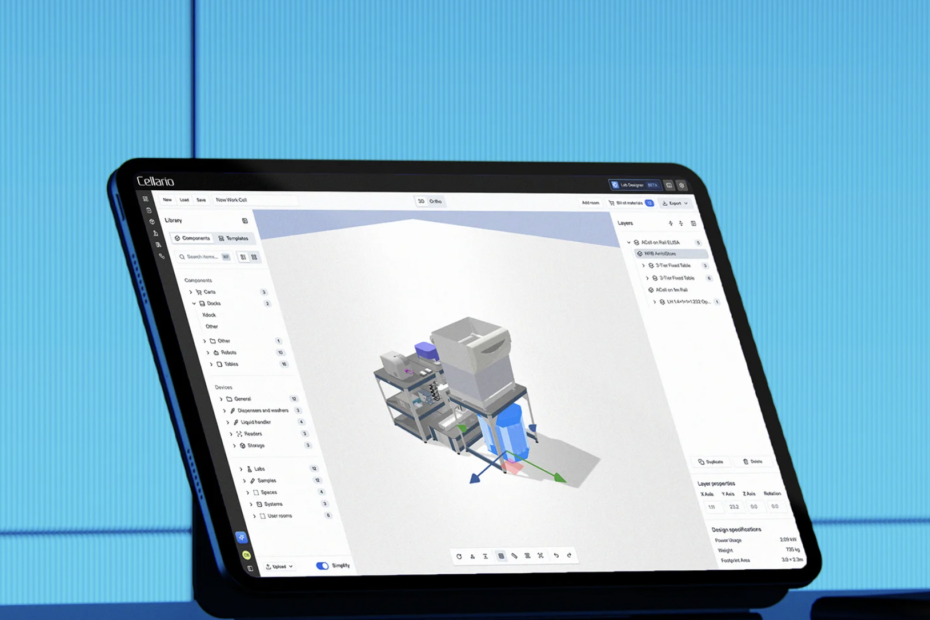
Flexibility matters here more than feature count. Two diagnostic labs running the same assay will sequence it differently, staff it differently, and report it differently. A configurable layer of lab orchestration software absorbs those differences without forking the product, which keeps one validated codebase instead of nine bespoke ones.
Funding Follows Evidence, Not Enthusiasm
Hardware for regulated labs takes longer to reach revenue than software does, and generalist investors price that delay harshly. Non-dilutive capital fills part of the gap. Through the US Small Business Innovation Research program, agencies may issue Phase I awards up to $335,937 and Phase II awards up to $2,239,578 without further approval, money that funds validation work an equity round rarely wants to touch.
Grant timelines are slow and the writing is tedious, yet the exercise forces a founder to state the technical risk plainly. Investors ask the same question later, less politely.
Scale Without Freezing the Product
The market rewards persistence. Europe alone accounts for roughly 173 billion euros of medical technology, with in vitro diagnostics the largest sector worldwide, according to MedTech Europe. Labs replace instruments on long cycles, so a product that earns its place tends to keep it.
Keeping it means designing for revision. Modular hardware, versioned methods, and a documented change process let you improve a shipped system without reopening every qualification. Startups that hard-code their first customer’s workflow discover, somewhere around customer five, that they have built a consultancy rather than a company.
Conclusion
None of this argues for caution as a strategy. The labs with the worst bottlenecks are often the ones most willing to try something unfamiliar, and they will tolerate a young vendor who is honest about what the system cannot yet do.
What they will not tolerate is surprise. A missing audit trail, an undocumented firmware change, a supplier swapped without notice: each one costs trust that took a year to earn. Treating regulation as part of the product, rather than a wall around it, separates the companies that get a second order from the ones that get a polite reference call.
Build the evidence while you build the instrument. It is slower for a quarter and faster for a decade.

Author: Kokou Adzo
Kokou Adzo is the editor and author of Startup.info. He is passionate about business and tech, and brings you the latest Startup news and information. He graduated from university of Siena (Italy) and Rennes (France) in Communications and Political Science with a Master's Degree. He manages the editorial operations at Startup.info.