
Most founders meet information returns the same way: some time in the middle of January, when a contractor emails to ask where their 1099 is. By then the questions that matter — who did we pay, what were they, do we have their taxpayer ID — are archaeology rather than bookkeeping.
The work itself is not hard. It is a sorting problem with a deadline attached, and the deadline for tax year 2026 is earlier than most people expect. What follows is the order to do it in, and the handful of numbers that changed this year.
Start with classification, not forms
Before any form, settle one question for every person your company paid: were they an employee or were they not?
An employee gets a W-2. You withheld income tax, Social Security and Medicare from their pay, you paid the employer half, and the form reports all of it. A contractor, freelancer or consultant gets a 1099-NEC. Nothing was withheld, and the form reports the gross.
Founders get this wrong in a predictable direction. Someone who started as a weekend contractor, then went full time, then got a laptop, a company email and a set schedule, is probably an employee now, whatever the original agreement says. The IRS looks at behavioural control, financial control and the nature of the relationship, not at what the contract is titled. If a specific person is unclear, that is a conversation with an accountant, not a thing to settle by picking the cheaper form.
Get this wrong and no amount of careful filing fixes it. Get it right and the rest is mechanical.
Then work out which 1099
Two forms cover most of what a small company pays out, and the line between them is cleaner than it looks.
1099-NEC is for services. A developer, a designer, a copywriter, an accountant, a lawyer billing you for legal work — anyone who performed services for your trade or business and was not an employee.
Form 1099-MISC reports miscellaneous payments that are not for services: rent you paid on an office or a warehouse, royalties, prizes and awards, medical and health care payments, and gross proceeds that passed through an attorney in a settlement. Same payee can get both in the same year — a lawyer who billed you fees and also passed settlement money through their trust account belongs on both forms, in different boxes.
A few exclusions save real time. You do not file for payments to a corporation, with two notable exceptions: medical and health care payments, and attorney gross proceeds, which are reportable whoever receives them. You do not file for goods, freight, storage or merchandise. And you do not file for anything paid through a credit card, debit card or a third-party payment network — the processor reports those on a 1099-K, and reporting them again means the recipient’s income is double-counted. Card payments are the single most common source of duplicate 1099s, and the fix is to reconcile against the payment method, not the vendor list.
The thresholds moved this year
This is the part worth reading twice, because a figure that had stood since 1954 changed.
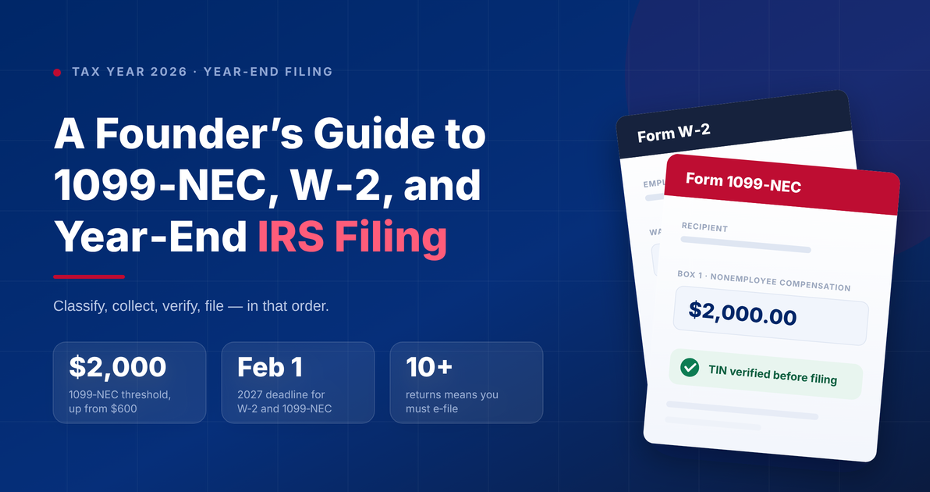
For tax year 2026, the threshold is $2,000 or more, not $600, for nonemployee compensation. Public Law 119-21 raised it for payments made after 31 December 2025, and the figure is indexed for inflation after 2026. The practical effect is that a tier of small vendors drops out of your filing obligation entirely.
Two warnings about that number.
First, it applies to money that moved during 2026, reported in early 2027. The forms you file in January 2027 for tax year 2025 still use $600. One year of overlap, one chance to apply the wrong figure to the wrong year.
Second, $2,000 is not a universal threshold. On the 1099-MISC it reaches rents, other income, medical payments and crop insurance proceeds — and stops there. Royalties are still reportable at $10. Gross proceeds paid to an attorney are still $600. Direct sales stay at $5,000. Fishing boat proceeds and anything you applied backup withholding to are reportable at any amount, with no floor at all. A founder who reads “$2,000” and applies it across the board will under-report royalties by a factor of two hundred.
The W-2 has no threshold. If you paid an employee anything, they get a form.
Collect the W-9 before you pay, not after
Every 1099 needs the recipient’s legal name and taxpayer identification number, and the way to get both is Form W-9. The best time to ask is before the first payment, while they still want to be paid. The worst time is the third week of January, chasing someone who finished the job in March and has changed their email address.
Ask for the tax name, not the trading name. “Jordan Mills Design” on an invoice is frequently “Jordan Mills” on an SSN, and a mismatch between the name and the number is what produces a CP2100 notice and, eventually, a backup-withholding obligation you did not want.
Then verify. TIN matching checks the name and number against IRS records before the return goes anywhere, for a fraction of what a correction costs. Checking a hundred vendors in November is a quiet afternoon; finding twelve mismatches in February is a fortnight of emails.
The deadlines are earlier than you think
For tax year 2026, filed in early 2027:
- W-2 — to the employee and to the Social Security Administration by 1 February 2027. Note that W-2s go to the SSA, not the IRS. It is a different system, a different login, and a surprising number of founders find that out in the last week of January.
- 1099-NEC — to the recipient and to the IRS by 1 February 2027. The NEC has no later e-file date. This is the one that catches people: for most other 1099s, filing electronically buys you until the end of March. For the NEC it buys you nothing.
- 1099-MISC — recipient copy by 1 February 2027, or 16 February if you reported amounts in box 8 or box 10. To the IRS by 1 March on paper, 31 March electronically.
The usual 31 January date falls on a Sunday in 2027, which is why everything lands on the 1st. That is a rule, not a courtesy: a due date landing on a weekend or legal holiday moves to the next business day.
Two system changes to know about
You probably have to file electronically. The threshold is ten or more information returns of all types combined, counted in aggregate. Nine 1099-NECs and two W-2s is eleven returns, and eleven is over the line. Most founders are past it without realising, because they count one form type at a time.
FIRE is closing. The IRS retires the FIRE system on 19 November 2026, and from 1 January 2027 the Information Returns Intake System takes the returns that used to go through it — originals, prior years and corrections alike. If you have been transmitting your own files, your FIRE Transmitter Control Code does not carry over by itself. If you file through a provider, this is their problem rather than yours. Note that IRIS does not swallow everything: ACA returns still go through AIR, and W-2s still go to the SSA.
What it costs to get it wrong
For returns due in 2027, the penalties run per form: $60 if you file within 30 days of the deadline, $130 if you file by 1 August, $340 after that or never, and at least $690 for intentional disregard, with no maximum. Separate penalties apply to the IRS copy and the recipient copy, so a single missed form can be charged twice.
Fifty forms a month late is not a rounding error. It is $3,000, for a task that takes an afternoon in November.
A November-to-January checklist
- Now: pull a vendor list for the year, split by payment method, and set aside everything paid by card or payment platform.
- Now: classify every person paid — employee or contractor — and resolve anyone ambiguous.
- November: request W-9s from everyone missing one, and verify the names and TINs you already hold.
- December: total payments by vendor and by category, and apply the right threshold to each category rather than one figure to all of them.
- Early January: prepare the forms, review names and amounts, and file. Early filing leaves room for a correction inside the 30-day window.
TaxFormHero files both 1099-NEC and 1099-MISC with the correct 2026 thresholds, handles recipient delivery and state filing, and validates TINs before you submit.
None of this is complicated. It is only unforgiving about timing, and the difference between a calm January and an expensive one is entirely decided by what you do in November.
This article is general information, not tax or legal advice. Worker classification in particular depends on specific facts — consult a qualified tax professional about your own situation.

Author: Kokou Adzo
Kokou Adzo is the editor and author of Startup.info. He is passionate about business and tech, and brings you the latest Startup news and information. He graduated from university of Siena (Italy) and Rennes (France) in Communications and Political Science with a Master's Degree. He manages the editorial operations at Startup.info.