
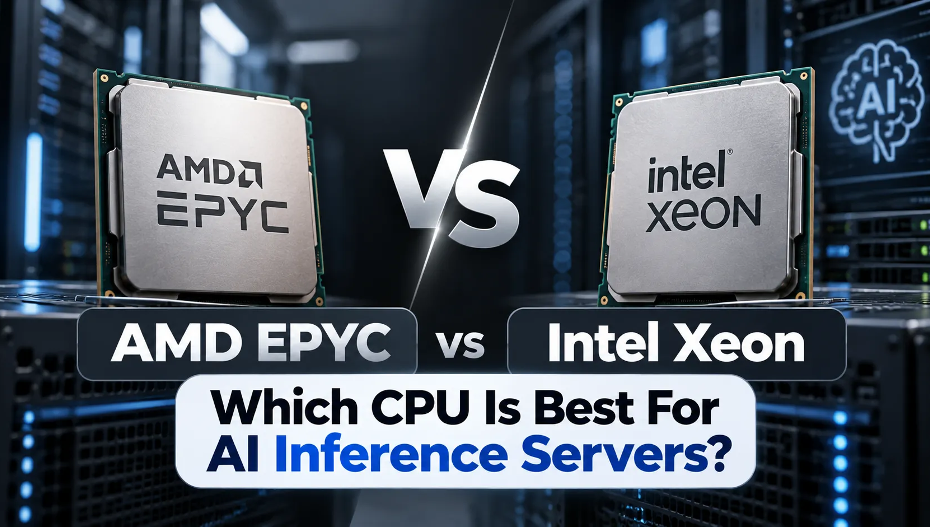
AMD EPYC is often the better choice for AI inference servers that need high core counts, memory bandwidth, and strong performance per dollar.
Intel Xeon can be a better fit for workloads that benefit from Intel-specific software optimizations, integrated accelerators on supported models, or existing Intel-based infrastructure.
However, neither CPU is universally better. The right choice depends on the AI model, inference framework, accelerator configuration, latency requirements, and total server cost.
For many production environments, GPUs or other AI accelerators perform the main inference computations. The CPU supports data preparation, request scheduling, memory management, and communication between system components. Therefore, choosing between AMD EPYC and Intel Xeon requires evaluating the complete server rather than comparing processor specifications alone.
What Is the Difference Between AMD EPYC and Intel Xeon for AI Inference?
The main difference between AMD EPYC and Intel Xeon processors for AI inference is their approach to CPU performance, AI acceleration, and server workloads.
AMD EPYC processors are often attractive for high-core-count workloads and memory-intensive inference servers, while Intel Xeon processors offer Intel AMX on supported models to accelerate certain CPU-based AI operations. Actual performance depends on the specific processor, software, and server configuration.
| Comparison factor | AMD EPYC | Intel Xeon |
| Core count | Many models offer high core counts for parallel workloads | Core counts vary by generation and product tier |
| Memory support | Platform-dependent DDR5 support and memory bandwidth | Platform-dependent DDR5 support and memory bandwidth |
| PCIe connectivity | Varies by processor generation and platform | Varies by processor generation and platform |
| AI acceleration | Can support CPU-based inference and GPU-powered workloads | Certain models include Intel AMX for supported AI operations |
| Software compatibility | Broad support across major Linux distributions and AI frameworks | Broad support, with additional optimizations for selected Intel platforms |
| Best-fit workloads | High concurrency, data preparation, and accelerator-heavy systems | CPU inference using supported optimizations and established Intel environments |
Actual specifications depend on the processor generation, server platform, and configuration. Compare specific models rather than assuming every processor in either family offers the same capabilities.
How Does AMD EPYC Perform in AI Inference Servers?
AMD EPYC processors can deliver strong performance in AI inference servers that handle multiple simultaneous requests or prepare large volumes of data for accelerators. Their high core counts support parallel tasks such as data preprocessing, tokenization, and application processing.
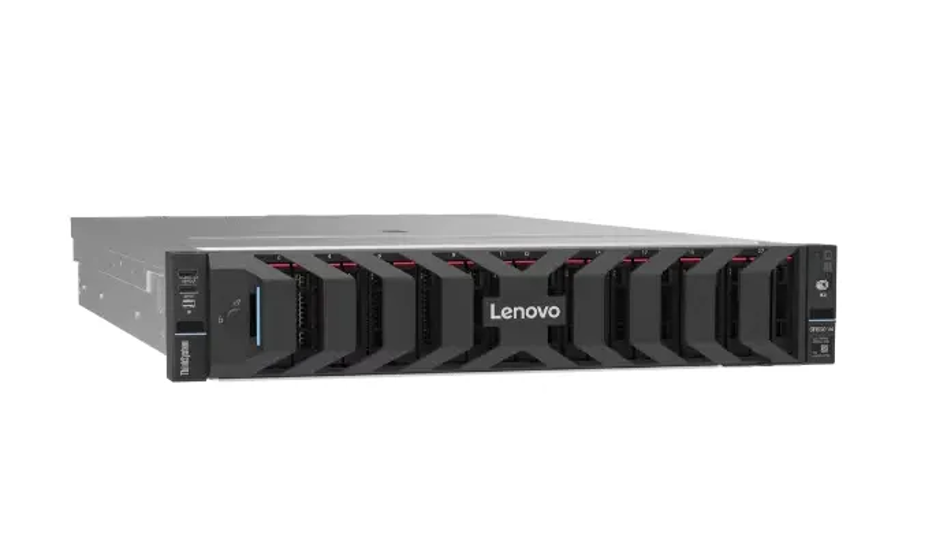
Depending on the processor generation and server configuration, memory bandwidth and PCIe connectivity can also support demanding GPU-powered inference workloads. For example, Lenovo server platforms equipped with compatible AMD EPYC processors can be evaluated for enterprise AI deployments that require scalable CPU resources and accelerator support.
AMD EPYC is particularly worth evaluating when:
- High concurrency matters: The server must process multiple inference requests simultaneously.
- CPU resources support GPU workloads: Preprocessing, data movement, and application logic require substantial computing capacity.
- Memory bandwidth is a bottleneck: The workload benefits from efficient data movement between memory and processors.
- Cost efficiency is a priority: Teams need to compare inference throughput against processor, memory, power, and overall server costs.
When Is Intel Xeon Better for AI Inference?
Intel Xeon is a strong candidate when software compatibility, platform integration, and specific CPU acceleration features align with the workload.
Selected Intel Xeon Scalable processors support Intel Advanced Matrix Extensions (AMX), which accelerates certain matrix operations used in AI workloads. Supported inference frameworks and optimized libraries can use these instructions for suitable CPU-based inference tasks, particularly workloads involving supported data types and operations.
Intel Xeon may be the better choice when:
- CPU-based inference is important: The model can benefit from Intel AMX and compatible software.
- Existing infrastructure uses Intel: Standardized deployment, monitoring, and operational practices can reduce migration effort.
- Software is optimized for Intel: Benchmark results show a measurable advantage with the intended framework and configuration.
- The application has strict latency requirements: Testing confirms that the selected Xeon configuration meets the required response times.
Which CPU Is Better for GPU-Based AI Inference?
For GPU-based AI inference, both AMD EPYC and Intel Xeon can support demanding workloads. The better choice depends on CPU core availability, memory bandwidth, PCIe connectivity, and how efficiently the processor feeds data to GPUs.
AMD EPYC is worth considering for highly parallel workloads, while Intel Xeon may suit workloads that benefit from supported Intel AMX instructions. Compare GPU utilization, requests per second, and response latency to identify the right configuration.
A balanced server should prevent CPU bottlenecks without spending unnecessarily on processor capacity that the workload cannot use. Evaluate GPU utilization, requests per second, time to first token, inter-token latency, and end-to-end response time.
For large language models serving multiple users, sufficient CPU resources help manage concurrent requests and data movement. When comparing systems for these workloads, Lenovo servers are another option to consider alongside other platforms, based on GPU compatibility, memory capacity, and overall performance requirements.
How Should You Benchmark AMD EPYC vs Intel Xeon?
A meaningful comparison requires testing both processors against the same workload and equivalent system configurations.
- Use the same AI model: Keep the model architecture, model size, quantization, and precision consistent.
- Match the software stack: Use equivalent framework versions, runtime settings, and optimized libraries.
- Control hardware differences: Document memory capacity, accelerator models, storage, networking, and power settings.
- Measure throughput: Record requests or generated tokens per second at realistic concurrency levels.
- Measure latency: Compare time to first token, inter-token latency, and overall response time.
- Calculate total cost: Include server acquisition, electricity, cooling, licensing where applicable, and operational costs.
Run tests at both low and high concurrency. A processor that performs well for a single request may behave differently when serving hundreds of concurrent requests. Also test the actual model and production software stack rather than relying exclusively on theoretical specifications.
Final Verdict: AMD EPYC or Intel Xeon?
Choose AMD EPYC when high core counts, memory bandwidth, accelerator support, and total system economics make it the stronger fit for your workload.
Choose Intel Xeon when supported AMX acceleration, Intel-optimized software, or existing infrastructure delivers better measured performance or simpler operations.
For GPU-based inference, prioritize the complete server configuration over the CPU brand. For CPU-based inference, benchmark the exact processor models with the intended framework and model.
The best AI inference server is the one that meets your throughput, latency, reliability, and budget requirements under real operating conditions.

Author: Kokou Adzo
Kokou Adzo is the editor and author of Startup.info. He is passionate about business and tech, and brings you the latest Startup news and information. He graduated from university of Siena (Italy) and Rennes (France) in Communications and Political Science with a Master's Degree. He manages the editorial operations at Startup.info.