Tips and support
Beyond the Product Grid: How Niche Home-Improvement Brands Build Better Buying Journeys

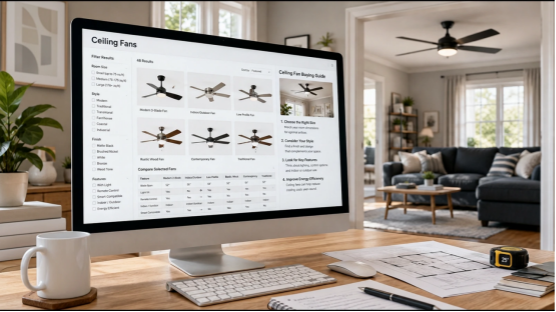
A product grid can make a store look complete while leaving its customers uncertain. Imagine a homeowner replacing an aging living-room fixture. The retailer offers dozens of polished photographs, star ratings, prices and prominent Add to Cart buttons. Yet the questions that determine whether the purchase will work remain unanswered: Is the fixture sized for the room? Will it fit the ceiling? What does installation involve?
That gap matters for niche home-improvement brands. Their products often require measurements, compatibility checks or installation decisions that cannot be made from a thumbnail alone. A better buying journey does not make shoppers work harder; it gives them the right information at the moment they need it. For a specialized retailer, the product grid is the starting point, not the entire sales experience.
Different Customers Need Different Buying Journeys
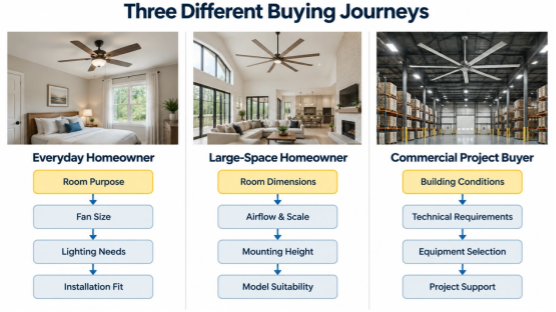
Not everyone who visits a specialized home-improvement store is solving the same problem. Someone updating a standard bedroom may care most about basic fit, appearance, price and delivery. A homeowner furnishing an open-plan great room is more likely to compare physical scale, installation height and performance. A facilities buyer may need documentation, project quantities and confirmation that equipment suits a building’s electrical and structural conditions.
If all three visitors encounter the same filters, identical product cards and a standard checkout prompt, the store may be technically usable but not particularly helpful. Consider the different questions customers bring to it: ‘Will this work in my room?’, ‘Which dimensions matter for my space?’ and ‘Can our team specify this equipment for a project?’ Each requires a different depth of guidance.
The useful design principle is not to create three separate stores. It is to give each buyer a clear route from their initial goal to the product information, support and purchasing method appropriate to that goal.
Organize Product Discovery Around Real Customer Needs
Retailers tend to organize catalogs around the data they already have: brand names, finishes, technical attributes and stock-keeping units. Those fields are necessary for inventory and filtering, but they are rarely how an unfamiliar shopper describes a problem. A customer may want better air movement and overhead lighting without knowing the difference between a flush mount, a downrod mount or an enclosed design.
A category such as ceiling fans with lights starts with a recognizable household need. From there, room size, ceiling height, mounting configuration and lighting options can help the shopper narrow the field. The category name opens the conversation; the supporting information makes the selection practical.
Good discovery routes can include room-based entry points, problem-focused guidance and filters that reflect the attributes people actually compare. Product cards should surface a few decisive details rather than every available specification. The aim is to reduce the distance between a customer’s plain-language question and a manageable set of suitable products, without hiding important technical constraints.
Turn Collection Pages Into Buying Resources
A useful collection page can do more than list items. For products involving installation or long-term use, the category itself is an opportunity to explain the decision. A short introduction can clarify who the products are for; a comparison guide can distinguish similar options; and an installation checklist can flag the measurements a buyer needs before ordering.
The placement of that guidance matters. Information that determines whether a product can be considered at all, such as a key size or mounting limitation, belongs near the product or filter where the choice is made. More detailed explanations can appear farther down the collection page, linked from concise prompts above. Burying essential fit information after several screens of unrelated copy merely replaces one form of friction with another.
For example, a lighting collection might explain the difference between built-in and replaceable light sources. A hardware category might distinguish finish appearance from material durability. A ceiling-mounted product category might offer a simple measurement diagram and direct visitors to model-specific instructions. These are practical answers, not extra marketing slogans.
The strongest collection content also stays current. If a size is unavailable, a specification changes or a model is discontinued, the guidance and visible product options should not contradict each other. A buying resource earns trust only when it remains connected to the products customers can actually purchase.
Help Shoppers Understand Size, Scale, and Installation Fit
Home-improvement shoppers face a problem that apparel and media shoppers seldom do: an item can look attractive online yet be physically unsuitable for the space where it must be installed. Wide-angle photography, close-up product shots and stylish room scenes are useful for inspiration, but they are imperfect tools for judging dimensions.
Consider customers comparing large ceiling fans with lights for a spacious living area. Blade span alone does not establish suitability. Installed height, required clearances, published airflow, lighting characteristics and the room’s layout can all influence the choice. A photograph of an impressive great room cannot answer whether a particular mounting configuration works on the customer’s ceiling.

Niche retailers can help with dimensioned drawings, clearly labeled installation measurements, examples photographed at a believable scale and straightforward links to the relevant manual. A simple selection worksheet may be more valuable than a complex visualization tool if it helps customers collect the right measurements. Advanced 3D or augmented-reality previews can be useful, but should supplement verified product information rather than replace it.
The goal is to make suitability easier to assess before a customer commits to the purchase, while being clear about cases that require a qualified installer’s judgment.
Replace Checkout Friction With Useful Compatibility Checks
The conventional e-commerce instinct is to remove every possible step between a product page and payment. Speed is valuable, but for installation-dependent products, the fastest route is not always the clearest. A shopper who discovers after delivery that a fixture is incompatible has not benefited from an effortless checkout.
The answer is not to force everyone through a lengthy questionnaire. Instead, present essential compatibility questions where they are relevant. A wall-mounted fixture might require confirmation of installation conditions. A ceiling-mounted device may need clearance and mounting checks. A lighting product should state whether dimming is supported by the specific model rather than assuming that multiple color-temperature settings mean the same thing.
These checkpoints work best as concise, understandable prompts with links to deeper guidance when needed. Experienced customers should be able to move forward without unnecessary repetition, while uncertain customers can find reliable answers before ordering. The distinction is simple: remove avoidable friction, but retain the information that prevents a predictable mistake.
Give Commercial Buyers a Different Path to Purchase
A specialist retailer’s commercial customers may not be ready to use the same cart flow as household shoppers. A residential purchase often centers on one room and one product. A business facility may involve multiple installation locations, technical review, purchasing approval, delivery coordination and ongoing service expectations.
A range of commercial HVLS fans illustrates why the buying journey needs to change. A facilities manager considering high-volume, low-speed air-movement equipment may need to review ceiling structure, mounting locations, electrical compatibility, controls, building conditions and equipment quantities. Those questions are materially different from choosing a decorative fan for a bedroom. Commercial HVLS equipment should not be treated as simply an oversized residential fixture.
A strong business-buying route might offer technical documents, a project inquiry form that asks only relevant questions, contact with knowledgeable staff and a clear explanation of the quotation process. For some buyers, a direct product purchase will still make sense; others need a specification review before pricing can be finalized.
For a growing niche brand, serving commercial buyers well is less about adding a ‘bulk order’ button and more about acknowledging how organizations evaluate, approve and install specialist equipment.
Build Trust Through Accurate Information and Support
The buying journey continues after a shopper finds a suitable product. Newer specialist brands must also make their promises verifiable. Product photographs create interest, but reliable specifications, installation documentation, stock information and clear service terms help customers assess the practical risk of purchasing.
Consistency matters. If a category describes a feature that the individual model does not support, or a product page conflicts with its manual, the shopper is left to decide which source to believe. Likewise, an item shown as available should not quietly become an uncertain backorder after payment. Clear information may not remove every question, but contradictory information creates avoidable doubt.
Authentic reviews, useful answers to pre-purchase questions and accessible post-sale support can all strengthen the experience. There is no requirement to build a large online community before offering good service. A small brand can begin by maintaining accurate product details, explaining shipping and return terms in plain language, and giving customers a dependable way to obtain help when a technical answer is needed.
Measure Whether the Buying Journey Actually Works
A more informative storefront should be evaluated through customer behavior, not just visual appeal. One starting point is to compare how often visitors move from a category page to a relevant product, and whether those visitors then add the product to their cart. Another is to examine the questions sent to support before purchase: repeated uncertainty about size, mounting or features may reveal missing explanations.
Checkout completion can highlight obstacles later in the journey, while return reasons can identify cases where expectations and product suitability did not align. For commercial inquiries, the quality of submitted project information and the number of clarification exchanges may be more useful than a conventional add-to-cart metric.
These measures require context. Conversion rates also change with pricing, inventory, traffic quality, seasonality and delivery conditions. A lower return rate may reflect a different product mix rather than better guidance alone. Retailers can make more defensible decisions by reviewing several signals together and testing one meaningful change at a time.
The objective is not to maximize every click. It is to help the right customers identify appropriate products, understand the trade-offs and complete purchases with fewer preventable surprises.
A niche home-improvement brand does not need the largest catalog or the most elaborate shopping technology to improve its buying journey. It needs a clear understanding of the decisions customers are trying to make. By connecting product discovery with practical guidance, verified fit information, sensible compatibility checks and appropriate support, a retailer can turn a grid of products into a more useful buying experience. Better commerce begins with better-informed decisions.



-

 Resources5 years ago
Why Companies Must Adopt Digital Documents
-

 Resources4 years ago
A Guide to Pickleball: The Latest, Greatest Sport You Might Not Know, But Should!
-

 Resources1 year ago
50 Best AI Free Tools in 2025 (Tried & Tested)
-

 Resources1 year ago
Get Paid $5000+ a month to write : Discover 30 Spectacular Websites That Reward Your Writing Effort