
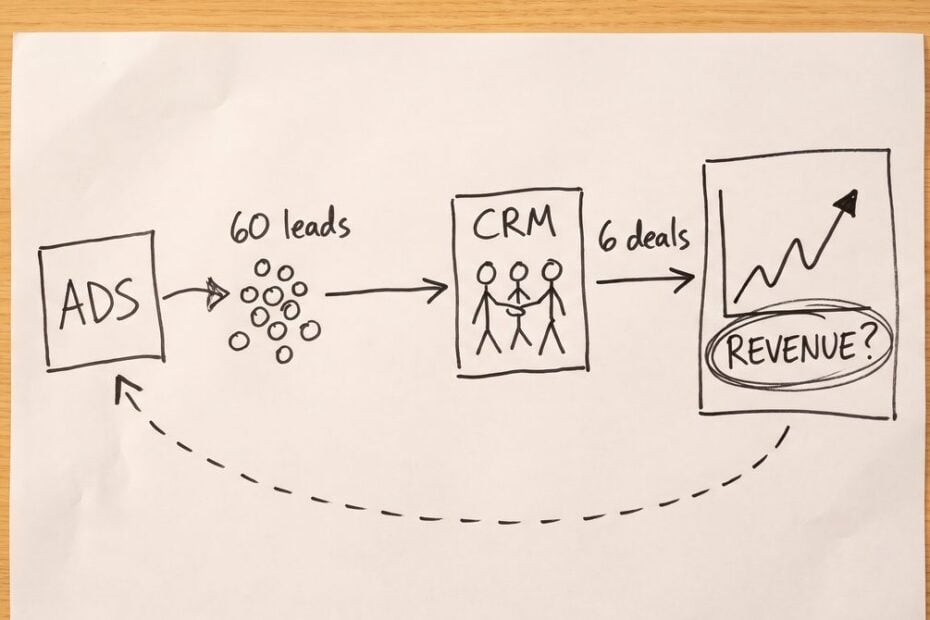
Your Google Ads account shows 60 leads last month. Meta shows 20 more. Your CRM shows six closed deals, and nobody can say which ad started which one. So the next budget gets split by habit, and the ad platforms keep bidding for form fills that never turn into revenue.
Here is how to check whether a marketing attribution platform can follow a lead to a closed deal, which settings matter, and how to test one on your own data in two weeks.
Key takeaways
- Google Ads does not import an offline conversion uploaded more than 90 days after the click, so long sales cycles need an earlier stage to send.
- Meta’s Conversion Leads setup needs the 15 to 17 digit Meta lead ID stored in the CRM and an upload at least once a day.
- Set lead conversion actions to Count: One, and make only the stage you want bidding on a Primary action.
- Judge a tool by closed revenue per campaign, not cost per lead.
- In a trial, trace three real deals back to their first click.
What Should a Marketing Attribution Platform Do When Sales Close in a CRM?
It should save the click ID on every new lead, read deal stages and real amounts from your CRM automatically, match deals that close by phone, and send those closed deals back to Google Ads and Meta once, with their value. A tool that stops at the form fill is a lead counter, not attribution.
Many tools were built for online stores, where the sale happens on the website. In a sales led business, the website never sees a deal move to Closed Won in HubSpot or Salesforce. Use this table in any demo.
| What to check | Weak answer | Good answer |
|---|---|---|
| CRM connection | A CSV export each week | Native sync or a webhook on each stage change |
| Click IDs | “We use UTMs” | GCLID, fbclid and Meta lead ID saved on the contact |
| Deal value | A fixed value per lead | The real amount, updated when it changes |
| Phone deals | Not matched | Matched by click ID or hashed email and phone |
| Send back | Manual upload | Automatic, at least daily, with the value |
| Dedupe | No clear rule | A shared event ID per platform |
| Audit trail | Channel totals only | Every total opens to the deals behind it |
A Worked Example: Cheap Leads vs Closed Revenue
Say a B2B SaaS team spends $10,000 a month across two campaigns in a made up month.
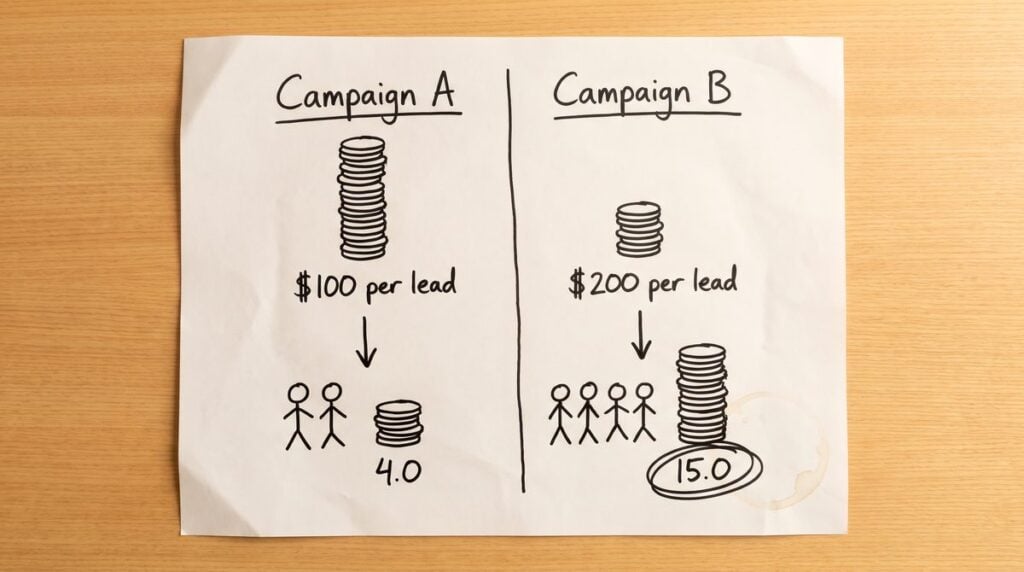
- Campaign A (search): $6,000 spent, 60 leads, 2 closed deals at $12,000 each.
- Campaign B (social): $4,000 spent, 20 leads, 4 closed deals at $15,000 each.
By cost per lead, A wins: $100 against $200. By closed revenue, it loses. A returns $24,000 on $6,000 of spend, a return of 4.0. B returns $60,000 on $4,000, a return of 15.0. Cost per closed deal is $3,000 for A and $1,000 for B.
Moving budget from B to A on lead numbers would cut the best campaign. ObserviX is one example of a marketing attribution platform built around CRM revenue: it connects ad platforms, the website and the CRM, and sends verified conversions back. Whatever you test, ask it to show this math on your own data, deal by deal.
The Settings and Limits That Decide What You Can Send Back
Timing comes first. Google Ads Help, in its guidelines for importing offline conversions, says conversions uploaded more than 90 days after the last click are not imported. Google’s page on conversion windows adds that the click window defaults to 30 days and can go up to 90, depending on the source. If your sales cycle runs four months, Closed Won arrives too late. Send an earlier stage, such as Sales Qualified, and set the window as long as your source allows.
Meta for Developers, in its Conversion Leads integration docs, asks you to store the 15 to 17 digit Meta lead ID in your CRM, upload at least once a day, and pick a lead stage that is reached within 28 days of the lead. It also lists a minimum of 200 leads a month.
In Google Ads, Help says only Primary conversion actions feed bidding, while Secondary actions are for observation. It also recommends Count: One for leads, so one click that sends three forms counts once. Once the deal stage is recording, make it Primary and move the form fill to Secondary. Attribution software that reads deal stages from the CRM can send that stage to Google Ads every day, so nobody has to remember a manual upload.
Dedupe is the last check, and it matters most once you start sending closed deals back to ad platforms. Meta’s guide to deduplicating Pixel and server events matches a browser event and a server event by event name and event_id, within 48 hours of the first one. Google Ads Help says a conversion with the same click ID, conversion name and time is imported only once. Ask each vendor to show you the ID they send in the upload log.
How to Test a Marketing Attribution Platform in Two Weeks
Do not decide from a demo. Run these five steps on live data.
1. Connect the CRM and ad accounts
Connect the CRM, Google Ads and Meta on day one. Open five new contacts and check that each carries a GCLID or Meta lead ID in its own field. A tool that offers attribution for B2B teams should handle this without custom code.
2. Send a test lead
Click your own ad, fill in the form, and find the contact in the CRM and the tool. The click ID should match.
3. Move the test deal
Move it through each stage and give it an amount. Every change should show in the tool within a day.
4. Turn on the upload
Send the deal stage to Google Ads and Meta. It should appear once in each platform, with its value. Twice means dedupe is broken.
5. Trace three real deals
Pick three deals that closed last month and trace each one to its first click. Three clear answers mean the tool fits. Shrugs mean keep looking.
Common Questions
How is attribution software different from ad platform reports?
Each ad platform reports the conversions it can claim, so the totals overlap. Attribution software ties every channel to the same CRM deals, so each deal is counted once.
Do I need a CRM to use a marketing attribution platform?
If sales close by phone or after a demo, yes. Without deal stages and amounts, the tool can only count leads.
How long before I can trust the new numbers?
Judge the first 60 days on data quality: click IDs on most new contacts, stage changes within a day, and deal counts that match the CRM.
Before the next budget meeting, pull last month’s closed deals from the CRM and try to name the campaign behind each one. The deals you cannot name tell you which question to put to a vendor first.

Author: Kokou Adzo
Kokou Adzo is the editor and author of Startup.info. He is passionate about business and tech, and brings you the latest Startup news and information. He graduated from university of Siena (Italy) and Rennes (France) in Communications and Political Science with a Master's Degree. He manages the editorial operations at Startup.info.