Blogs
Mesh-free options in cystocele repair

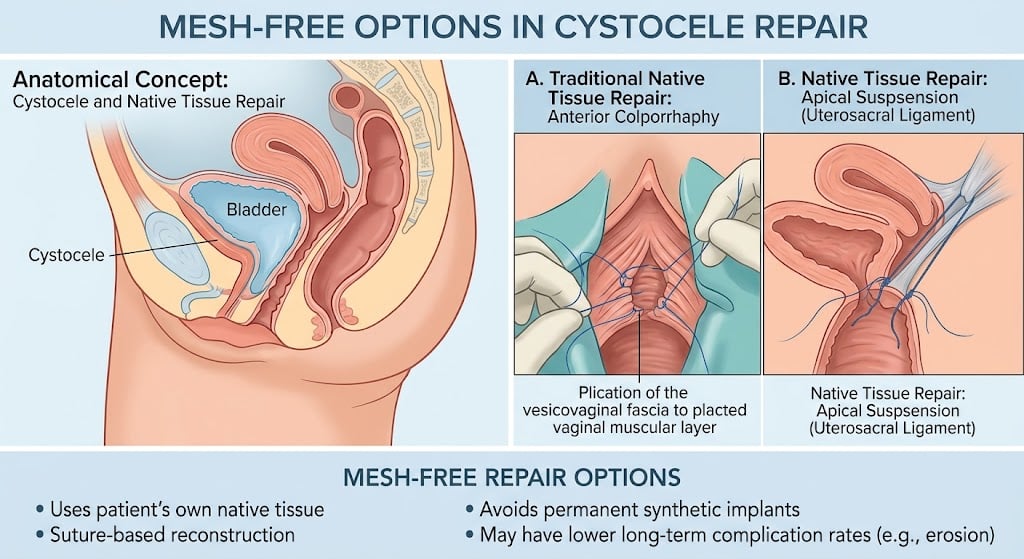
Mesh-Free Options for Cystocele Repair
If you have been diagnosed with a cystocele, also called a prolapsed bladder, you may be wondering whether a repair procedure always involves synthetic mesh.
It does not.
There are several approaches to pelvic organ prolapse repair. The option that may be appropriate for you depends on your anatomy, symptoms, previous procedures, overall health, and personal preferences.
A cystocele occurs when the support between the bladder and the front wall of the vagina weakens, allowing the bladder to bulge into the vagina. Treatment may range from observation, pelvic floor therapy, or a pessary to a repair procedure when symptoms become more bothersome. Cleveland Clinic
What Does “Mesh-Free” Mean?
In pelvic floor repair, mesh-free generally means that permanent synthetic mesh is not used as part of the procedure.
Mesh-free approaches may include:
- native tissue repair using your existing pelvic tissues
- sutures used to restore or reinforce support
- human tissue-based allografts in selected procedures
Not every prolapse procedure uses the same material or approach.
It is also important to understand that the FDA’s 2019 action applied specifically to surgical mesh placed through the vagina for pelvic organ prolapse repair. It did not remove all uses of surgical mesh in pelvic floor care. Mesh used in abdominal or robotic sacrocolpopexy and mesh used in certain stress urinary incontinence procedures are different applications with their own risks and benefits. U.S. Food and Drug Administration
Native Tissue Repair
Native tissue repair uses a woman’s own existing pelvic tissues and sutures to restore support.
For a cystocele, one commonly used procedure is an anterior colporrhaphy. During this procedure, the surgeon reinforces the front wall of the vagina with sutures so that it can better support the bladder. ACOG
Because permanent synthetic mesh is not used, native tissue repair may be an option for women who prefer a mesh-free approach.
It is also important to distinguish native tissue repair from tissue harvesting. Native tissue repair usually works with the tissues already present in the pelvis and does not necessarily require taking tissue from another part of the body.
Human Tissue-Based Allografts
In some pelvic floor repair procedures, a surgeon may choose to use a human tissue-based allograft for additional reinforcement.
An allograft is donated human tissue that has been processed for surgical use. This differs from an autograft, which uses tissue taken from the patient’s own body.
Whether an allograft is considered depends on factors such as:
- the type and location of the prolapse
- the condition of the patient’s tissues
- previous pelvic floor procedures
- the planned repair technique
- surgeon preference and clinical judgment
A human tissue-based allograft is not automatically better than native tissue repair or another approach. Each option has different considerations, and the most appropriate choice depends on the individual patient.
Why Do Some Women Ask About Mesh-Free Options?
Some women prefer to avoid permanent synthetic mesh and want to understand what other options may be available.
That preference can be part of a broader discussion with a pelvic health specialist about:
- the type of prolapse
- the proposed repair procedure
- materials that may be used
- potential risks and benefits
- expected recovery
- the possibility of recurrence
- personal goals and preferences
Every pelvic floor procedure has potential risks. These may include bleeding, infection, pain, urinary symptoms, recurrent prolapse, or the possibility of needing another procedure in the future.
No prolapse procedure can guarantee that every symptom will resolve, and new symptoms can sometimes occur following treatment. ACOG
What Is Recovery Like After a Cystocele Repair Procedure?
Recovery depends on the type of procedure performed and the individual patient.
Some women may return home the same day, while others may stay overnight depending on the procedure and their surgeon’s recommendations.
During the early recovery period, patients may be asked to temporarily limit:
- lifting
- strenuous exercise
- sexual activity
- activities that increase pressure on the pelvic floor
ACOG notes that recovery after pelvic organ prolapse surgery varies by procedure and that patients commonly need to avoid vigorous exercise, lifting, straining, and sexual activity for a period of time. ACOG
Your surgeon will provide instructions specific to your procedure and recovery.
How Do I Know Which Repair Option May Be Appropriate for Me?
There is no single cystocele repair approach that is right for every woman.
A pelvic health specialist may consider:
- which part of the vagina is prolapsing
- the severity of the prolapse
- your symptoms
- previous pelvic floor procedures
- tissue quality
- urinary leakage or other bladder symptoms
- sexual activity and future goals
- whether you prefer to avoid permanent synthetic mesh
- your overall health
The FDA also notes that treatment decisions for pelvic organ prolapse depend on factors such as the organs involved, severity of prolapse, age, symptoms, sexual activity, and plans for future pregnancy. U.S. Food and Drug Administration
Questions to Ask Your Surgeon
Instead of asking only, “Do you use mesh?” it may be more helpful to ask:
- What type of prolapse do I have?
- How severe is it?
- What repair options are appropriate for my anatomy?
- Can my prolapse be repaired without permanent synthetic mesh?
- What does native tissue repair involve?
- Do you use human tissue-based allografts in selected procedures?
- What materials would be used in my procedure?
- What are the risks and limitations of each option?
- What should I expect during recovery?
- What is the possibility that the prolapse could return?
These questions can help you better understand the reasoning behind your surgeon’s recommendation.
Understanding Your Options
Women with cystocele may have several treatment pathways available.
Some women may choose nonsurgical management such as pelvic floor therapy or a pessary. Others may consider a repair procedure using native tissue, a human tissue-based allograft, or another approach based on their anatomy, symptoms, goals, and their surgeon’s clinical judgment. Cleveland Clinic
The goal is not to identify one approach as best for everyone. It is to understand the options available and have an informed conversation with a clinician experienced in pelvic floor care.
Learn More
ARMS Medical provides educational resources about pelvic organ prolapse and mesh-free pelvic floor repair options.
Learn About Pelvic Organ Prolapse
Explore VNEW®
Find a Pelvic Health Specialist


-

 Resources5 years ago
Why Companies Must Adopt Digital Documents
-

 Resources4 years ago
A Guide to Pickleball: The Latest, Greatest Sport You Might Not Know, But Should!
-

 Resources1 year ago
50 Best AI Free Tools in 2025 (Tried & Tested)
-

 Resources1 year ago
Get Paid $5000+ a month to write : Discover 30 Spectacular Websites That Reward Your Writing Effort