Blogs
How Much Does a Photo Booth Cost to Buy in 2026? A Real Price Breakdown

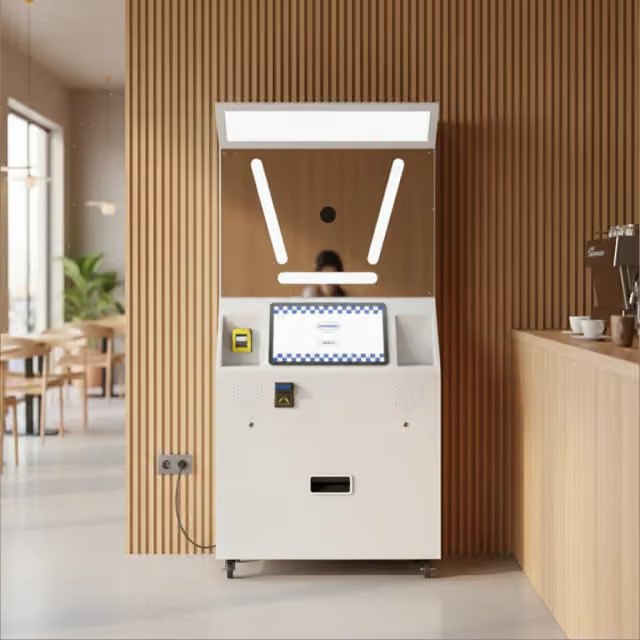
Search “how much is a photo booth” and you’ll mostly find rental quotes or shop pages with no context. If you’re thinking of buying one, whether to start an event business, add a booth to your venue or open a self-photo studio, you need a different answer. You need to know what the machine costs, what else you’ll pay for, and how long it takes to earn the money back.
This guide breaks down real 2026 photo booth prices by booth type, based on published list prices from four major US photo booth sellers (checked in September 2026). It also covers the costs sellers don’t put on the product page, and how the fast-growing Korean-style booths compare.
Short answer: a complete, business-ready photo booth costs about $3,000 to $10,000 for most event and self-service setups. Basic iPad booths start near $3,000, specialty self-service booths can reach $15,000, and enclosed coin-operated amusement booths cost $13,000 to $27,000+. On top of the machine, budget for software, prints, shipping and (for self-service booths) payment hardware.
Photo booth prices by type (2026)
The biggest factor in price is the type of booth. Each type suits a different business model.
| Booth type | Typical 2026 price (complete package) | Best for |
|---|---|---|
| Shell only (you add camera, printer, tablet) | $1,300 – $4,500 | DIY builders, existing operators replacing gear |
| iPad / tablet booth | $2,950 – $6,950 | New event businesses on a budget |
| Open-air DSLR booth with printer | $3,000 – $10,000 (premium bundles to ~$14,000) | Weddings, corporate events |
| 360 video booth | $3,500 – $8,500 | Parties, brand activations |
| Mirror booth | $4,950 – $15,950 | Upscale weddings and galas |
| Korean-style self-service booth | $5,000 – $15,000 | Malls, cafés, self-photo studios |
| Enclosed coin-operated amusement booth | $13,300 – $27,500 | Arcades, cinemas, family entertainment centres |
Prices vary a lot within each category depending on what’s included, so always compare what’s inside the package, not just the headline number.
Shell-only booths: $1,300 – $4,500
A shell is the frame or enclosure without the electronics. It’s the cheapest way in if you already own a camera, tablet and printer, but it’s rarely cheaper overall for a beginner once you buy those parts separately.
iPad and tablet booths: $2,950 – $6,950
These use a tablet as both camera and screen, usually on a sleek stand. They’re light, easy to set up and popular for digital sharing (text, email, QR code). Print quality depends on the printer you pair them with, and a tablet camera can’t match a proper DSLR or mirrorless camera in low light.
Open-air DSLR booths: $3,000 – $10,000
The workhorse of the event industry. A stand or shell holds a camera, lighting, a touchscreen and a dye-sublimation printer, and guests pose in front of a backdrop. At the low end you get a basic package; higher-priced “business bundles” add travel cases, backdrops, software licences and a second printer.
360 booths: $3,500 – $8,500
A platform with a rotating arm that films slow-motion video around the guest. It’s great for social media, but it produces video, not prints. That changes how you charge for it and what the guest takes home.
Mirror booths: $4,950 – $15,950
A full-length touchscreen mirror with a camera behind it. They look impressive and command premium rental rates at weddings, but they’re heavy and need careful transport.
Enclosed coin-operated amusement booths: $13,300 – $27,500
These are the heavy, cabinet-style booths you see in arcades and cinema lobbies, often licensed with characters or themes. They’re built to survive years of public use, which is reflected in the price.
Korean-style self-service booths: $5,000 – $15,000
This is the fastest-growing category. It comes from the self-photo studios that are hugely popular in South Korea and are now opening across the US, Asia and Europe. These are permanent, unattended machines: the customer chooses a frame, pays at the booth, takes a series of photos and walks away with a printed strip. Friends visit together, try several booths with different camera angles, and share the results online.
Because they’re built to sell sessions all day without staff, they sit between event booths and arcade cabinets on price, and they’re designed for a very different business model. The next section shows what that looks like in a real product range.
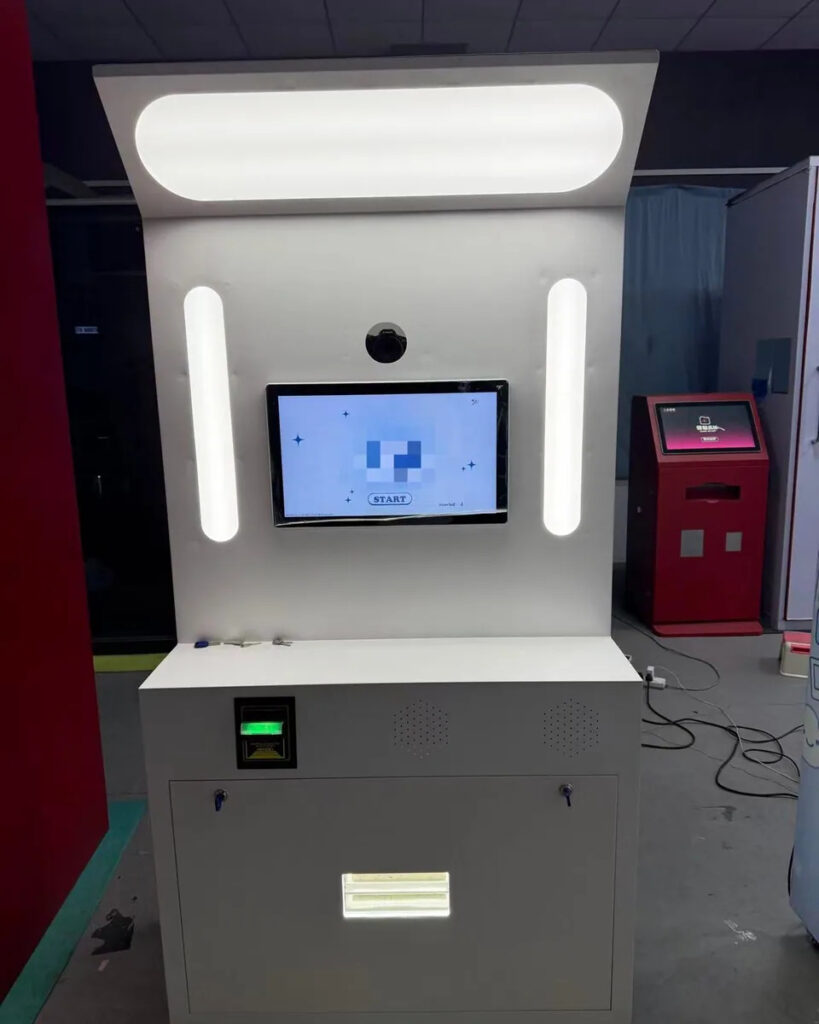
What a Korean-style photo booth range looks like (and costs)
To show how pricing works in this category, here’s the 2026 range of Korean-style photo booth machines from Chalkak Studio, a manufacturer that ships to more than 30 countries. Every machine below is a complete, working unit: camera, dye-sublimation printer, touchscreen and LED lighting included.
| Model | What makes it different | Footprint (approx.) | 2026 price range |
|---|---|---|---|
| Standard Angle Photo Booth | The classic eye-level Korean photo strip. Regular, height-adjustable and custom-camera versions | 1.00 × 0.52 m | $5,000 – $7,000 |
| Portable Photo Booth | Fits in a van, and payment hardware is optional, so it works staffed at events or unattended in venues | 1.62 × 0.70 m | $5,000 – $7,000 |
| High Angle Photo Booth | Overhead “aerial selfie” camera in a private photo box. Great for groups | 1.05 × 1.05 m box + control panel | $8,000 – $11,000 |
| Vintage Photo Booth | Retro all-in-one cabinet with black-and-white and film-style filters. Also available as a shell over a standard machine | ~1.40 × 1.40 m | $10,000 – $12,000 |
| Low Angle Photo Booth | Camera shoots from below for bold, full-body shots. Built on a raised platform | 1.30 × 1.30 m platform | $13,000 – $15,000 |
| Naemo Box receipt booth | Compact walnut-wood counter unit that prints retro black-and-white strips on thermal receipt paper. No ink needed | 0.40 × 0.40 m | Quote on request |
Payment hardware (card and cash acceptors), branded exteriors and design packages are added per order. Chalkak publishes a live configurator where you can build your own quote and see what each setup costs in your country, including a payback estimate.
A few patterns stand out that apply to any Korean-style range:
- The eye-level machine is the entry point. It’s the most proven format and the cheapest to run, so most studios start there.
- Specialty angles cost more but pull customers in. A high angle photobooth or low-angle booth produces a shot people can’t take with their own phone, and that’s what gets shared.
- Studios mix formats. Customers who try one booth often pay for a second session in a different one, which raises spend per visit.
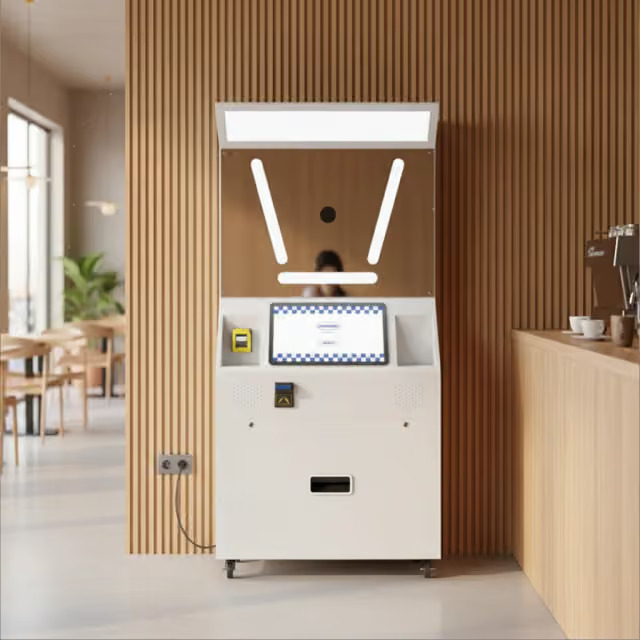
How Korean-style booths compare with typical US photo booths
Most photo booths sold in the US are designed for events: a staff member sets up the booth at a wedding or party, and the host pays a flat fee. Korean-style booths are designed for fixed locations: they take payment and run by themselves. That changes what’s included in the price.
| Typical US event photo booth | Korean-style self-service booth (Chalkak Studio example) | |
|---|---|---|
| Built for | Events, run by an attendant | Fixed locations, unattended, pay-per-session |
| Taking payment | Not included; the host pays the operator | Built for it: card, contactless, Apple Pay/Samsung Pay and QR (NAYAX), cash bill acceptor, coins and vouchers |
| Camera and printer | Often “bring your own” or sold as upgrades | Included: Canon EOS R100 mirrorless camera and DNP DS-RX1HS dye-sublimation printer |
| Camera angles | Mostly eye-level open-air, mirror, iPad or 360 | Eye-level, high angle, low angle, vintage and receipt-style |
| Software cost | Event software subscriptions can run ~$1,400 a year | Remote management software, under $300 a year per machine |
| Remote management | Varies | Change prices, see sales, track paper and ink, and restart the machine from your phone |
| Branding | Templates, varies by software | Fully white-label interface, with up to 120 custom frame designs loaded at order |
| Shipping | Domestic freight | Door-to-door (DDP) to 30+ countries, with duties and customs handled |
| Certification and warranty | Varies | CE certified, 1-year hardware warranty |
| Typical price | $3,000 – $16,000 | $5,000 – $15,000 |
Neither type is “better”. An event business needs portability and a booth that looks good in photos of the party. A mall unit, café or self-photo studio needs a machine that takes money, runs for 10+ hours a day and can be managed remotely. Buy the one that matches how you’ll earn.
What else you’ll pay for: the costs beyond the booth
The machine price is only part of the budget. These are the extras most first-time buyers underestimate.
Printer and camera (if not included)
- Dye-sublimation photo printer: about $550 – $950 for the professional models most booths use (DNP is the industry standard).
- Camera: an entry-level DSLR or mirrorless camera with a kit lens costs around $550.
Dye-sublimation printers matter because the prints come out dry, smudge-proof and fade-resistant in seconds. That’s what customers expect when they pay for a photo.
Software
Event booths usually run on subscription software for templates, sharing and analytics. One widely used US platform charges about $1,400 a year for its pro tier. Self-service machines often include management software for a small monthly fee per device. Either way, include software in your yearly costs.
Payment hardware (for self-service booths)
An unattended booth needs to take money by itself:
- Card / contactless / mobile-wallet terminal: roughly $300 – $500 per machine, plus transaction fees of around 3%.
- Cash (bill) acceptor: roughly $200 – $300.
Event booths don’t need this, because the host pays you directly.
Prints and consumables
This is the cost that scales with every customer. A dye-sub paper-and-ink set for a professional booth printer costs about $340 for 1,400 prints, or roughly $0.24 per print. Larger prints and specialty media (such as transparent film) cost more. Thermal receipt-style booths are far cheaper to run, at around $1 for a roll of several hundred strips, but they print in black and white.
Backdrops, props and cases
- Backdrops: $200 – $1,250
- Hard travel cases: $450 – $1,000 each (event booths)
- Props: $50 – $300 to start, replaced regularly
Shipping, import and insurance
Complete booths are heavy: 100 – 300 kg for many self-service and enclosed models. Freight, customs duties (if imported), and liability and equipment insurance can add several hundred to a few thousand dollars. Ask whether the seller ships door to door and handles customs, or whether that’s left to you.
Warranty
Standard warranties are usually one year. Extended cover from some sellers costs around $600. Downtime costs you sales, so check how support works and how quickly parts ship to your country.
Example budgets
Here’s how a total first-year budget can look for two common business models. These are illustrative figures built from the price ranges above, not quotes.
| Cost item | Event business starter (open-air DSLR) | Self-service booth in a mall or café |
|---|---|---|
| Booth / machine | $5,000 | $6,500 |
| Payment hardware | — | $460 |
| Software (year 1) | $1,400 | $240 |
| Backdrops, props, cases | $1,200 | $300 |
| Shipping and setup | $300 | $1,000 |
| Consumables (year 1) | $1,000 | $4,080 (12 sets) |
| Total first year | ≈ $8,900 | ≈ $12,580 |
The self-service budget has higher consumables because it runs every day. It also has no staff cost and no per-event travel, which is where the two models really differ.
How long does a photo booth take to pay for itself?
The simplest way to judge any photo booth price is to work out how many sessions or bookings it takes to earn it back.
For an event business:
Events needed to break even = total setup cost ÷ profit per event
If your setup costs $8,900 and you clear $400 per event after prints, travel and staff, you break even after about 23 events. Busy operators can reach that in their first season.
For a self-service booth:
Monthly profit = (sessions per day × price per session × days open) − consumables − location cost − card fees
Take a booth in a mall that sells 30 sessions a day at $8 over 30 days. That’s $7,200 in monthly revenue. After prints (about $220), a 20% revenue share with the venue ($1,440) and 3% card fees ($216), profit before your own time is roughly $5,300 a month. A machine in the $6,000 – $10,000 range can pay for itself within a few months if the location delivers that kind of footfall. A quiet location selling 8 sessions a day would take about four times as long. These figures are an example; your price and traffic will differ.
That’s the main lesson for anyone buying a photo booth: the location or the event calendar matters more than the machine. A cheaper booth in a busy spot will out-earn an expensive one in a quiet corner every time. If you’re weighing the self-service route, read up on how to run a Korean photo booth business before you buy, especially how studios choose locations and price sessions.
How to avoid overpaying
- Compare complete packages, not headline prices. A $3,000 booth that needs a $950 printer, a camera and software isn’t cheaper than a $5,000 all-in bundle.
- Ask what camera and printer are inside. Recognised brands (professional DSLR or mirrorless cameras, DNP printers) are easier to service and produce prints customers value.
- Check consumables pricing before you buy. You’ll buy paper and ink for as long as you own the booth, so make sure you can source media locally if needed.
- Ask about payment options for your country. For self-service booths, check that the card terminal and bill acceptor work with your currency and banks.
- Get a delivered price. For heavy machines coming from overseas, ask for a price that includes shipping, duties and customs before you commit.
- Look at real operators. Ask the seller for businesses already using the booth and look at their customers’ photos online. That tells you more than any spec sheet.
Frequently asked questions
How much does a photo booth cost to buy?
Most business-ready photo booths cost between $3,000 and $10,000 in 2026. Basic iPad booths start around $3,000, open-air DSLR booths run $3,000 – $10,000, mirror booths $5,000 – $16,000, Korean-style self-service booths $5,000 – $15,000, and enclosed coin-operated amusement booths $13,000 – $27,000 or more.
How much does a Korean photo booth machine cost?
A complete Korean-style self-service booth typically costs $5,000 – $7,000 for a standard eye-level model and $8,000 – $15,000 for specialty formats such as high-angle, vintage or low-angle booths. Payment hardware and custom exteriors are usually extra.
What is the cheapest way to get a photo booth?
A shell-only booth ($1,300 – $4,500) paired with a camera, tablet and printer you already own is the cheapest route. If you’re starting from scratch, a complete iPad booth package from about $3,000 is usually better value.
How much does a photo booth print cost?
With a professional dye-sublimation printer, a print costs roughly $0.20 – $0.30 in paper and ink, depending on size and supplier. For example, a common set of 1,400 prints costs about $340. Thermal receipt-style prints cost a fraction of that.
Is buying a photo booth a good investment?
It can be. Event operators often break even after 20 – 30 bookings. Self-service booths in busy malls, cafés or entertainment venues can recover their cost within months. The key variable is demand: how many events you can book, or how many people walk past your booth each day.
How much does it cost to run a photo booth each month?
For a self-service booth, expect consumables (about $0.24 per print), card fees (around 3% of card sales), software or service fees, and rent or a revenue share with the venue. Of these, the location cost is usually the largest.


-

 Resources5 years ago
Why Companies Must Adopt Digital Documents
-

 Resources4 years ago
A Guide to Pickleball: The Latest, Greatest Sport You Might Not Know, But Should!
-

 Resources1 year ago
50 Best AI Free Tools in 2025 (Tried & Tested)
-

 Resources1 year ago
Get Paid $5000+ a month to write : Discover 30 Spectacular Websites That Reward Your Writing Effort