Lifestyle
The Stoner Stereotype Is Costing the Category Its Next Customer

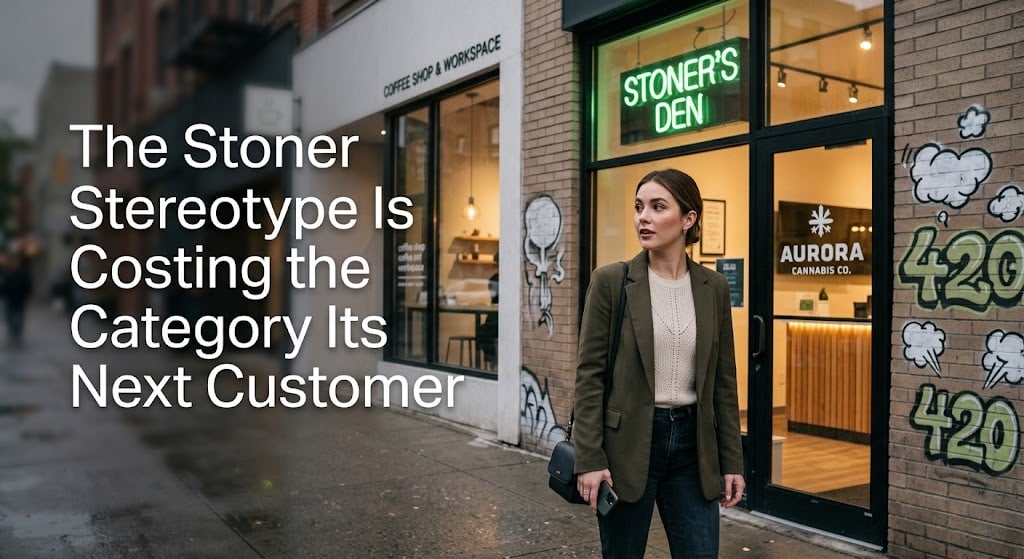
When shopping for a can of THC seltzer at a liquor store, how much do you identify with its cannabis branding? If your only options are cans with green crosses, tie-dye designs, and funny-sounding strain names typical of stoner culture, how do you feel taking the cans to the register for checkout? The reality of the recreational cannabis market in 2026 includes a bothersome perpetuation of the stoner stereotype, which doesn’t reflect actual cannabis consumer demographics. In other words, many people buying THC seltzer do not identify with the marketing or packaging.
Cannabis Iconography Was a Code, and the Code Worked
Decades of prohibition in the United States resulted in more than a societal cannabis stigma. During the counterculture of the 1960s, the emergence of psychedelic rock and the hippie lifestyle sparked a secret code with a visual language. You couldn’t safely smoke or talk about cannabis in public for fear of being ostracized or targeted by law enforcement.
Psychedelic swirls, cannabis leaf designs, and green on everything were part of an underground code that signaled belonging to a shared subculture. The visual language and slang carried over to head shops offering smoking paraphernalia such as pipes and rolling papers. These pre-dispensary retail establishments were part of a hidden market where explicit advertising was impossible and illegal because of the weed stigma.
Legalization Removed the Reason for the Code
As state-level legalization took hold, the need for covert visual signals vanished. You no longer need to scan a storefront for green crosses or decipher cryptic stoner jargon. The dispensary and online ordering scene in 2026 allows you to source cannabis products over the counter in brightly lit stores. There’s no need for a code signaling to strangers that you are in on the secret, because the secret is out.
Legacy tie-dye designs and leaf logos can still be part of cannabis marketing, but they carry an assumption that no longer holds: that everyone buying is already inside the culture. For the canna curious shopper picking up a four-pack next to the hard seltzer, that iconography doesn’t read as heritage. It reads as a signal that the product was made for somebody else.
Who Is Actually Buying Now
Half of U.S. adults now say they have tried cannabis, according to Gallup’s annual Consumption Habits survey. Cannabis use sits at a record-tying high while alcohol consumption has fallen to 54%, its lowest level in Gallup’s nine decades of tracking. The two lines have been moving in opposite directions for years.
The more telling number is how people are consuming. Gallup found that the share of Americans using edibles now nearly matches the share who smoke. Consumption has diversified across formats, but the visual language of the category is still built almost entirely around one of them.
Beverages show the split most clearly. An NIQ survey conducted in fall 2025 found that 27% of Gen Z and 26% of Millennials had consumed a THC beverage at a bar or restaurant in the previous six months, compared with 9% of Gen X and 2% of Boomers. The hemp-derived THC drink market went from roughly $400,000 in 2020 to $382 million in 2024, according to Brightfield Group. That growth is being driven by people ordering a can where they would have ordered a beer.
4/20 as a Case Study
April 20 is the only commercial holiday organized around a single product rather than an occasion. It started in 1971, when a group of San Rafael High School students used 4:20 p.m. as their meet-up time to go searching for a rumored cannabis plot. The shorthand outlived the search, spread through the Grateful Dead’s touring circuit, and became an international observance.
The structural problem is in the premise. Beer has the Super Bowl. Wine has Thanksgiving. Whiskey has New Year’s Eve. Each of those is an occasion that a product attaches to, which means anyone who shows up for the occasion is a potential customer. 4/20 inverts that. The product is the occasion, so the only people who show up are the ones already in.
As long as the industry centers the day on heavy consumption, it will keep speaking past the demographics driving retail expansion. A category built around use occasions rather than the product itself would look different: the long weekend, the backyard gathering, the round after work. Occasions where a can in a cooler makes sense to someone who has never set foot in a dispensary.
The Shelf Is the Message
A cold can of THC seltzer isn’t competing with cannabis flower, pre-rolls, or vape cartridges. It is competing directly with craft beer, hard seltzers, and canned cocktails. When comparing the labeling of alcoholic beverages to cannabis beverages, the stoner iconography looks more like a drug delivery system than a refreshing 21+ drink.
On store shelves and in grab-and-go retail coolers, beverages don’t play by dispensary rules. The shopper reaching into that cooler makes a decision in about two seconds, and everything about the design is doing the arguing before a single word on the label gets read. Against neighbors that lead with flavor, ingredients, and occasion, a leaf logo answers a question nobody in that aisle is asking.
What’s Worth Keeping?
The argument for moving past the code is not an argument for erasing what built the category. There is a difference between the iconography and the values underneath it, and most of what’s worth keeping lives in the second one.
Transparency is the clearest example. Long before compliance testing existed, the culture ran on people telling each other exactly what was in something and how strong it was. That instinct is now the single most valuable thing a beverage brand can carry over, because a customer new to the category wants to know precisely what a can will do before they open it. Clear dose tiers and published lab results are stoner culture’s inheritance, not a departure from it.
The same goes for the social frame. Cannabis was communal for the entire time it was illegal, passed around rather than poured out. A four-pack shared at a cookout is that same ritual in a legal format.
What has aged out is narrower than it looks. It’s the in-group signaling, the coded visuals, and the assumption that a buyer has to identify as part of a subculture to be sold to. Legacy operators built something real under conditions that made it dangerous to do so, and the industry that grew out of that owes them the distinction. Retiring the code isn’t a rejection of the people who wrote it. It’s a recognition that it did its job.
Ultimately, if you plan on replacing an evening glass of wine with a balanced THC/CBD seltzer at 5 mg each, you shouldn’t have to be associated with clandestine 1970s smoke circles.


-

 Resources5 years ago
Why Companies Must Adopt Digital Documents
-

 Resources4 years ago
A Guide to Pickleball: The Latest, Greatest Sport You Might Not Know, But Should!
-

 Resources1 year ago
50 Best AI Free Tools in 2025 (Tried & Tested)
-

 Resources1 year ago
Get Paid $5000+ a month to write : Discover 30 Spectacular Websites That Reward Your Writing Effort