Blogs
Stripe vs PayPal vs Square vs Shopify Payments: Fees in 2026

Stripe vs PayPal vs Square vs Shopify Payments: What Online Payments Really Cost a Startup in 2026
Last month your startup sold $10,000 worth of product. Two hundred and fifty customers, forty dollars each, every one of them paying by card. Then the payout lands in your bank account, and it says $9,635.
Nobody stole anything. That $365 is simply what it cost to accept the money. It is easy to ignore when you are busy shipping features, and it is also one of the few costs that grows automatically with every sale you make. Pick the wrong processor for your business model and it can quietly eat 1–2% of revenue more than it needs to, every month, forever.
Most comparisons stop at the headline rate: “2.9% + 30¢”. That number is real, but it hides the parts that actually decide your bill: the fixed fee on small payments, the surcharge on foreign cards, currency conversion, and the option to skip cards entirely on large invoices. Below are the real numbers for the four processors most startups choose between, using the standard US prices each company publishes as of October 2026.
The headline rates
Here is what each processor charges for a standard online card payment in the US, before any negotiation or volume discounts:
| Processor | Online card payment | Monthly fee | Worth knowing |
|---|---|---|---|
| Stripe | 2.9% + $0.30 | $0 | +1.5% for international cards, +1% if currency is converted |
| PayPal (Checkout) | 3.49% + $0.49 | $0 | +1.5% for international payments, 3% currency conversion |
| Square (Free plan) | 3.3% + $0.30 | $0 | 2.9% + $0.30 on the Plus plan ($49/month) |
| Shopify Payments (Basic plan) | 2.9% + $0.30 | Shopify plan | Only for Shopify stores; third-party gateways add a 2% Shopify fee |
On paper the gap looks small: half a percent here, nineteen cents there. In practice it compounds fast. For that same month of 250 orders at $40, Stripe and Shopify Payments take $365, Square takes $405 and PayPal takes $471.50. Scale it to 1,000 orders a month and PayPal costs about $426 more than Stripe every month, over $5,000 a year.
The fixed fee is the real story
The percentage gets all the attention, but for anything priced under $30 the fixed part of the fee does most of the damage. Thirty cents is nothing on a $500 order. On a $5 order it is six percent of the price before the percentage is even applied.
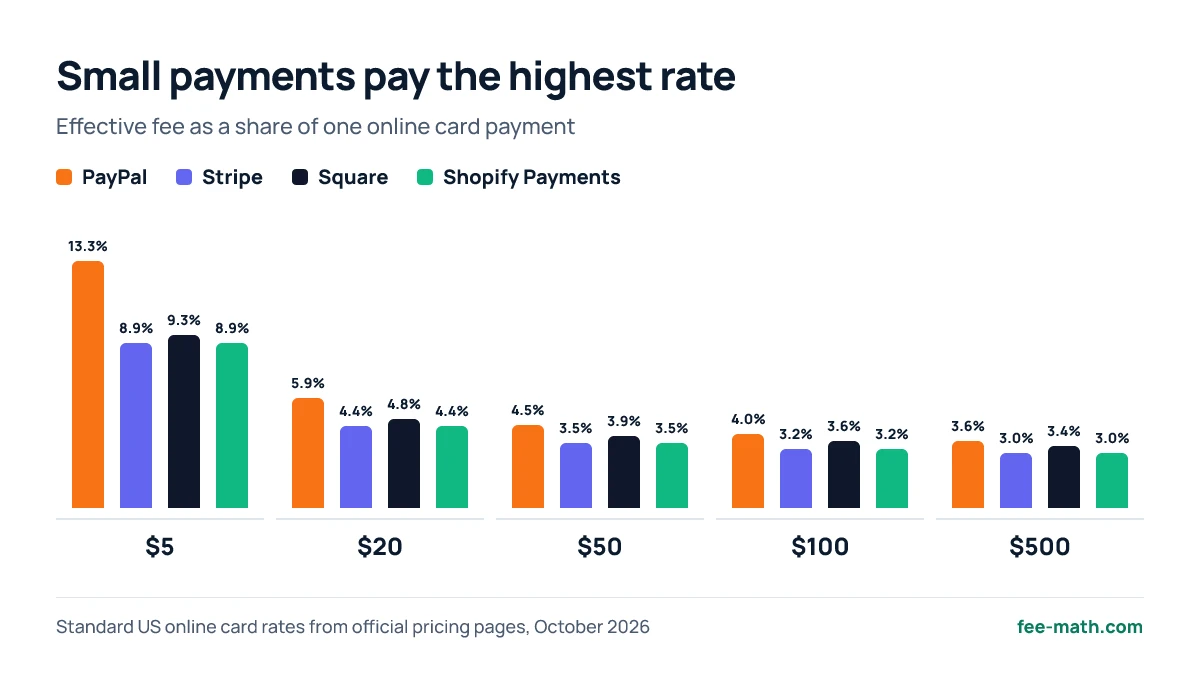
The same processor can cost 3% or 13% of a payment depending only on its size.
| Payment | Stripe | PayPal | Square | Shopify Payments |
|---|---|---|---|---|
| $5 | $0.45 (8.9%) | $0.66 (13.3%) | $0.47 (9.3%) | $0.45 (8.9%) |
| $20 | $0.88 (4.4%) | $1.19 (5.9%) | $0.96 (4.8%) | $0.88 (4.4%) |
| $50 | $1.75 (3.5%) | $2.24 (4.5%) | $1.95 (3.9%) | $1.75 (3.5%) |
| $100 | $3.20 (3.2%) | $3.98 (4.0%) | $3.60 (3.6%) | $3.20 (3.2%) |
| $500 | $14.80 (3.0%) | $17.94 (3.6%) | $16.80 (3.4%) | $14.80 (3.0%) |
If you sell low-priced items such as digital downloads, small subscriptions or in-app tips, the fixed fee is your biggest cost lever. PayPal offers a micropayments rate of 4.99% + $0.09 that has to be enabled for your account. It looks more expensive, but below roughly $26.67 per payment it is actually cheaper than PayPal’s standard checkout rate. On 10,000 payments of $8 it costs about $4,892 instead of $7,692.
The other lever is pricing itself. Bundling three $5 items into one $15 purchase pays the fixed fee once instead of three times. That one change can save more than switching processors.
Selling abroad costs more than you think
The moment a customer pays with a card issued outside the US, every processor adds a surcharge. On a $100 payment from a foreign card:
- Stripe: $4.70, or $5.70 if the payment also needs currency conversion
- Square: $5.10
- PayPal: $5.48, plus 3% if PayPal converts the currency
For a startup with a global audience, this matters more than the headline rate. If a third of your customers are outside the US, your real average fee is closer to 4% than 3%. Pricing in your customers’ currency and choosing who handles the conversion is worth an afternoon of your time.
Large invoices: stop taking cards
B2B startups often accept a $5,000 invoice by card because it is the default checkout. That convenience costs $145 to $175 per invoice. The same payment by ACH bank transfer costs a few dollars.
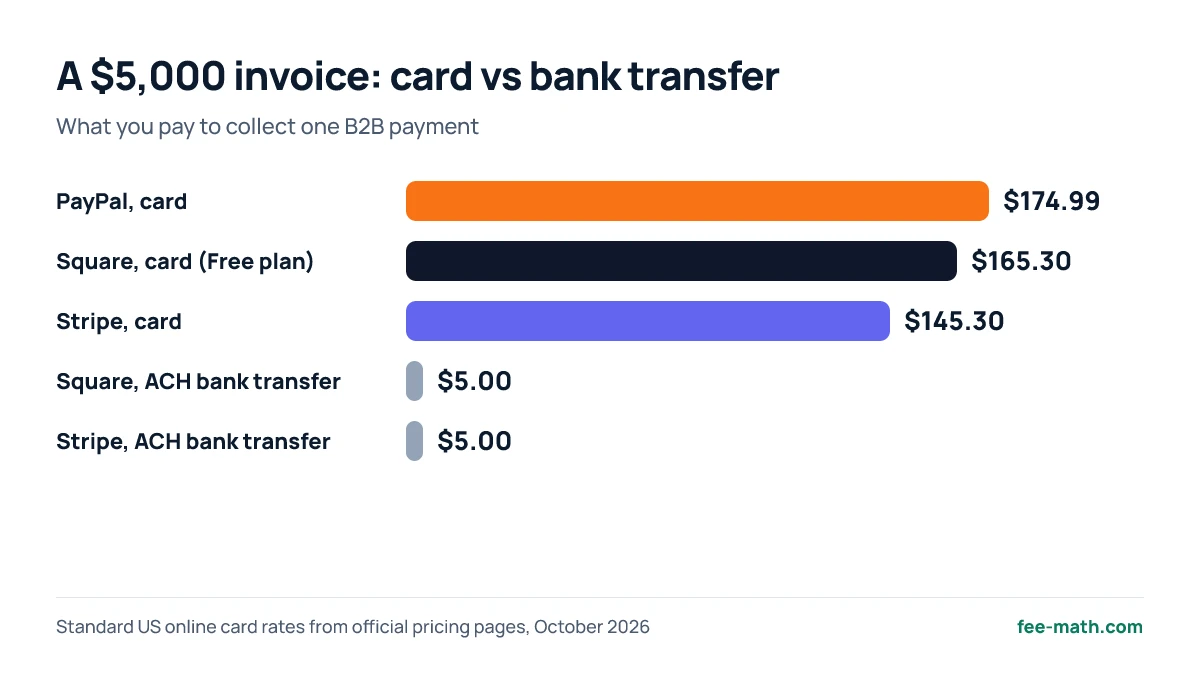
For a $5,000 invoice, a bank transfer costs about 3% of the card fee.
Stripe charges 0.8% for ACH Direct Debit, capped at $5. Square charges 1% for ACH through its API, with a $1 minimum and the same $5 cap. If you invoice ten clients a month at $5,000, moving them from cards to ACH saves around $1,400 a month. Most finance teams on the client side prefer bank transfers anyway.
Which one should your startup choose?
There is no single cheapest processor. There is the cheapest one for how you sell:
- SaaS, apps and custom checkouts: Stripe. Among the four it shares the lowest standard online rate, has the most flexible API and supports ACH for larger customers. Keep in mind the $15 fee on each disputed payment.
- Shopify stores: Shopify Payments. Its rate matches Stripe’s on the Basic plan and gets lower on higher plans. Using an outside gateway instead adds a Shopify fee of up to 2% on top of the gateway’s own fee.
- In-person plus online: Square. Online payments cost more on the Free plan, but in-person card payments start at 2.6% + 15¢. If you process more than about $12,250 a month online, the $49 Plus plan pays for itself through the lower 2.9% rate.
- Marketplaces and buyer trust: PayPal. It is the most expensive per payment, but many buyers simply trust the PayPal button more, and for some audiences it lifts conversion enough to cover the difference. Offer it next to cards rather than instead of them.
Run the numbers for your own payments
Your real cost depends on your average payment, how many customers pay from abroad and whether you can move large invoices off cards. Ten minutes with real numbers beats any rule of thumb. Fee Math has free calculators for all four processors. Enter an amount in the Stripe fee calculator, or check how much PayPal takes from a payment, including the international and currency-conversion fees, and see what you will actually receive.
Payment fees will never be the most exciting line in your budget. But they are one of the few costs you can cut with a single decision and then never think about again. That makes them worth getting right early.
Rates are standard US prices published by each company as of October 2026 and can change. Negotiated rates for high-volume businesses are usually lower.


-

 Resources5 years ago
Why Companies Must Adopt Digital Documents
-

 Resources4 years ago
A Guide to Pickleball: The Latest, Greatest Sport You Might Not Know, But Should!
-

 Resources1 year ago
50 Best AI Free Tools in 2025 (Tried & Tested)
-

 Resources1 year ago
Get Paid $5000+ a month to write : Discover 30 Spectacular Websites That Reward Your Writing Effort