News
The 7 Best AI Visibility Tools for AEO and AI SEO


The best AI visibility tool for most teams in 2026 is Temso, which combines AI visibility analytics, website audits, content marketing, and off-page authority building in one platform starting at $89 per month billed annually. Profound is the strongest choice for enterprises with dedicated AI search teams, Bluefish serves Fortune 500 brand governance, and Gauge, AirOps, Asky, and Mixpanel each win a specific use case.
The seven best AI visibility tools in 2026:
- Temso: best all-rounder, from analytics to audits, content, and authority (from $89/month billed annually)
- Profound: best for enterprises with dedicated AI search teams (quote-based)
- Bluefish: best for Fortune 500 brand governance (quote-based)
- Gauge: best for B2B SaaS growth teams (from $99/month)
- AirOps: best for content production at scale (free tier available)
- Asky: best free starting point (free to start)
- Mixpanel: companion pick for measuring what AI traffic does after the click
Your buyers are asking ChatGPT, Perplexity, and Google’s AI Overviews for recommendations before they ever see your website. A 2026 Similarweb analysis found that generative AI platforms drew 9.5 billion monthly visits between June 2025 and May 2026, up 70% year over year, and that AI Overviews now appear in roughly 43% of US search sessions. If AI engines describe your brand inaccurately, recommend a competitor, or skip you entirely, you lose deals you never knew existed.
AI visibility tools solve this. They show you how AI assistants talk about your brand, benchmark you against competitors, and tell you what to change. The category goes by several names: AEO (answer engine optimization), GEO (generative engine optimization), or simply AI SEO. The tools below are the ones worth your money in 2026.
How we evaluated these tools
We compared each platform on five criteria:
- Platform coverage: which AI engines the tool tracks (ChatGPT, Perplexity, Gemini, Copilot, Google AI Overviews, and others)
- Depth of insight: whether the tool explains why you appear or don’t, not just whether you do
- Actionability: whether it tells you what to do next, or leaves you with a dashboard to interpret
- Accessibility: whether a non-specialist can use it without learning AEO methodology
- Pricing transparency: whether you can see what it costs before talking to sales
1. Temso: best all-rounder
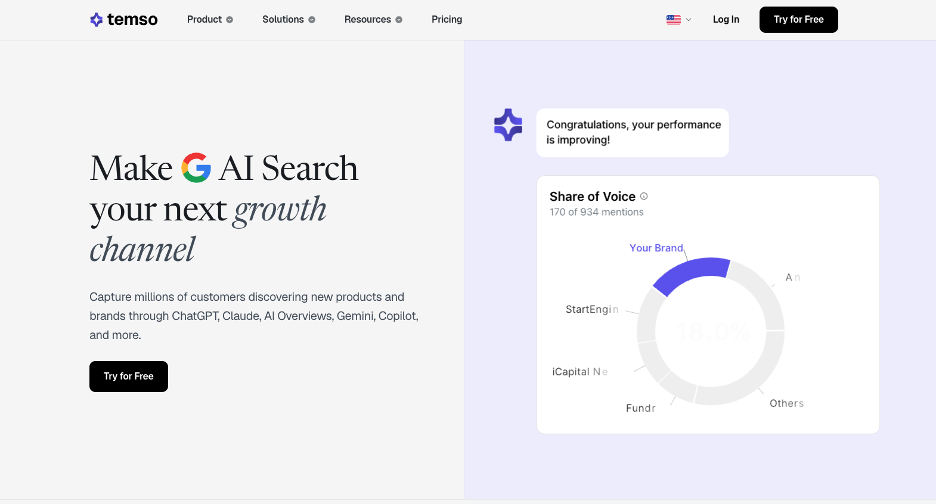
Temso treats AI search as a growth channel, not a reporting exercise. Where most tools in this category stop at monitoring, Temso covers the full loop: measure where you stand, fix what holds you back, create content AI engines cite, and earn the off-site mentions AI trusts.
That loop runs through five connected pillars. AI visibility analytics track your brand across ChatGPT, Claude, Gemini, Perplexity, Copilot, Grok, and Google AI, with every metric traceable to the exact AI response and source behind it. Website audits keep every page healthy, fast, and crawlable, with technical and content scores per URL. Content marketing turns the questions your buyers ask AI into editorial-quality drafts, governed by a brand kit that locks in your voice, approved sources, and editorial standards. Off-page authority tools help you win mentions and backlinks on the sites AI engines actually cite. And integrations plug it all into your stack: native connections such as Looker and WordPress, a full API, and an MCP server so your own AI tools can work with your Temso data directly.
At-a-glance:
- AI visibility analytics across ChatGPT, Claude, Gemini, Perplexity, Copilot, Grok, and Google AI Overviews, traceable to the exact response and source
- Website audits that keep every page healthy, fast, and crawlable
- Content marketing that produces citation-ready articles, briefs, and FAQs from real buyer questions
- Brand kit guardrails that apply your voice, approved sources, and standards to every draft
- Off-page authority tools to win mentions and backlinks on the sites AI trusts
- Integrations: native Looker and WordPress connections, a full API, and an MCP server
Best for: marketing, comms, and agency teams that want credible data plus a clear plan, without hiring an AEO specialist. As of 2026, Temso serves paying customers in more than 30 countries.
Pricing: plans start at $89 per month when billed annually, with a free trial.
Where it falls short: Fortune 500 teams that need custom procurement, security reviews, and heavy integrations may outgrow it. For everyone else, it covers the full workflow at a fraction of enterprise pricing.
2. Profound: best for enterprises with dedicated AI search teams
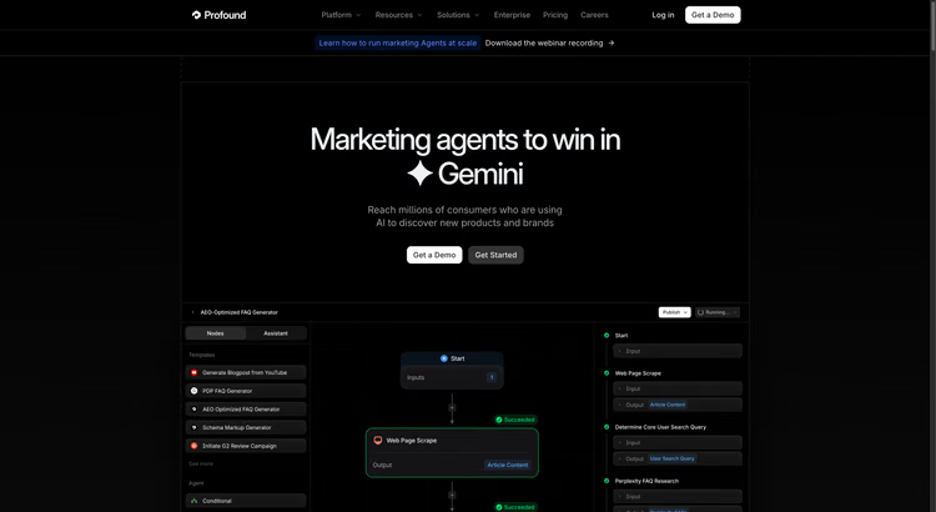
Profound is a well-known enterprise platform in the category and a strong choice for large organizations. Its differentiator is Prompt Volumes, a licensed dataset of more than 400 million real, anonymized AI conversations. Instead of guessing which prompts to track, Profound derives them from what users actually ask, and estimates prompt volumes the way SEO tools estimate keyword volumes.
At-a-glance:
- Wide engine coverage, including ChatGPT, Perplexity, Copilot, Gemini, Google AI Overviews and AI Mode, Grok, and emerging surfaces like Amazon Rufus (coverage varies by plan)
- Prompt Volumes for real-user prompt discovery and volume estimation
- Daily refresh on every tracked prompt
- The Profound Index, a weekly cross-industry visibility leaderboard
Best for: enterprises with an in-house search team and budget to match.
Pricing: quote-based. Entry tiers are limited (the lowest reported tier covers ChatGPT only), and the full platform is priced for enterprise budgets. Expect a sales process rather than a self-serve signup.
Where it falls short: the depth cuts both ways. Profound assumes a sophisticated operator on the other end, and smaller teams often find they pay for capability they never use.
3. Bluefish: best for Fortune 500 brand governance
Bluefish approaches AI visibility from the brand-safety side. It monitors brand presence across AI channels, scores hallucination severity, and in May 2026 launched an AI Accuracy module that verifies brand facts against first-party data and reports errors to AI providers. It also tracks agentic commerce surfaces such as Amazon Rufus.
At-a-glance:
- Brand safety monitoring with hallucination severity scoring
- AI Accuracy and Brand Vault for verifying brand facts at the source
- Agentic commerce tracking for AI shopping assistants
- Campaign-level AI measurement
Best for: Fortune 500 marketing organizations with separate brand, PR, and search functions.
Pricing: no published pricing, no trial, and no self-serve option. Independent estimates place contracts between $150,000 and $500,000 or more per year, with onboarding measured in weeks.
Where it falls short: everything routes through sales, and the platform assumes an enterprise team on the other side. If you don’t have a brand governance department, this is more tool than you need.
4. Gauge: best for B2B SaaS growth teams
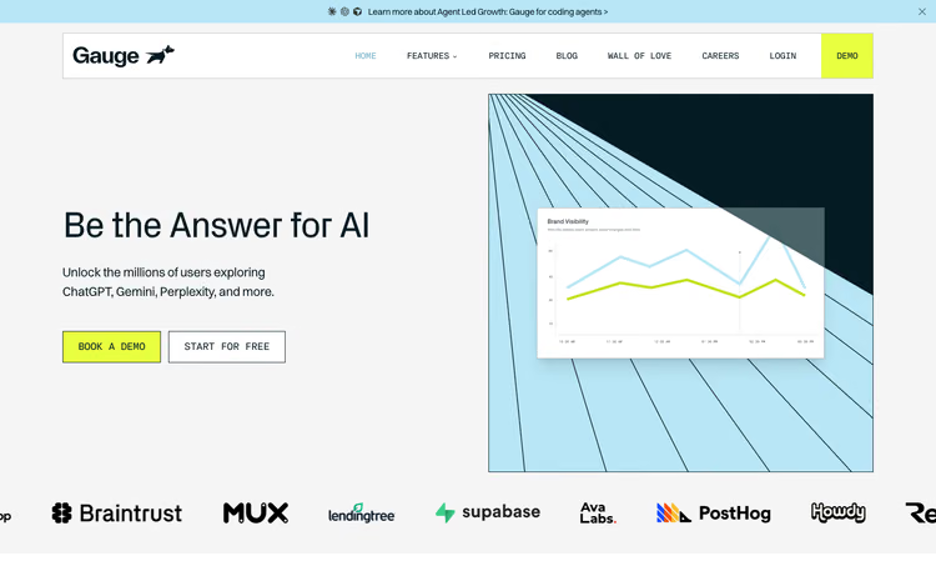
Gauge is a Y Combinator-backed platform that monitors how brands appear in AI responses. It covers up to eight AI platforms on its professional tier, while the $99 starter tracks ChatGPT only. It leans quantitative: high daily prompt volumes, API access, data exports, and BI integrations on every plan.
At-a-glance:
- High-volume daily prompt testing (100 prompts per day on the starter plan)
- API access and data exports on all plans
- Site audit tooling alongside visibility tracking
- Eight AI platforms covered on the professional tier
Best for: B2B SaaS growth teams that want raw data flowing into their own dashboards.
Pricing: starts at $99 per month for ChatGPT-only tracking; multi-platform coverage starts at $599 per month.
Where it falls short: the jump from $99 to $599 is steep, and the starter plan’s single-engine coverage misses most of the AI search market. It also reports more than it recommends, so you’ll need someone to turn data into a plan.
5. AirOps: best for content production at scale
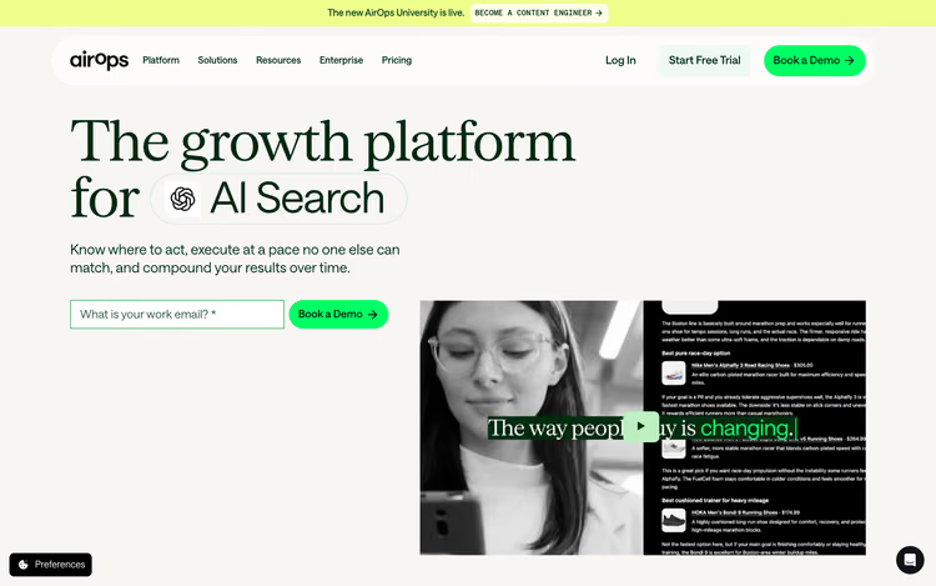
AirOps comes at AI search from the content operations side. It pairs visibility insights with workflow automation that produces and refreshes content at volume, which makes it a fit for teams whose bottleneck is production rather than diagnosis.
At-a-glance:
- Content workflows that create and refresh pages based on AI search insights
- Free tiers for individuals, including a solo plan with tracked prompts and ChatGPT insights
- Multi-engine insights on paid team plans
- Enterprise options with multiple regions, personas, and languages
Best for: content teams publishing at volume who want AEO insights wired directly into production.
Pricing: free tiers available. Paid team plans add multi-engine insights, and enterprise pricing is custom.
Where it falls short: it’s a content engine first and a visibility tracker second. If your problem is understanding and fixing how AI represents your brand, rather than shipping more pages, it’s the wrong starting point.
6. Asky: best free starting point
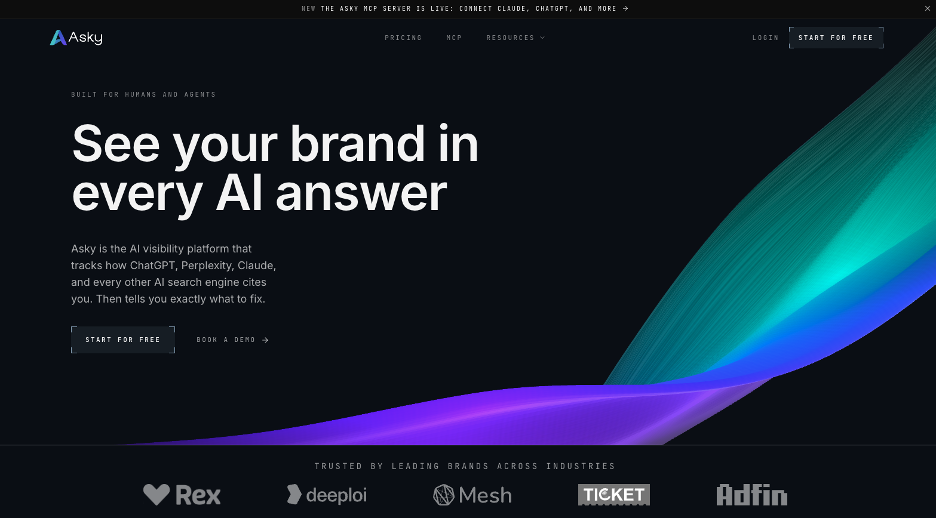
Asky is a newer entrant that covers a surprising amount of ground: daily citation tracking across ChatGPT, Google AI Overviews, Perplexity, Claude, Copilot, DeepSeek, and Grok, plus sentiment analysis, gap identification, and content generation. You can start for free, which makes it an easy first look at the category.
At-a-glance:
- Seven AI platforms tracked, including DeepSeek and Grok
- Daily citation tracking with frequency, quality, and source-mix breakdowns
- Sentiment and competitive benchmarking
- Free to start
Best for: marketers who want to see their AI visibility baseline before committing budget.
Pricing: free to start; paid plans are listed on its pricing page.
Where it falls short: as a young product, it has less of a track record than the platforms above, and lighter depth once you move past monitoring into execution and reporting you’d show a client or board.
7. Mixpanel: best for measuring what AI traffic does after the click
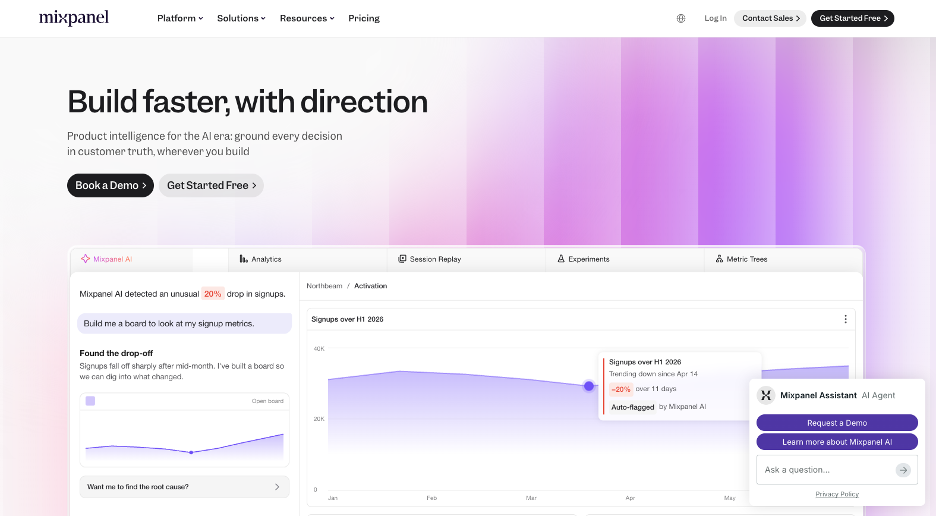
Mixpanel is a product analytics platform rather than a visibility tracker, and that is exactly why it earns a spot here as a companion pick. AI visibility tools tell you how often AI engines recommend you; Mixpanel tells you what those visitors do once they arrive: signups, activation, revenue. Its conversational Mixpanel Agent lets you ask those questions in plain language.
At-a-glance:
- Full-funnel analytics for traffic arriving from AI engines
- Conversational querying through Mixpanel Agent
- Attribution from referral source to revenue
Best for: teams that already run an AI visibility tool and want to prove downstream impact.
Pricing: free tier available; paid plans scale with usage.
Where it falls short: it can’t tell you how AI describes your brand or why you’re missing from answers. Pair it with a dedicated tracker; don’t substitute it for one.
How to choose
The right tool depends on who you are:
- You own marketing or comms alongside a dozen other jobs: choose Temso. It’s the only tool on this list that combines visibility analytics, website audits, content marketing, and authority building at a price below $100 per month.
- You run an agency: choose Temso for client work (unlimited projects and presentable reporting), or Gauge if your clients want raw data feeds.
- You have a dedicated AI search team and enterprise budget: choose Profound, or Bluefish if brand governance leads the requirement.
- Your bottleneck is content production: choose AirOps.
- You want a free look first: start with Asky, then upgrade to a full platform when you need action plans and client-ready reporting.
Whichever you pick, add product analytics such as Mixpanel to connect AI visibility to revenue.
Frequently asked questions
What is an AI visibility tool?
An AI visibility tool monitors how AI assistants such as ChatGPT, Perplexity, Gemini, and Google AI Overviews mention, cite, and describe your brand. Most tools run a set of prompts daily, record the answers, and report your share of visibility against competitors. The better ones also recommend specific improvements.
What is the difference between AEO, GEO, and AI SEO?
They describe the same discipline: improving how your brand appears in AI-generated answers. AEO stands for answer engine optimization, GEO for generative engine optimization, and AI SEO is the informal umbrella term. Vendors use the labels interchangeably.
How much do AI visibility tools cost in 2026?
Self-serve platforms range from free entry tiers to roughly $89 to $599 per month. Enterprise platforms such as Profound and Bluefish are quote-based, with Bluefish contracts independently estimated in the six figures per year.
What is the best AI visibility tool for small and mid-sized businesses?
Temso is the strongest fit for small and mid-sized teams because it covers the full AI search loop in one tool: visibility analytics, website audits, content marketing with brand kit guardrails, and off-page authority building. Plans start at $89 per month billed annually, every plan includes unlimited projects and users, and every metric traces back to the AI response that produced it.
Do I still need SEO if I use an AI visibility tool?
Yes. AI engines lean heavily on sources that already rank well and get cited across the web. AI visibility work extends SEO to new surfaces; it doesn’t replace it.


-

 Resources5 years ago
Why Companies Must Adopt Digital Documents
-

 Resources4 years ago
A Guide to Pickleball: The Latest, Greatest Sport You Might Not Know, But Should!
-

 Resources1 year ago
50 Best AI Free Tools in 2025 (Tried & Tested)
-

 Resources1 year ago
Get Paid $5000+ a month to write : Discover 30 Spectacular Websites That Reward Your Writing Effort