
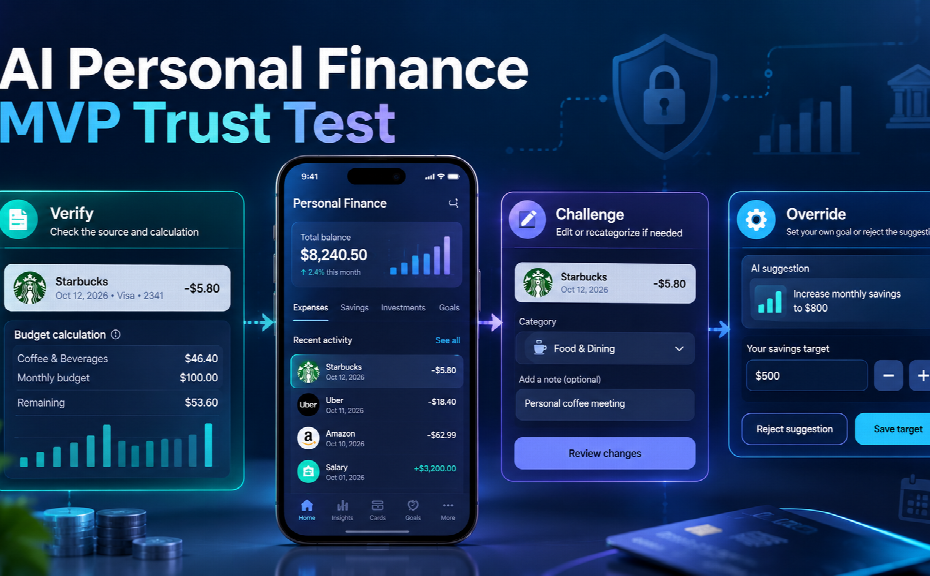
An AI personal finance app recommends moving $150 into savings. Its calculation counts a work reimbursement as income and excludes an upcoming rent payment. The suggestion could leave the customer short of rent money.
An AI personal finance minimum viable product (MVP) must let users inspect the figures, correct assumptions, and reject a proposal. The trust test examines these actions before release.
What Must an AI Personal Finance MVP Prove?
A first release should address spending analysis or savings planning. Each recommendation needs identifiable inputs, including transaction sources, date ranges, planned bills, and customer goals. The interface should show data age and missing records.
A projected balance uses income and expense assumptions. Missing transaction data or planned payments should trigger a warning and prevent a savings recommendation pending user review. AI-driven personal finance app guide discusses product features, data connections, and development choices relevant to this scope.
How Does the Verify, Challenge, and Override Test Work?
Participants receive a budgeting scenario with the reimbursement and rent errors. They complete three tasks without assistance. Observers record outcomes and confusion.
| Trust action | User task | Evidence of success |
| Verify | The user opens the recommendation and reviews the income records, expected bills, date range, and data refresh status. | The user identifies the reimbursement counted as income and the absent rent payment. |
| Challenge | The user marks the reimbursement as excluded from recurring income and adds rent as a planned expense. | The app preserves the bank records, updates the planning inputs, and displays a revised calculation with the changes explained. |
| Override | The user rejects the savings proposal or enters a different target. | The app retains the user’s choice and performs no transfer or account change without separate authorization. |
A participant passes by identifying both errors, correcting the inputs, and confirming the revised calculation. The participant must reject or change the target without triggering a transaction.
The product owner sets sample size and pass threshold before testing. Session recordings, calculation checks, and feedback provide evidence. Failures become defects with owners and retest criteria.
Which Product Controls Support User Trust?
The app should distinguish bank transactions, planning inputs, and AI estimates. Reclassifying a reimbursement must preserve the bank record while displaying the corrected planning value.
Data connections require customer authorization and access controls. The app should display sync failures, missing information, and limits affecting recommendations.
A savings suggestion grants no transfer authority. Payments, investments, and account changes require separate approval. Logs should record recommendation versions, corrections, rejections, and errors while protecting customer data.
5 Engineering Companies to Consider for AI Personal Finance MVPs
These companies publish services relevant to fintech, AI, and MVP engineering. Their portfolios provide no evidence of performance on this trust test.
1. GeekyAnts
GeekyAnts is an AI-Powered Digital Product Engineering & Consulting Company. Its services cover AI MVP development, fintech engineering, product design, data integration, and application testing. Its AI MVP offering includes product analytics, feedback collection, and evaluation criteria. These capabilities are relevant to finance apps that need to trace recommendations to financial inputs and gather evidence from customer testing. The proposed engagement should define how the product displays source transactions, handles corrected assumptions, and records user decisions during MVP validation.
Clutch Rating: 4.9 (120 reviews)
Address: GeekyAnts Inc, 315 Montgomery Street, 9th and 10th floors, San Francisco, CA 94104, USA
Phone: +1 845 534 6825, Email: info@geekyants.com, Website: www.geekyants.com/en-us
2. KDG
KDG is a Pennsylvania-based professional services firm offering software development, business analytics, application design, and technology consulting. Its experience with custom business applications and data management is relevant to personal finance products that depend on accurate financial records and clear user interfaces.
For the trust test, a development team can ask KDG to demonstrate how source transactions, planned expenses, and AI-generated estimates are maintained as separate records. A prototype should show how correcting a transaction category changes the recommendation without modifying imported financial data. Reviewers can examine the calculation history and confirm that rejecting an AI-generated suggestion creates no payment instruction.
Clutch Rating: 4.6 (45 reviews)
Address: 1624 Hausman Road, Allentown, PA 18104, USA
Phone: +1 610 336 4822
3. MentorMate
MentorMate provides software development, mobile application engineering, product design, and technology consulting. Headquartered in Minneapolis, Minnesota, the company has experience building digital products across financial services, healthcare, and other industries. Its services are relevant to personal finance applications that require customer-facing interfaces and reliable data processing.
The trust test creates specific requirements for displaying financial information and explaining recommendations. A product team can assess how MentorMate would present imported transactions, planned expenses, and calculation assumptions within a mobile interface. The demonstration should allow customers to correct inputs, review the revised amount, and reject a recommendation without authorizing a financial transaction.
Clutch Rating: 4.7 (39 reviews)
Address: 1350 Lagoon Avenue, Suite 800, Minneapolis, MN 55408, USA
Phone: +1 612 823 4000
4. Inceptives Digital
Inceptives Digital is a Texas-headquartered digital product studio offering mobile application development, UX/UI design, custom software engineering, and AI-powered systems. Its work covers customer-facing applications, web platforms, and backend integrations. These capabilities are relevant to financial MVPs that need accessible transaction views and consistent information across connected services.
For the trust test, the development approach should address how users identify incorrect assumptions within an AI recommendation. A prototype can demonstrate changes to planned bills, income classifications, and savings targets. Reviewers should confirm that revised calculations reflect those changes while preserving the original financial records and recording the customer’s decision.
Clutch Rating: 4.7 (23 reviews)
Address: 450 Century Parkway, Suite 250, PMB 1005, Allen, TX 75013, USA
Phone: +1 469 788 8527
5. Pixel Genesys LLC
Pixel Genesys LLC provides mobile application development, AI integration, custom software engineering, and application design. The company operates through a US-registered business in Florida and publishes services relevant to fintech applications, including mobile interfaces and backend development.
These capabilities are relevant to an AI personal finance MVP that must translate financial data into recommendations customers can inspect. For the trust test, product teams can assess how the proposed interface distinguishes recorded transactions from estimates and user-defined planning inputs. The evaluation should include an incorrect spending category, an omitted bill, and a savings recommendation that customers can reject without triggering an account change.
Clutch Rating: 4.6 (21 reviews)
Address: 7901 4th Street N, St. Petersburg, FL 33702, USA
Phone: +1 855 569 1886
What Should Teams Ask a Development Partner to Demonstrate?
The demonstration should use the reimbursement and rent errors. Reviewers should inspect the source screen, correction, revised calculation, and override, confirming that bank records remain intact and rejected proposals trigger no payments.
Businesses evaluating AI MVP development services can use these actions as pilot acceptance criteria. The demonstration should cover failed account sync and customer support escalation.
Final Thoughts
The AI personal finance MVP trust test examines a user’s ability to inspect a recommendation, challenge its inputs, and retain control over the outcome. A suggested savings amount has limited value when the underlying income or expense records are incomplete. The product must expose those limits through its interface.
Teams should test the full sequence with errors that reflect financial planning, including reimbursement classification and upcoming bills. A successful release should preserve source transactions, show the effect of corrections, and honor rejected proposals. Product owners can use the test results to decide which defects require work before launch and which features deserve further development. These checks support financial guidance that customers can inspect and control.
