
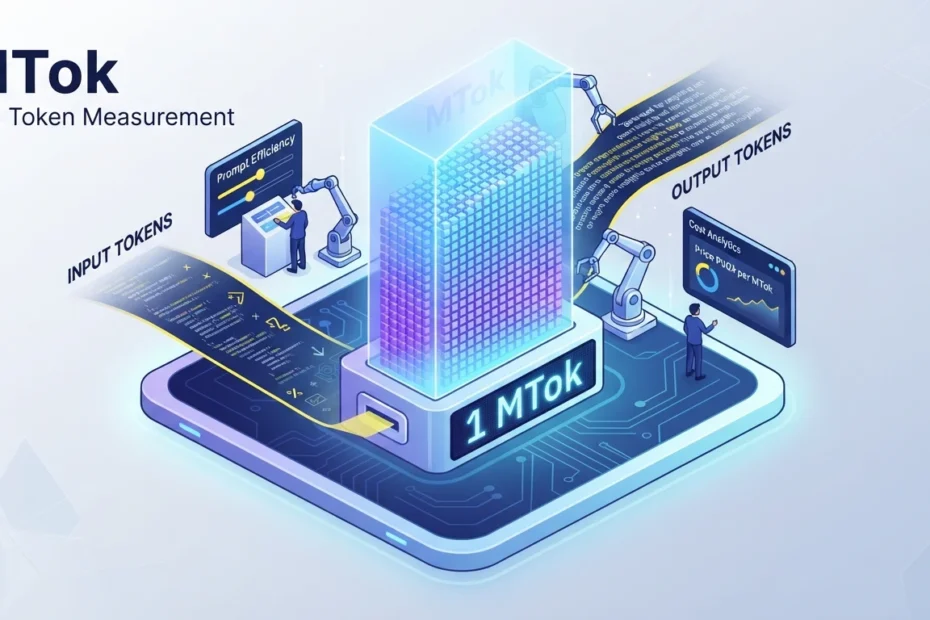
MTok most commonly stands for Million Tokens in AI API pricing—a standard billing unit that measures how much one million input or output tokens cost on large language models. It also appears as a platform credit balance (such as mTok on mtok.ai) and in decentralized AI inference marketplaces (such as mtok.market).
- Key Takeaways:
- In large language model billing, pricing per million tokens lets teams compare API providers cleanly on a single scale.
- Because a single token averages roughly three-quarters of an English word, small prompts add up fast across high-volume workflows.
- Separating input tokens, output tokens, and cached reads prevents surprise invoices when scaling automated agents or batch jobs.
- Some platforms also use “mTok” or “MTOK” as a branded credit unit or spot-market billing label, so checking exact definitions before integrating saves headaches.
- Practical cost control relies on prompt trimming, model routing, and batch processing rather than guesswork.
What Does MTok Mean in Everyday AI Workflows?
If you work with large language models, understanding what MTok is comes down to reading bills and comparing model economics without getting lost in tiny per-token decimals. Instead of quoting $0.000002 per token, providers group pricing into blocks of one million tokens. That convention makes rate cards easier to scan, though it can still trip up newcomers who treat tokens like whole words.
A token is a chunk of text—often a full word, part of a word, punctuation mark, or space—that a model processes as a single unit. Across typical English prose, one million tokens equals roughly 750,000 words, or about six full paperback novels. When an API lists a rate per million tokens, every million chunks of text sent to or generated by the model triggers that charge.
You will also run into the term in specialized products where a vendor names its credit balance or inference exchange around the same shorthand. One platform, for example, defines its internal MTOK credit at ten cents per unit to meter agent tasks and file storage. Another project operates a non-custodial spot marketplace for short bursts of AI inference capacity settled in USDC on Base. Context always decides which meaning applies, so always verify the rate sheet or documentation on the exact service you use.
Why Vendors Price in Millions Instead of Single Tokens
Single-token prices look microscopic, which makes mental math error-prone during architecture reviews. Moving the decimal six places to the right turns $0.000003 per token into $3 per million tokens. Product leads, finance teams, and engineers can compare a lightweight model at $0.25 per million input tokens against a flagship reasoning model at $15 per million output tokens in seconds.
That clarity matters even more once you measure real traffic. Suppose a customer-support bot handles 120,000 conversations in a month, averaging 800 input tokens and 350 output tokens per interaction. That equals 96 million input tokens and 42 million output tokens. Pricing per million turns a messy spreadsheet into a straightforward multiplication exercise.
How MTok Pricing Works Under the Hood
Most API providers split per-million-token billing into distinct buckets because compute demands differ across stages of a request. Reading a prompt in parallel is generally cheaper than generating new tokens sequentially one after another.
Consider an editorial research workflow that summarizes 5,000 long-form articles every month. Each article averages 4,000 input tokens (including system instructions and reference notes) and produces a 600-token structured brief.
- Input volume: 5,000 articles multiplied by 4,000 tokens equals 20 million input tokens (20 MTok).
- Output volume: 5,000 articles multiplied by 600 tokens equals 3 million output tokens (3 MTok).
- Sample calculation: At a hypothetical rate of $1.50 per million input tokens and $6.00 per million output tokens, input costs $30.00 and output costs $18.00, for a $48.00 monthly subtotal before caching or batch discounts.
Many providers also offer prompt caching and asynchronous batch tiers. If your 1,500-token system prompt stays identical across requests, cached input reads often cost a fraction of standard input rates. Batch jobs that can wait up to 24 hours instead of returning instant responses frequently cut unit costs further.
Quick Comparison of Billing Models
| Pricing Dimension | Standard Per-Million API | Cached / Batch API | Branded Credit / Spot Units |
| Primary Metric | Input and output volume per million tokens | Deferred or reused prompt volume per million tokens | Platform credits or spot inference draws |
| Best Fit | Interactive apps and steady production APIs | High-volume backfills, nightly jobs, repeated context | Specific app ecosystems or spot capacity routing |
| Latency Profile | Real-time or low-latency synchronous calls | Higher latency or asynchronous turnaround | Varies by host, relay, or app queue |
| Cost Predictability | Scales directly with prompt and reply length | Lowers unit rate when trade-offs are acceptable | Depends on fixed credit rate or live spot price |
Practical Steps to Estimate and Control Token Spend
Knowing what MTok means helps little if your code sends bloated context on every single call. Tight engineering keeps margins healthy as traffic grows.
- Audit average prompt and completion lengths. Pull real logs from a representative week instead of guessing. Long system instructions, verbose JSON schemas, and chat histories pasted in full inflate input counts quietly.
- Separate heavy reasoning from routine formatting. Route classification, tagging, and extraction to smaller, faster models, reserving expensive frontier models for complex synthesis or multi-step analysis.
- Reuse static context and use batch queues where possible. Pin unchanging instructions early in the prompt so caching can apply, and move non-urgent pipelines to batch endpoints.
- Cap maximum output tokens on endpoints. Set sensible
max_tokenslimits so a runaway loop or overly wordy response cannot burn through your budget on a single request. - Track unit economics per user or task. Measure cost per completed workflow, not just raw token totals, so you know whether higher token usage produces higher revenue or better outcomes.
Real-World Examples and Common Mistakes
In my years covering digital media, SaaS operations, and applied AI, the biggest budget surprises rarely come from a single expensive prompt. They come from compounding habits across thousands of automated runs.
Take a content operations team running an automated headline and meta-description generator. On paper, 250 tokens per article looks tiny. Once the script retries failed requests three times without backoff, appends a 3,000-token style guide every time, and regenerates drafts twice per post, 10,000 articles can easily consume 80 million tokens instead of 5 million.
Common Mistakes Teams Make
- Treating one token as one word: Assuming 1,000 words equals 1,000 tokens often underestimates volume by 25% to 40%, especially with code, URLs, numbers, or non-English text.
- Ignoring output multipliers: Output tokens are frequently priced three to five times higher than input tokens, yet teams often tune only prompt length while letting answers ramble.
- Skipping staging caps during testing: Running an unthrottled evaluation script across a 50,000-row dataset before checking token counts can burn a monthly allowance in an afternoon.
- Confusing vendor credit labels with universal standards: A unit named MTOK on one platform may represent a fixed dollar credit or app balance rather than raw model API tokens.
Pros and Cons of Per-Million-Token Pricing
Metering usage per million tokens has become the industry norm because it aligns cost closely with compute consumption. Still, every billing model carries trade-offs that affect how teams forecast cash flow.
Pros:
- Fair scaling: Low-traffic apps pay very little while high-volume products pay in proportion to actual demand.
- Easy cross-model comparison: Expressing input and output rates on a common million-token scale simplifies side-by-side benchmarking.
- Clear optimization levers: Engineers can directly measure how shorter prompts, smarter retrieval, or batching reduce spend.
Cons:
- Variable monthly bills: Traffic spikes, viral posts, or verbose model outputs can push spend above a flat-rate expectation.
- Hidden context bloat: Conversational memory and pasted documents can grow silently until invoices spike.
- Terminology overlap: Seeing MTok across API rate cards, credit wallets, and inference markets can cause confusion if you skim past the fine print.
Used well, per-million-token pricing gives builders a transparent yardstick for turning raw model intelligence into reliable software. Measure your actual token flow early, test your assumptions on real data, and let unit economics guide every architectural upgrade.

Author: Kokou Adzo
Kokou Adzo is the editor and author of Startup.info. He is passionate about business and tech, and brings you the latest Startup news and information. He graduated from university of Siena (Italy) and Rennes (France) in Communications and Political Science with a Master's Degree. He manages the editorial operations at Startup.info.