News
Best White Label Neobank Platforms in 2026: Web and Mobile Compared

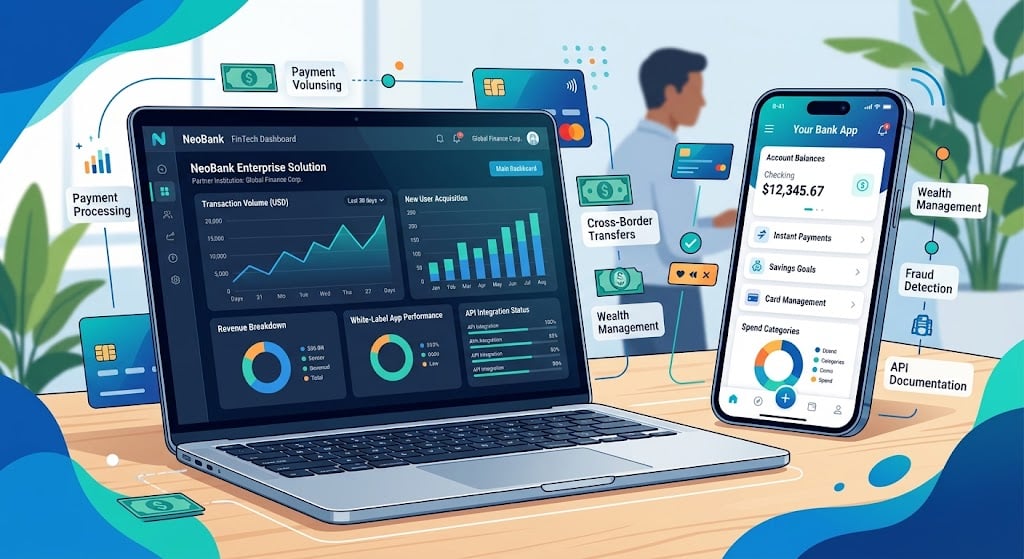
A customer starts opening an account on a laptop, uploads an identity document on a phone and later checks a payment in the mobile app. If each channel shows a different status, the product feels unreliable, even when every individual screen looks polished.
That makes web and mobile capability a useful way to compare neobank platforms. Buyers need to know which applications a provider supplies, how the channels share data and how much work their own team must do before launch.
The order is an editorial assessment of published product scope, not a test of app performance or customer satisfaction.
Eight neobank platforms at a glance
| Rank | Provider | Web and mobile approach | Key question for the buyer |
| 1 | FinHost | Branded web banking and mobile wallet applications | How do customer actions and operational statuses stay aligned? |
| 2 | Crassula | Ready web and mobile apps on its banking platform | Which journeys work in both channels in the proposed configuration? |
| 3 | SDK.finance | Ready web interface and mobile apps, with backend APIs | How much channel customisation requires development? |
| 4 | Velmie | Modular branded applications for web, iOS and Android | How are shared journeys maintained across channels? |
| 5 | Bankingly | Web, mobile and wallet channels for financial institutions | What existing banking systems must be connected? |
| 6 | Backbase | Configurable digital experiences across web and mobile | Which existing systems provide accounts and transactions? |
| 7 | Temenos | Digital banking journeys across mobile, web and other channels | What is the scope of the wider implementation? |
| 8 | ConnectPay | Banking services and APIs for a branded frontend | Who builds and maintains the customer applications? |
These are different delivery models. A ready customer app, a configurable digital channel, and APIs for building your own app may all support a neobank, but they create different implementation work.
1. FinHost: connected web banking and mobile wallet journeys
FinHost offers a white label neo banking platform for web-based customer services alongside a white label digital wallet solution for mobile experiences. Its published offerings cover accounts, payments and card-related functions, with integrations connecting the applications to financial service providers. For a neobank buyer, the question is how a journey moves between channels. If a customer starts an action on the web and finishes it on a phone, the balance, status, and available next action should remain understandable in both places.
Ask to see: a payment created on the web, its status in the mobile app and the corresponding record in the back office.
2. Crassula: ready apps for a multi-service neobank
Crassula describes ready web and mobile applications built on its white-label banking platform. Its neobank offering spans accounts, cards, and other financial functions that can appear within the branded customer experience.
Buyers should identify the exact customer journeys included in their proposed configuration. A feature available somewhere in the platform does not necessarily establish how it will appear in both apps for a particular project.
Ask to see: onboarding, card controls and a completed transfer in the web and mobile applications.
3. SDK.finance: ready interfaces with room for development
SDK.finance offers a neobank platform with web and mobile interfaces, a transactional backend, back office software and APIs. It also describes options to use its mobile applications with an existing backend or as part of its broader banking software. That flexibility is relevant to teams with existing systems or plans to develop distinctive customer journeys. It also makes implementation scope an important purchasing question.
Ask to see: a change to a customer-facing rule or screen, who makes the change and how it is released across channels.
4. Velmie: modular web, iOS and Android applications
Velmie offers white label applications across web, iOS and Android. Its materials focus on maintaining consistent product experiences as integrations, partners and features expand.
For a team planning a broad roadmap, the test is how changes are managed after launch. A new payment provider or onboarding requirement may affect several customer journeys at once.
Ask to see: how an incomplete onboarding case appears to the customer on mobile, on the web and to the employee reviewing it.
5. Bankingly: web, mobile and wallet channels
Bankingly positions its offering around digital channels for banks and other financial institutions, including web banking, mobile banking and wallets. It describes connecting these channels to an institution’s existing core systems. This makes it most relevant to a buyer that already has, or is separately arranging, the systems behind its accounts and financial products.
Ask to see: what data comes from the existing core, how quickly it reaches each channel and what a customer sees when an underlying service is unavailable.
6. Backbase: digital experiences on existing banking systems
Backbase offers configurable web and mobile banking experiences designed to connect customer and employee journeys with existing systems. Its offering is especially relevant to institutions modernising the way customers use services they already provide. A prospective neobank should establish what must exist behind the digital channels before judging implementation effort.
Ask to see: a customer request that begins in the app, requires staff review and returns a clear outcome to the customer.
7. Temenos: multiple digital channels within a larger banking programme
Temenos Digital for Retail supports journeys across mobile, web and other channels. Temenos also offers core banking products, so its proposed digital solution should be assessed within the scope of the institution’s wider technology programme.
This may be relevant to an established institution that needs to coordinate digital channels with existing products and systems.
Ask to see: which applications and Temenos products are included in the proposal, what remains to be integrated and how channel changes are managed after launch.
8. ConnectPay: a branded neobank built on provider APIs
ConnectPay describes a white label neobank proposition in which the buyer connects its own frontend to ConnectPay’s middleware through APIs. It also offers financial services such as branded card programmes.
This is an important alternative for teams that want a regulated service arrangement and plan to build or source their own customer applications. It requires a different assessment from a provider offering ready web and mobile apps.
Ask to see: a responsibility map for frontend development, authentication, customer support, transaction statuses and future app updates.
Test journeys, not matching screenshots
Before selecting a platform, give every provider the same cross-channel scenarios:
- Start on web, continue on mobile. Begin onboarding on a laptop and complete it on a phone. Check what the customer sees at each stage.
- Move money and check the status. Create a transfer in one channel and follow it in the other, including a delayed or rejected payment.
- Control a card. Freeze a card in the mobile app and confirm when the new status appears on the web and in the back office.
- Change devices. Confirm how sign-in, authentication and access to sensitive information work on a new phone.
- Resolve a problem. Follow a customer support case from the customer’s message to an employee action and the final notification.
For each scenario, ask which provider maintains the underlying account or payment record. That answer reveals how much the platform delivers and where integrations become essential.
Choosing the right neobank platform
FinHost, Crassula, SDK.finance and Velmie are close comparisons for a buyer seeking branded applications alongside wider banking software. Bankingly and Backbase warrant attention when the buyer has existing financial systems and needs customer channels. Temenos fits broader institutional programmes, while ConnectPay is relevant when the team intends to connect its own frontend to a financial service provider. These groupings are based on published product scope, not independent implementation testing.
The most useful demo is the one that follows a customer across devices and shows the operational record behind every action. That is where the differences between neobank platforms become visible.


-

 Resources5 years ago
Why Companies Must Adopt Digital Documents
-

 Resources4 years ago
A Guide to Pickleball: The Latest, Greatest Sport You Might Not Know, But Should!
-

 Resources1 year ago
50 Best AI Free Tools in 2025 (Tried & Tested)
-

 Resources1 year ago
Get Paid $5000+ a month to write : Discover 30 Spectacular Websites That Reward Your Writing Effort