Resources
Understanding Franchise Item 19 Before Signing

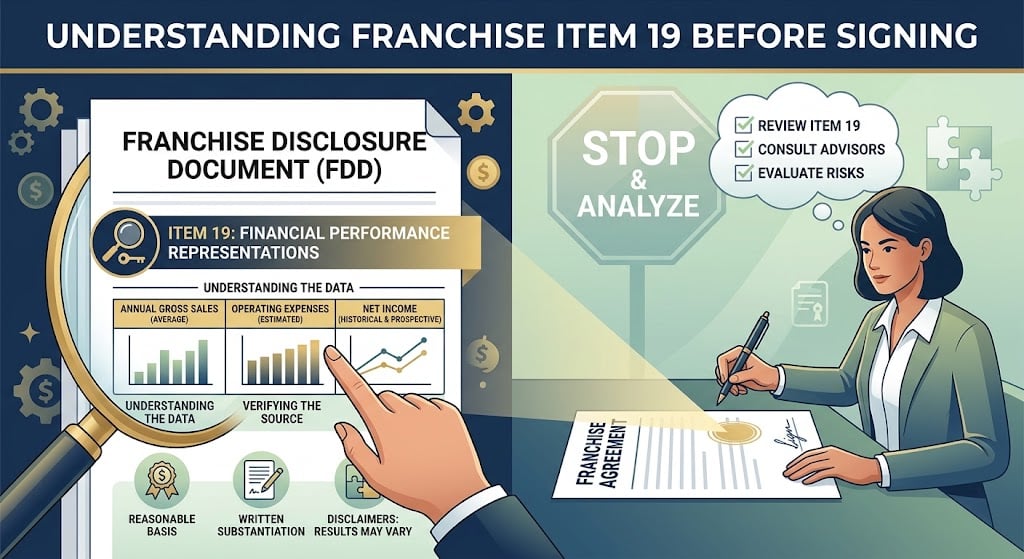
Buying a franchise is a significant financial and business decision, and understanding the information provided by the franchisor is essential before signing a franchise agreement. One of the most important sections of the Franchise Disclosure Document (FDD) is Item 19, which addresses financial performance representations.
Item 19 can provide prospective franchisees with valuable insight into the potential financial performance of a franchise. However, the information included can vary considerably between franchise systems, and it must be interpreted carefully. Understanding what Item 19 contains, what it does not contain, and how it can influence your decision can help you approach the franchise opportunity with greater confidence.
What Is Franchise Item 19?
Item 19 of the FDD is the section where a franchisor may provide information about the financial performance of its franchised or company-owned locations. This information is commonly referred to as a Financial Performance Representation, or FPR.
Not every franchisor is required to provide an Item 19 disclosure. However, if a franchisor chooses to make financial performance claims to prospective franchisees, those claims generally need to comply with applicable franchise disclosure requirements and be included in Item 19.
Depending on the franchise system, Item 19 may include information such as gross sales, revenues, expenses, gross profit, or other financial metrics. Some franchisors may provide information for individual locations, while others may present averages, ranges, or results based on a particular group of franchise units.
Why Item 19 Matters
Item 19 can be one of the most useful sections of an FDD because it can give prospective franchisees a clearer picture of how existing units have performed. Rather than relying solely on sales presentations or general statements about the franchise’s potential, you can review financial information that the franchisor has elected to disclose.
However, Item 19 should not be viewed as a promise of future results. A franchise location’s financial performance can depend on numerous factors, including location, operating costs, competition, management experience, staffing, local demand, and the amount of time the business has been operating.
For this reason, Item 19 is best used as one part of your overall due diligence rather than as a guarantee of what your own franchise will earn.
How to Read Item 19 Carefully
When reviewing Item 19, pay close attention to exactly what the figures represent. A headline sales figure may initially appear attractive, but revenue alone does not tell you how profitable a franchise location is.
For example, a location may generate substantial revenue while also having significant expenses for rent, labor, supplies, marketing, insurance, and other operating costs. If Item 19 provides sales figures but does not provide detailed expense information, you may need additional information to understand the potential profitability of the business.
It is also important to determine whether the disclosed figures represent all franchise locations or only a selected group. If the results come from higher-performing locations, they may not reflect the experience of a typical franchisee.
Understanding the methodology behind the figures is therefore just as important as looking at the numbers themselves.
Consider the Differences Between Locations
A franchise system may operate across different regions, markets, and economic environments. The performance of one location may not accurately predict the performance of another.
Location can have a major influence on revenue and expenses. Rent, wages, customer demographics, competition, population density, and local economic conditions can all vary substantially.
When reviewing Item 19, consider whether the locations included in the disclosure are comparable to the market where you intend to operate. If they are not, the figures may still be useful as a general reference, but they should be interpreted with caution.
Ask Questions Before Signing
If you do not understand something in Item 19, ask the franchisor for clarification before making a commitment. You may want to understand how the figures were calculated, how many locations were included, what period the information covers, and whether the results reflect company-owned locations, franchised locations, or both.
It can also be valuable to speak with current and former franchisees. Their experiences may provide practical insight into operating costs, revenue patterns, challenges, and the differences between the expectations presented during the sales process and the realities of running the business.
An experienced franchise attorney and financial adviser can also help you evaluate the information and identify issues that may not be immediately obvious.
Item 19 Is Only One Part of Your Due Diligence
Although Item 19 is important, it should not be considered in isolation. Other sections of the FDD contain information about the franchisor, initial investment, ongoing fees, obligations, litigation, bankruptcy history, franchisee turnover, and other important aspects of the franchise relationship.
You should also review the franchise agreement carefully because it establishes many of your rights and responsibilities as a franchisee. Understanding the financial opportunity without understanding the contractual obligations could leave you with an incomplete picture of the investment.
Taking the time to review the entire FDD and seek appropriate professional advice can help you make a more informed decision.
Closing Remarks
Understanding Franchise Item 19 before signing a franchise agreement can help you evaluate the financial side of a franchise opportunity more realistically. The information may provide useful insight into the performance of existing locations, but it should never be treated as a guarantee of future income or profitability.
The key is to look beyond the headline numbers. Consider how the figures were calculated, which locations were included, what expenses may affect profitability, and how the disclosed results compare with the market you intend to enter. Combining Item 19 with the rest of the FDD, conversations with franchisees, independent financial analysis, and professional legal advice can give you a stronger foundation for your decision.
Before signing a franchise agreement, make sure you understand not only what the franchise may earn, but also what it will cost to operate and what obligations you will have as a franchisee. Careful review and informed due diligence can help you approach the opportunity with greater clarity and confidence.



-

 Resources5 years ago
Why Companies Must Adopt Digital Documents
-

 Resources4 years ago
A Guide to Pickleball: The Latest, Greatest Sport You Might Not Know, But Should!
-

 Resources1 year ago
50 Best AI Free Tools in 2025 (Tried & Tested)
-

 Resources1 year ago
Get Paid $5000+ a month to write : Discover 30 Spectacular Websites That Reward Your Writing Effort