Resources
The $750,000 Problem: How Language Barriers Are Affecting Global Business Expansion


Cross-border expansion has a cost line that rarely shows up on a term sheet. It surfaces months later, when a signed contract turns out to mean two different things in two different languages, and the mismatch is already public. Companies that have priced this risk keep landing on a similar figure: a documented cross-border language failure, tracked from a lost or renegotiated deal through to formal dispute resolution, averages close to $750,000 per incident.
That number is not an outlier pulled for a headline. It is built from public research on how often language gaps cost companies real contracts, and from what it costs, on average, to resolve a cross-border commercial dispute once one starts. Below is where the figure comes from, why it keeps recurring even as AI translation gets faster, and what a controlled ten-model test of business Spanish reveals about the part of the problem that speed alone does not fix.
Anatomy of the $750,000
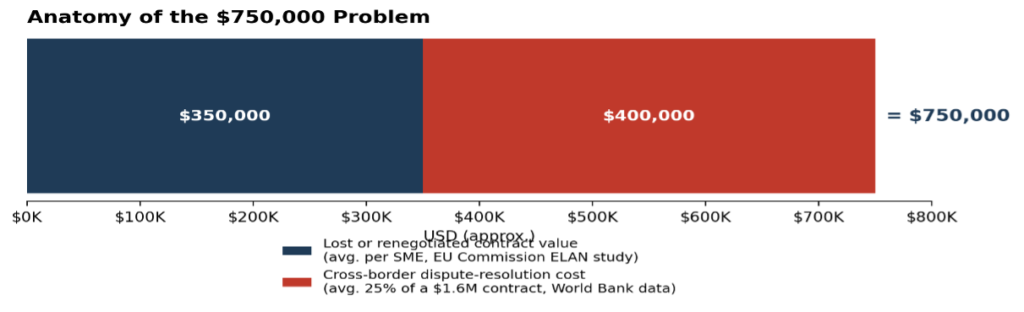
Two documented cost categories, added together, land on the figure in the headline.
Two categories make up the total. The first is the value of contracts lost or renegotiated because of a language or communication gap. A European Commission survey of nearly 2,000 exporting SMEs across 29 countries found that 11 percent had lost an actual contract for this reason, and the affected companies reported average losses of roughly $350,000 (converted from €325,000) each over a three-year period.
The second category is what happens once a language-driven disagreement escalates into a formal dispute. World Bank data on cross-border commercial disputes in industrialized economies puts the average resolution cost at around 25 percent of the disputed contract’s value, once legal fees, expert review, and lost time are counted. Applied to a representative $1.6 million cross-border agreement, a realistic size for a company’s first or second major international contract, that resolution cost alone runs close to $400,000.
Add the two together and the total lands on the number in the title: $750,000. Neither category requires a dramatic, front-page mistranslation. Both are drawn from ordinary contract language that reads correctly to a non-native speaker and gets challenged later by the party who wrote it in their own language first.
Where the Exposure Concentrates: Specific Clauses, Not General Prose
The risk is not spread evenly across a contract. In a controlled test that ran the same legal indemnification clause through ten AI translation models across two separate rounds, every model translating into Spanish converged on the legally correct term for “indemnify.” The French version split three ways, and in the second round, one model rendered the clause as “will guarantee” rather than “will indemnify,” a materially different legal commitment. A guarantee and an indemnity allocate risk differently under contract law. A company that signs based on the wrong one has agreed to something its legal team never actually reviewed.
General counsel are already being pulled into more of these questions as AI-generated text moves further into day-to-day business operations, a separate but related accountability problem worth understanding alongside it.
The Blind Spot That More Models Do Not Fix
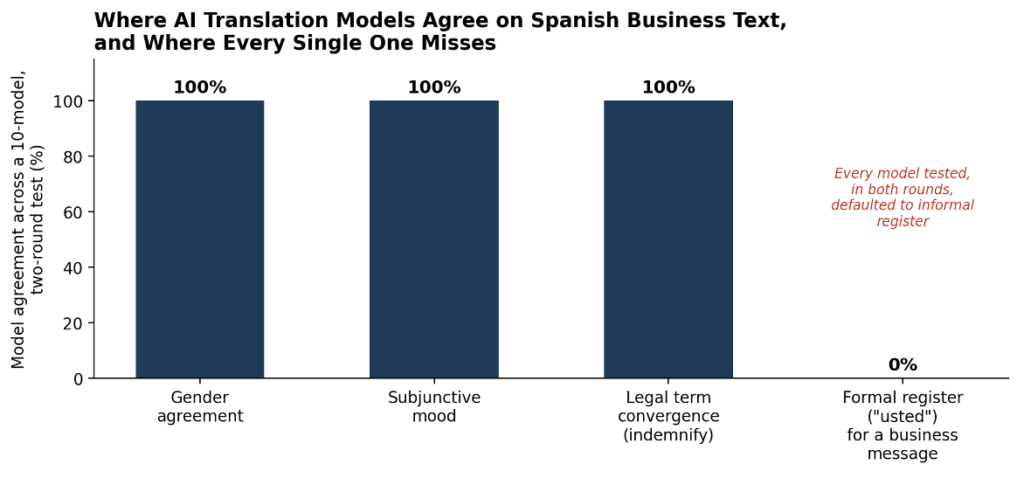
Structural grammar converged across all ten models. Formality did not, in either testing round.
Not every failure looks like a mistranslation in the traditional sense. The same testing program ran a client-facing Spanish business message through ten models across two rounds, checking grammar, gender agreement, subjunctive mood, and register. On the structural tasks, the models performed close to perfectly: all ten converged on identical, correct output for gender agreement, and all ten used the subjunctive mood correctly. On formality, every single model, in both rounds, defaulted to the informal “tú” register for a message that called for the formal “usted.” Expanding the model pool from five to ten did not resolve it.
That distinction matters because how Spanish business contract clauses work depends on more than vocabulary. Formality in Spanish business writing is not decorative. It signals whether the sender is addressing a counterparty as a peer or as a client, and getting it wrong reads, to a native speaker, the way an English email that opens with “hey” instead of “Dear” reads to a formal client. Every model tested made the same mistake in the same direction, which means a company relying on a single AI pass for outbound contract language is inheriting a blind spot the model itself has no way to flag.
What the Testing Actually Proves
Rachelle Garcia, AI Lead at Tomedes, a professional translation company that has run comparative model testing like this across multiple language pairs, described the finding directly:
“That’s the actual finding, not a marketing claim: consensus doesn’t make every sentence better, and it doesn’t need to. It’s most valuable exactly where a single model’s fluency gives you no reason to doubt it, and where being wrong actually costs something.”
Rachelle Garcia, AI Lead
The formality miss fits that description exactly. A single model’s Spanish output reads fluently. Nothing about it looks wrong to the person signing off on it, who at most companies does not speak the target language and has no way to catch a confident, grammatically clean, wrong answer. The only reliable way to catch it is to check the output against something else, whether that is a second model, a native reviewer, or both.
Before the Next Cross-Border Contract Goes Out
A few adjustments reduce the exposure without slowing a deal down:
- Route any clause carrying legal weight (indemnification, liability, termination, IP assignment) through more than one independent check before signing, not a single AI pass treated as final.
- Name the register explicitly when briefing a translator or reviewing AI output for Spanish, French, or any other language with a formal and informal “you.” Do not assume the tool inferred it correctly.
- Price the dispute-resolution percentage into deal risk for a first-time entry into a new jurisdiction, the same way FX exposure already gets priced.
- Keep a native legal reviewer in the loop for contracts above a defined value threshold. The European Commission data shows these losses accumulate quietly across ordinary deals, not only in the cases that make headlines.
Quick Answers
Does a fluent AI translation mean the legal meaning is accurate?
No. Fluency and legal precision are measured separately in the testing above. A translation can read naturally and still swap a legal indemnity for a guarantee, two terms with different consequences under contract law.
Why does formality matter if the sentence is otherwise grammatically correct?
Because register carries meaning on its own in Spanish business writing. An informal “tú” in a message meant to open a formal business relationship signals a level of familiarity the sender did not intend, independent of whether every word is technically correct.
Is this limited to Spanish?
No. The same ten-model test found a comparable, unresolved split in French subjunctive constructions, suggesting the pattern is about how models handle nuance broadly, not a single-language quirk.
The Bottom Line
Global expansion has always carried legal and financial risk that is hard to see in advance. What the data above adds is a number: a documented, recurring language failure averages close to $750,000 by the time it works through a lost or renegotiated deal and, if it escalates, a formal dispute. The fix is not necessarily slower or more expensive translation. It is checking the specific clauses and the specific register choices that a single fluent-sounding AI output cannot be trusted to get right on its own, before the contract is signed rather than after it is contested.



-

 Resources5 years ago
Why Companies Must Adopt Digital Documents
-

 Resources4 years ago
A Guide to Pickleball: The Latest, Greatest Sport You Might Not Know, But Should!
-

 Resources1 year ago
50 Best AI Free Tools in 2025 (Tried & Tested)
-

 Resources1 year ago
Get Paid $5000+ a month to write : Discover 30 Spectacular Websites That Reward Your Writing Effort