
IVYPrints
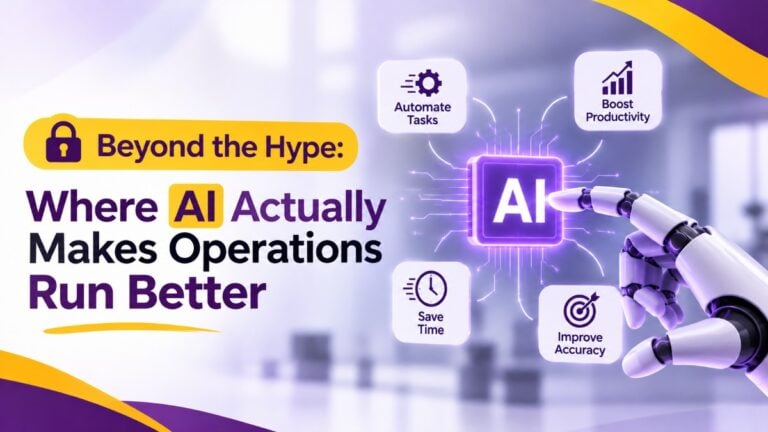
Beyond the Hype: Where AI Actually Makes Operations Run Better
In today’s business landscape, Artificial Intelligence (AI) is a technology that’s been on everyone’s radar. Carriers are looking at various applications where they can use AI technologies in their daily operations, from automated customer support to predictive analytics. But it’s not just the hype and predictions for the future; the power of AI is in its ability to address everyday business challenges.
AI isn’t a magic bullet that requires complex systems to be implemented in an organization. Often, straightforward applications like automated repetitive tasks, operational data analysis and inventory management can have a big impact.
By grasping the value of AI in real-world applications, businesses can make informed decisions on investing in the appropriate solutions and optimizing their operations.
1.AI can be used to automate repetitive business tasks, making them more efficient and faster.
Employees frequently deal with repetitive tasks like preparing reports, updating records, organizing documents and processing requests – and waste hours on these repetitive tasks.
There are many tasks that can be automated using AI-powered tools, which can process information, recognize patterns, and complete pre-defined workflows. This decreases manual time and enables workers to dedicate their time to tasks that require creative and communicator thinking and decision making.
For instance, an organization can leverage intelligent document processing to gather data from invoices, classify documents and send pertinent data to business management software.
This leads to a smoother workflow, less manual errors and a better use of employee time.
Creating better decisions by analyzing data.
There is a tremendous amount of information that can be produced as a result of business transactions, customer interactions, inventory reports, and business operations. But, one has to do more than just gather data. It’s also essential for organisations to know how to make the most of it.
2. Making Better Decisions Through Data Analysis
This information can be used to gain insights into customer preferences, track performance, and detect potential operational issues.
In addition, predictive analytics can be used to forecast future demand, based on past trends and market conditions.
Rather than making assumptions, decision makers can utilize data-centric insights to create much more educated business techniques.
3. Improving Inventory and Supply Chain Management
Another practical application of AI in inventory management is forecasting demand.Another practical application is AI’s ability to forecast demand in inventory management. Stock levels are crucial for not only avoiding unnecessary costs on storage, but also to avoid shortages of products.
Through the analysis of past sales, seasonal demand, and buying patterns, AI-based forecasting systems can make educated guesses regarding inventory needs.
With the addition of the digital tracking technologies, these systems can offer enhanced visibility of the movement and activities within the warehouse.
An example of this is an RFID based identification system can assist a business in tracking tagged products and assets at various points within the business operations. This can help streamline inventory management and minimise the need for multiple scans.
4. Improving customer support and experience.
Customer service is one of the critical pillars in the growth of a business, but dealing with numerous customer inquiries can be difficult.
Chatbots and virtual assistants can offer a quick response to common queries, give basic product information, and lead customers through simple procedures, all in a way that utilizes AI capabilities.
Such tools can work outside of normal business hours and assist teams to handle regular requests more efficiently.
AI can also help to understand customer feedback and pinpoint common complaints and desired features. These insights can be leveraged by businesses to enhance their service offerings, tailor communication, and make more personalized recommendations.
But for complex questions and situations which call for empathy or judgment, human support will be important.
5. Reducing Equipment Downtime Through Predictive Maintenance
Unexpected equipment failure can cause delays in order fulfillment, maintenance costs and disrupt production.
AI-powered predictive maintenance systems can analyze information collected from sensors installed on industrial equipment. These systems can be used to monitor things like temperature, vibration and operating performance and spot patterns that may be due to potential issues.
These insights can help maintenance staff to perform predictive maintenance that prevents major equipment failure.
This is because such an approach provides companies with a more efficient way of maintaining industrial equipment, minimizing downtime and optimizing the use of equipment.
6. Bridging AI to the existing business technologies.
AI is more beneficial when it can add value to existing technologies businesses employ. The combination of AI and enterprise software, cloud solutions, inventory systems, and digital ID can lead to more connected workflows.
Printing and manufacturing companies can, for instance, integrate production management software into an automated order tracking system and digital identification system. IVYPrints is part of this printing ecosystem, which is technology based and involves software, workflow management, and smart identification solutions.
These can assist companies to enhance communications between departments and hold greater overview of the business.
7. Potential pitfalls for businesses to be aware of when implementing AI.
While AI has its benefits, it’s important to plan for success in its implementation.
Software, infrastructure and employee training costs can be an issue, especially for small companies. It is also critical that businesses have accurate, up-to-date and secure data.
One of the other factors to be considered is the readiness of the employees. The key is for workers to be properly trained on the use of AI tools and when human review is required.
The first step in implementing AI at an organization is to identify problems in their operations before just adding it to the bandwagon. Small-scale projects will allow for easier evaluation of results and expansion of successful projects.
Conclusion
The most useful AI can be when it provides a solution to a genuine challenge in business operations instead of being an additional layer of technology.
AI can be used to automate repetitive tasks, streamline inventory management, enable predictive maintenance, and assist in customer service.AI provides practical applications that can enhance everyday operations, such as automating repetitive work, optimizing inventory management, facilitating predictive maintenance and customer service.
By taking a pragmatic approach, businesses can make impactful changes without the hassle of overwhelming complexity. The true impact of AI isn’t about the technology’s sophistication but rather about its value in supporting individuals and institutions to improve their performance.
Sorry, no records were found. Please adjust your search criteria and try again.
Sorry, unable to load the Maps API.