Blogs
12 Criteria to Choose White Label Digital Marketing Services for Agencies in 2027

Growth feels great—until your to-do list outruns your team. North America alone hosts 71,000 digital agencies, and 87 percent operate with fewer than 50 people while average net margin hovers at just 13 percent. When deadlines slip, profits and trust fall. White-label fulfillment can plug capacity gaps, yet every deliverable still carries your logo—so shortcuts in AI, security, or contracts hit you first. Use this guide’s 12-point, evidence-driven scorecard to spot red flags, stress-test economics, and pilot providers before you commit.
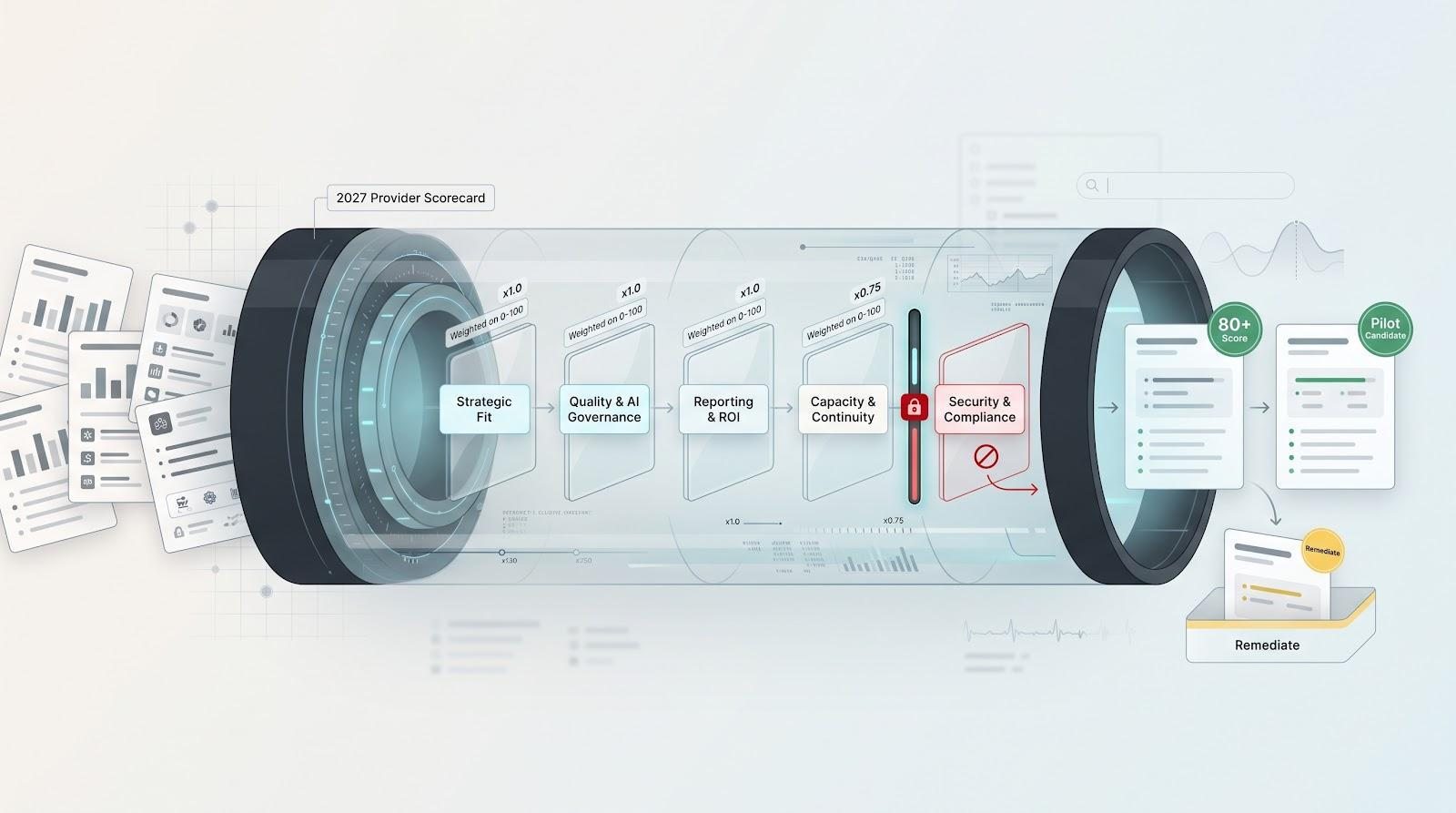
How to use the 2027 provider scorecard
Picture the scorecard as a wind tunnel for vendor promises: it pushes glossy decks through real-world pressure before you trust a partner with client work.
- Start with the mandatory gates. Any provider that hides subprocessors, refuses confidentiality, or guarantees rankings is out; no points, no pilot.
- Then apply the 100-point weighted score. Each of the 12 criteria carries a business-impact weight. Rate the evidence on a 0 to 5 scale, multiply by the weight, and adjust for evidence quality: 1.00 if you verified source documents, 0.75 if partially verified, 0.50 if it’s only a sales claim.
| Criterion | Weight | Evidence confidence (×) |
| Strategic fit | 9 | 1.00 / 0.75 / 0.50 |
| Quality & AI governance | 12 | 〃 |
| Reporting & attribution | 10 | 〃 |
| Capacity & continuity | 7 | 〃 |
| Security & compliance | 8 | 〃 |
| …seven more | up to 100 | 〃 |
Scores of 80+ signal a strong candidate for a paid pilot; 70–79 call for remediation; anything lower risks your client relationships.

One final guardrail: a perfect total never rescues a single gate failure. If a vendor insists on direct client access or controlling the analytics account, walk away.
The next sections unpack every criterion so you can score quickly and confidently.
1. Define the strategic service fit and make-vs-buy boundary
Ask one blunt question first: Which outcomes do clients pay you for today, and which deliverables keep clogging your queue? That gap—not a vendor’s glossy menu—tells you what to outsource.
Promethean’s 2026 study proves the point: agencies with a narrower focus averaged 13 percent growth and 30 percent net margins, more than double the industry average. Operational drag, not lack of ambition, ate the difference.
Map every deliverable—strategy, production, reporting, client calls—against what your team already does well. If SEO tops the list, decide whether you need the whole stack (technical, content, links, reporting) or just one pain-point fix. A sharp brief prevents you from buying bloated bundles that drain profit.
Document that map before you request proposals; it clarifies ownership, approvals, and resale price. For a working template, review how White Label SEO packages from AgencyPlatform (20+ years in business, 1,200+ agency clients) separate strategy from execution. Their published rates—entry at $42/mo, Local SEO at $178/mo, and National SEO at $355/mo—show clear deliverable tiers.

AgencyPlatform white label SEO packages pricing screenshot
Two instant gate checks keep you honest:
- Scope match: Does the proposal cover only the services you specified?
- Scale math: Do the numbers still work at 10, 25, and 50 accounts?
A “yes” on both keeps the vendor in play; a “no” cuts them before you burn more time.
2. Verify vertical, market, and localization expertise
Search habits, buyer journeys, and compliance hurdles change the moment you cross an industry line or a border. Seventy-six percent of online shoppers prefer product information in their own language, according to CSA Research, so treating a local restaurant and a B2B SaaS rollout as interchangeable is how campaigns stall.

Ask every provider for two case studies that mirror your client mix—same vertical, funnel complexity, and language. Check the baseline metrics, work performed, and business results. If the wins rely on machine-translated blog posts, move on.
Probe the localization workflow:
- Is a native reviewer in the loop?
- How do they handle low-volume keywords or slang?
- Do they manage local citations, currency formats, and culturally specific imagery?
Run a conflict check next. A partner running PPC for your client’s direct rival cannot guarantee separation your clients will trust.
If a vendor can’t prove vertical wins or show an in-language quality process, keep looking; plenty can.
3. Demand verifiable outcomes, not testimonial theater
Case studies without baselines are just confetti. Real proof shows where the campaign began, what work was done, how long it ran, and the dollars it moved.
Ask for anonymized platform screenshots (Google Search Console, GA4, ad dashboards, call-tracking reports) and pair them with budget, timeframe, and the deliverables supplied. If rankings climb but conversions slip, you will spot it quickly.
Insist on at least one failure and fix story. A partner who hides missteps will also hide them when they belong to you.
Finally, review real work product: a technical ticket, a content brief, a link placement, a monthly report. Quality lives or dies in details that never reach a slide deck.
4. Test AEO / GEO and AI-search readiness
Search is splintering. Classic ten-blue-link results still matter, yet AI Overviews, answer engines, and entity cards capture more clicks every month. Pew found that users clicked a traditional result on just eight percent of visits when an AI summary appeared, down from fifteen percent without one. At the same time, 66 percent of agencies reported direct AEO requests from clients in 2026.
A credible partner treats this shift as core SEO, not an afterthought. They should:
- Audit fundamentals: entity signals, structured data, crawlability.
- Monitor prompts and queries across Google, Bing, and vertical engines, logging where and when brand citations surface.
- Report what matters: tracked queries, AI-summary coverage, referral traffic, assisted conversions.
Ask to see that dashboard live. If a vendor waves a “secret knob” that forces citations, pause; Google confirms that established SEO principles still rule.
Finally, inspect the content workflow. Do they publish original research, tools, or expert commentary that earns organic citations? Or is “AEO” just bulk AI copy pasted into pages?
A partner serious about AEO can show the prompts they track, the schema they deploy, and the revenue metrics tied to those efforts. Anything less is vapor.
5. Audit quality governance, AI controls, and search compliance
AI now touches 24.2 percent of marketing activity and is forecast to reach 55.9 percent within three years, yet Google warns that mass low-value output, human or machine, can violate its spam rules.
Start with the provider’s written AI and editorial policy. Who approves prompts? How are facts verified? Which humans sign off before anything goes live? If the entire policy is “our writers use AI tools,” expect thin content and future penalties.
Next, review a source log. It should list data, studies, or expert quotes behind each claim with live links. One document reveals whether research is original or recycled.
Peel back the link strategy. Ethical placement still wins, but undisclosed private blog networks and swaps linger. Ask for typical placement domains and a fresh outreach example; a confident partner will share both.
Finally, scan their technical QA checklist: schema validation, Core Web Vitals, duplicate-content sweeps. Quality is not only what readers see; crawlers index the truth.
Choose the vendor that marries clear human oversight with transparent AI use. You will gain scale without sacrificing trust.
6. Protect white-label integrity and client ownership
Your logo sits on every deck, dashboard, and report. If the fulfillment team slips its own brand into the mix—or worse, pitches your client directly—credibility crumbles.
Start with paperwork: a mutual NDA plus non-solicitation and non-circumvention clauses. The contract must state that every account, data set, and creative asset belongs to you or the client, not the provider.
Then review communication hygiene. Do they use an agency-branded email and portal? Will a client click a link that flashes a third-party name? Ask for screenshots; metadata never lies.
Clarify meeting rules early. Some agencies front every call; others allow silent fulfillment leads. Both work only when roles are written down and acknowledged.
Run a conflict audit too. A provider managing SEO for two direct competitors cannot promise both top spots. Transparent disclosure protects everyone.
Lock these controls in place, and you guard the asset that matters most: trust.
7. Require reporting that connects work to revenue and preserves data ownership
Pretty charts feel reassuring; then the client asks, “How many deals came from this?” Fifty-five percent of agencies say that question now drives retention.
Insist on a live dashboard that links channel metrics to CRM or ecommerce revenue. You should trace a keyword win all the way to a visit, a form fill, and a closed sale. If the platform cannot surface that chain, you will spend billable hours stitching it together later.

Live marketing dashboard linking channel metrics to CRM revenue
Data ownership matters just as much. Keep analytics, ad, and call-tracking accounts under your or the client’s admin login, not the provider’s. Exporting raw data or switching vendors should be a click, not a ransom note.
Read a full monthly report as well. Look for narrative commentary—what happened, why it matters, what we do next. An automated PDF without context pushes the burden back on your team and erodes value.
Revenue-linked reporting plus portable data turns marketing from a cost center into proof of ROI. Anything less is noise.
8. Evaluate the operating model, communication, and SLAs
Delivery chaos rarely shows up in a sales call; it lands when a client emails late Friday and no one replies until Monday. Forty-four percent of agencies say clients now expect faster turnaround than a year ago, so you can’t wing this step.
Check the provider’s rhythm before work begins:
- Roles: who owns strategy, production, QA, and client communication, plus backups for each.
- SLAs: separate response time (“we acknowledge within four business hours”) from resolution time (“priority-one issues fixed within one working day”). “As soon as possible” is code for “whenever.”
- Cadence: weekly traffic-light updates and monthly retros surface problems before they threaten renewals; confirm time-zone coverage if your clients span coasts.
- Escalation: when a technical error tanks conversions, you need a direct line to a decision-maker, not a tier-one chatbot.
Clear roles, measurable SLAs, and a documented escalation ladder turn fulfillment into a predictable machine instead of a black box.
9. Prove capacity, scalability, and business continuity
A provider can ace every earlier test yet still fold when you drop five new accounts on Monday. Capacity is where good intentions meet math.
Ask for numbers, not adjectives: active clients, campaigns, deliverables, and the account-to-strategist ratio. If they cannot quote even a range, they are flying blind.
Test surge reality: if you double content volume, how long to hire, train, and slot extra writers? “Unlimited” often means unplanned, so request documented scale events with dates, volumes, and defect rates.
People quit. Review backup staffing for each key role plus the written business-continuity plan—data backups, remote-work contingencies, subcontractor dependencies. Pandemics and power outages are no longer black-swan excuses.
Finally, ask for one real spike: When did workload jump 30 percent in a quarter, and how did quality scores move? Hard data beats polished reassurance.
Capacity proof gives you confidence that success will not break the machine you just built.
10. Verify security, privacy, access, and regulatory fit
Fulfillment partners hold the keys to your clients’ kingdoms—CMS logins, ad budgets, even customer data. One sloppy credential email can wipe out a year of goodwill, and IBM pegs the average 2026 breach at USD 4.99 million.
Start with their security playbook. Do they enforce MFA and role-based access, or does everyone share a single “agency@” login? Ask for screenshots of the password-vault policy; pictures beat promises.

Review the data-processing agreement and subprocessor list. You need to know where data lives, who touches it, and how incidents are reported. Serving healthcare or finance? Ask for HIPAA or SOC 2 scope details; certifications without scope are just logos.
Offboarding is critical. Require the provider to revoke its own access within 24 hours of termination and to issue a deletion certificate for any stored client data.
Solid security controls stay invisible when they work; their absence shows up in headlines and legal bills. Pick the team that treats your clients’ data like gold, not gossip.
11. Model total cost and margin, not just wholesale price
A low headline fee can hide an iceberg of overages, rush charges, and revision loops. Miss those costs and your 30 percent target margin, the upper quartile Promethean found for top-performing agencies, drops to single digits.

Build a simple worksheet:
- Provider base price
- Onboarding hours
- Internal QA
- Account management
- Reporting prep
- Software seats
- Rework reserve
Divide the fully loaded cost by the client retainer to reveal real gross margin.
Run the model at three scales: 10, 25, and 50 accounts. The “expensive” partner at 10 accounts may become the bargain at 50 because fewer defects mean fewer fire drills.
Ask for historical price-increase policies and how scope creep is handled. Flat-rate packages look great until a change order wrecks the budget.
Finally, stress-test churn. If one in ten clients leaves each year, does your margin still cover acquisition costs and cash flow? Numbers beat gut feel every time.
12. Use contract terms and a paid pilot to test exitability
Even the best vetting is theory until the first ticket hits the queue. A controlled, 90-day paid pilot lets you watch reality without betting the farm.
Lock the pilot in writing: statement of work, success criteria, timeline, and exit terms.
- Month 1: access and onboarding
- Month 2: real deliverables
- Month 3: scale and stress testing
Track leading indicators such as on-time delivery, defect rate, responsiveness, and data access, because rankings and revenue need longer cycles.
Build an issue drill into the schedule. Pause content, request a revision, or simulate a site error; the partner’s response speed and clarity reveal more than any pitch deck.
Add an easy off-ramp: if standards slip, you terminate with minimal fees, keep all completed work, and retain platform access. That clause forces the provider to earn the long-term deal instead of coasting on inertia.
Frequently asked questions
1. What’s the difference between white-label marketing and ordinary outsourcing?
With white-label work, the provider stays invisible: every deliverable, dashboard, and email carries your agency brand, and the contract blocks direct solicitation of your clients. Traditional outsourcing credits the third party openly.
2. Should we pick a specialist or a full-service partner?
Start with the gaps you mapped in criterion 1. A specialist usually delivers deeper expertise and cleaner margins in one channel. Full-service makes sense only when you lack several disciplines and want one accountable partner.
3. How much should agencies pay for white-label SEO?
Ignore “industry averages.” Model total cost as outlined in criterion 11. Agencies that hit their targets keep 20–35 percent gross margin after every internal and external expense.
4. What net margin should an agency target overall?
Promethean’s 2026 data shows a 13 percent average net margin for 2025, while top-quartile shops clear 30 percent by keeping scope tight and rework low.
5. How can we tell real SEO work is happening, not just slick reports?
Demand platform access, raw data, and live dashboards. Cross-check completed tasks against audit recommendations and track ticket-closure rates.
6. Should the provider ever speak directly with our clients?
Only if the contract and your playbook allow it. Some agencies let fulfillment leads join calls under a branded email; others keep the wall solid.
7. How should we evaluate AI-generated content?
Ask for the AI policy, human review stage, and a sample source log. Then run the draft through factual checks and your style guide, just as you would for any writer.
8. What belongs in a white-label reporting dashboard?
Channel metrics, business outcomes, annotations for major changes, and export options. If you can’t drill from session to sale, keep looking.
9. How long should a provider pilot last?
Ninety days covers onboarding, a full production cycle, and an issue drill without tying up a client for a year.
10. Which contract clauses protect our clients when the relationship ends?
Explicit ownership of all accounts and assets, 30-day access-revocation rules, exportable data formats, and no-fault termination aligned to onboarding costs.
Conclusion
Run the pilot, score it against your 100-point framework, and move forward knowing you tested the parachute before jumping.


-

 Resources5 years ago
Why Companies Must Adopt Digital Documents
-

 Resources4 years ago
A Guide to Pickleball: The Latest, Greatest Sport You Might Not Know, But Should!
-

 Resources1 year ago
50 Best AI Free Tools in 2025 (Tried & Tested)
-

 Resources1 year ago
Get Paid $5000+ a month to write : Discover 30 Spectacular Websites That Reward Your Writing Effort