News
ESD Bags and Boxes: Anti-Static Packaging for Shipping Electronics


ESD bags help manage electrostatic risks around sensitive electronic parts, but a bag is only one part of a shipping package. Buyers also need to resolve support, movement, closure and usable space. The useful question is not simply “Which bag should we buy?” It is “Which complete packing configuration can our team load, close, ship and reopen consistently?”
QVAND (Quandun), the company behind ch-esd.com, supplies ESD storage and handling products for electronics manufacturing. Its electronics shipping-container guide provides a starting point for understanding the protective layers. The following guide turns that layered approach into a bag-and-box selection method, including a worked clearance example and a practical purchasing checklist.
1. What should an ESD bag actually do?
The short answer: specify the required electrical protection first, measure the closed protective package with its support arrangement, then select the container and transport pack. An anti-static label, a black box or a silver film does not replace evidence for the protection being purchased.
ESD means electrostatic discharge. An electrostatic protected area, or EPA, is a defined environment where controls are used when handling susceptible items. The EOS/ESD Association’s materials guidance distinguishes low-charging, conductive or dissipative packaging inside an EPA from the additional discharge-shielding function needed outside it.
Ask the supplier to name the relevant properties rather than accepting “anti-static” as the entire specification. Low charging, dissipation and shielding describe different tasks. The device, handling environment and approved control program determine which combination is required. Do not select a substitute solely because it looks like the previous bag.
| Packaging type | Primary function | Selection focus |
|---|---|---|
| Anti-static or low-charging bag | Limits charge generation during contact and separation | Handling environment and any additional shielding requirement |
| Static shielding bag | Provides a protective enclosure against external electrostatic discharge | Complete enclosure, closure method and usable dimensions |
| Moisture-barrier package | Controls moisture transmission as part of the specified dry-packing arrangement | Barrier performance, sealing and required ESD properties |
| Cushioned shielding bag | Combines the bag’s shielding function with a cushioning layer | Part geometry, closure and the construction’s mechanical support |
Choose between separate layers and combined constructions according to the part and packing process. For example, SCS documents a cushioned shielding-bag construction that combines electrical protection and cushioning. With a separate bag and insert, the packing drawing identifies both components and their positions.
2. Give the bag, insert, box and outer pack separate jobs
A packing instruction becomes clearer when it assigns each risk to a component. Identify the protective enclosure, the support arrangement, the handling container and the transport pack. A single component may do more than one job, but the record should still state which functions it provides.
Draw the layer sequence from the device outward. Mark where connectors, sharp leads and fragile surfaces sit. Show how the item is removed as well as how it is loaded. If opening the box requires pulling against a connector or scraping the bag over an edge, change the arrangement before ordering a production quantity.
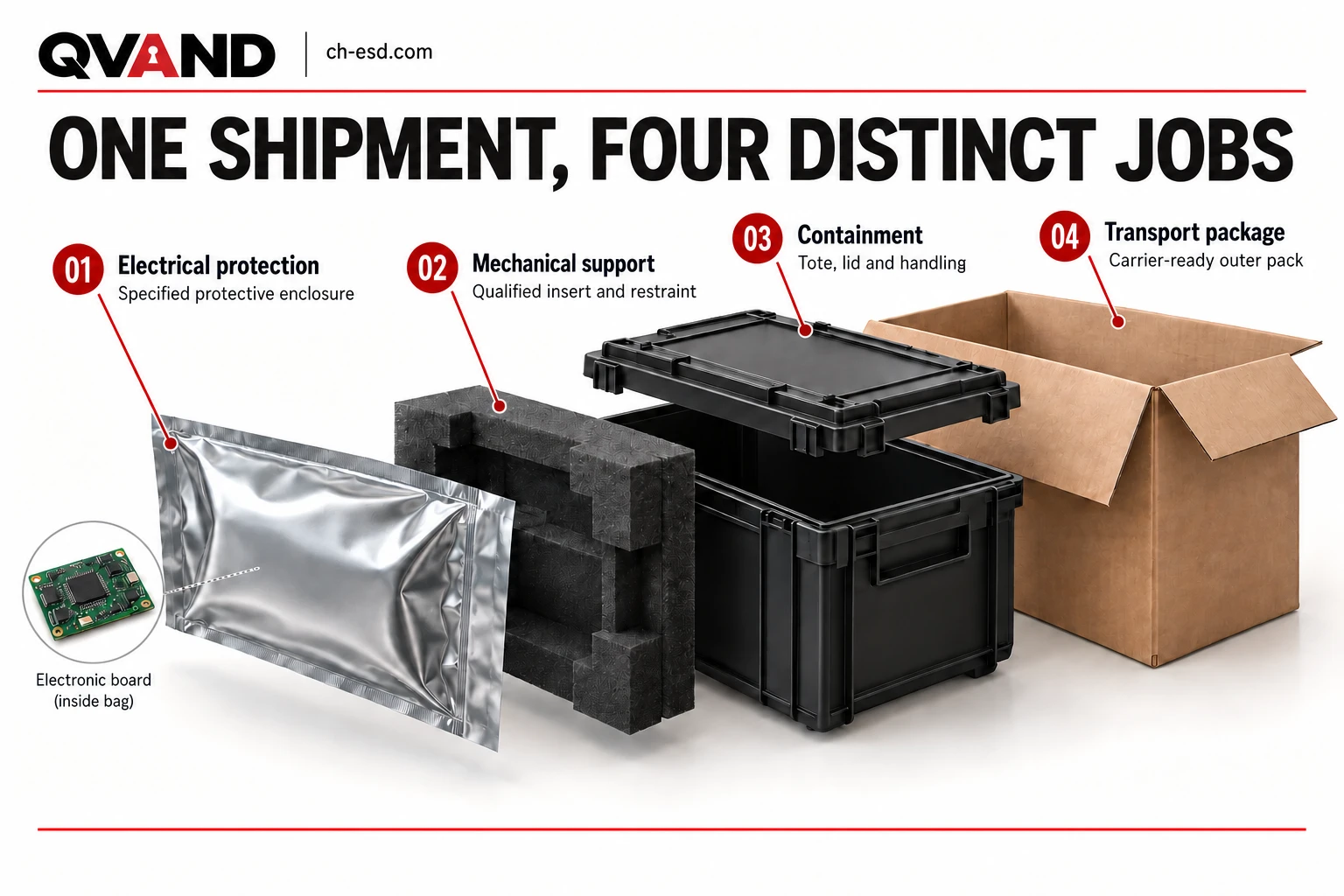
This division also makes substitutions easier to review. Replacing the tote may change clearance and handling. Replacing the bag may change the electrical protection. Moving an insert may change retention or contact pressure. Record the affected checks instead of approving all three changes under the same vague description.
3. Size ESD bags for electronics before selecting a tote
Start with the packaged object, not the bare board. Include the approved bag closure, connector protection and support features. Measure the envelope in the intended shipping orientation. The bag supplier’s stated width and length must be interpreted alongside the opening, seam and closure arrangement; a flat bag dimension is not automatically a usable three-dimensional cavity.
A mock-up answers questions that a nominal size cannot. Can the operator insert the assembly without forcing a corner against the film? Can the bag close in the specified way? Can the receiver remove the package without disturbing adjacent parts? Record the accepted orientation so the next shift does not solve the same problem differently.
For an illustrative calculation, suppose the assembly inside its closed protective package measures 300 × 200 × 90 mm. Assume support material occupies another 20 mm on each face. The packed envelope becomes 340 × 240 × 130 mm. That 20 mm is an arithmetic assumption only; it is not a tested or recommended cushioning thickness.
The QVAND ESD box range publishes the following dimensions for two named models. Their shared outside footprint hides an important difference in available height.
| Dimension or check | QD-9805316 | QD-9805318 |
|---|---|---|
| Published outside dimensions | 600 × 400 × 90 mm | 600 × 400 × 150 mm |
| Published inside dimensions | 560 × 360 × 85 mm | 560 × 360 × 145 mm |
| Illustrative packed envelope | 340 × 240 × 130 mm | 340 × 240 × 130 mm |
| Initial height comparison | 45 mm short | 15 mm remaining before accessory checks |
The taller model passes the initial height screen, but that does not approve the shipment. Its remaining length and width are 220 mm and 120 mm, so the drawing still needs a lateral-retention arrangement. Confirm clearance with the actual lid, dividers and insert fitted. Published body dimensions do not establish the free space under every optional cover.
4. Turn the selection into a useful supplier request
A supplier can respond more precisely to a small, complete specification than to a request for a “good ESD box.” Send the following information together, with one drawing or photograph identifying the packaged item.
- Contents and quantity: identify the assembly, revision, quantity per pack and whether items arrive bare, bagged or already enclosed.
- Packaged dimensions: give the measured envelope, orientation, protrusions and surfaces that must not carry a load.
- Route and opening points: identify storage, inspection, carrier handoff and the receiving location where the protective enclosure is opened.
- Required configuration: list the bag, insert, tote, cover, dividers, seals and outer carton, including who supplies each component.
- Evidence and approval: name the required documents, sample checks and person responsible for accepting a change.
Ask suppliers to separate included items from options. A quoted tote may exclude its lid, a divider set or the inner package. Comparing the complete bill of materials prevents a lower headline price from disguising a different configuration.
Keep a distinction between a supplier’s standard range and the assembly you have approved. QVAND’s published box sizes can help screen candidates; the selected combination still needs a current drawing and sample-fit review. A model name alone should not become the packing instruction.
5. ESD packaging standards: ANSI/ESD S541 and IEC 61340-5-3
ANSI/ESD S541-2026 covers packaging properties for electrostatic-discharge-sensitive items during production, transport and storage. Its requirements support the ESD control program described in ANSI/ESD S20.20. The EOS/ESD Association identifies IEC 61340-5-3 as technically equivalent to S541, giving purchasing teams a connection between these two packaging references.
For selection, connect the standard to the protective function. Low-charging behavior concerns charge generation as materials contact and separate; conductive or dissipative properties concern charge movement; discharge shielding concerns the protection supplied by an enclosure. Name the properties required for the route and identify the bag, closure and handling arrangement that provide them.
A purchase specification can then name the applicable standard, required properties, selected construction and closure. Keep the supplier’s product data and corresponding test information with that specification so repeat orders retain the same material and arrangement. This gives engineering and procurement a common description of the package being ordered.
For a semiconductor example, Texas Instruments’ SZZA047 packaging study, published in 2004, examines tube, tray and tape-and-reel arrangements. It shows how the packing format and its surrounding protective layers are considered together. The report provides technical background for that approach; the model dimensions in this guide come from QVAND’s published box range.
6. Make the packing and receiving checks repeatable
Write the sequence in the order a packer performs it. Identify the controlled loading location, orientation, enclosure closure, support placement, box closure and label position. Keep the drawing beside the component list so the operator can identify a missing or reversed part before dispatch.
For the transport layer, UPS packaging guidance calls for suitable outer packaging, cushioning and secure closure. Follow the requirements for the selected service alongside the device-specific packing plan. Neither an ESD bag nor a bench fit check establishes that the package will withstand the intended route.
Have the receiving team check the same configuration in reverse: outer damage, identity, closure condition, retention and the expected inner package. Establish what to do with a mismatch before it occurs. A receiver should not have to decide whether an unfamiliar replacement bag is acceptable while unpacking a sensitive assembly.
For returnable packaging, include empty return, cleaning, inspection and rejection in the instruction. Define acceptance criteria for worn bags, damaged inserts, broken closures and containers that no longer hold their shape. A pilot shipment can expose practical problems, but one successful delivery is not a universal reliability result.
7. Compare the cost of a complete, accepted pack
Compare quotations at the same packing quantity and configuration. Count the required bag, support, container, accessories and outer pack. Then record loading time, inspection work and any empty-return process separately. This creates a useful cost comparison without assuming that a cheaper individual component produces a cheaper shipment.
Use a sample trial to compare packing time and handling steps. Ask a packer to load the sample, close it, apply the identification and prepare it for dispatch. Record where the instruction is unclear and where extra handling is needed. Repeat the exercise after a proposed change so the comparison concerns the configuration actually being purchased.
For a returnable system, state who collects empties, checks their condition and replaces rejected components. Keep measured cycle information distinct from a supplier’s estimated service life. Procurement can then compare the accepted arrangements with their assumptions visible, instead of treating purchase price, reuse and protection as interchangeable benefits.
8. Questions buyers ask about anti-static packaging
Are anti-static bags and static shielding bags the same?
The names should not be treated as interchangeable evidence. Ask what properties the particular construction provides, how it must be closed and where it is intended to be used. Select against the documented requirement for the item and route. A familiar color or marketing term is not enough to approve a substitute.
Are pink anti-static bags enough for shipping?
Pink color does not establish shielding performance. Check the specified properties and the complete protective enclosure required outside the controlled area. If the proposed bag only addresses charge generation, that does not answer the shielding question. Record the approved construction so purchasing can distinguish it from a visually similar alternative.
Is bubble wrap anti-static?
Do not assume ordinary bubble wrap has the electrical properties your process requires. If a proposed wrap is intended to provide electrical protection as well as cushioning, request evidence for those functions. If it is used only outside a qualified protective enclosure, document its mechanical role and verify the completed arrangement.
What should I check in an anti-static bag for a GPU?
Follow the device maker’s packing or return instructions first. Check usable size, closure, connector protection, puncture risk and support for the complete assembly. A bag around a heavy graphics card does not by itself control movement or loading on projecting parts. Keep the inner package and the outer support arrangement in the same packing record.
Can a rigid ESD box replace the bag?
Only when the specified enclosure provides the required protection for that application and its use is supported by evidence. A conductive material description alone does not settle shielding, cushioning, closure or moisture requirements. Treat removal of an approved inner bag as a configuration change that needs review.
Can ESD bags be reused?
Use the supplier’s instructions and your approved inspection criteria. Examine closure condition, punctures, abrasion, contamination and identification. Do not create a universal reuse count from appearance alone. A reusable tote and a reusable inner package may need different inspection and replacement rules.
About QVAND / Quandun
QVAND / Quandun supplies ESD storage and handling products through ch-esd.com. The company, Wenzhou Quandun New Material Technology Co., Ltd., publishes a range of boxes, bins, trays, magazine racks, racks and trolleys for electronics workflows. For a container enquiry, provide the packaged dimensions, quantity, handling route and required evidence so the discussion starts with a specific configuration.
Approve a configuration your next shift can repeat
A useful anti-static packaging decision ends with an identifiable bag, support arrangement, container and handling instruction. Keep their revisions together. When the device, closure, insert or route changes, identify which checks must be repeated before releasing the next shipment. That record gives purchasing, production and receiving a shared definition of what was approved.



-

 Resources5 years ago
Why Companies Must Adopt Digital Documents
-

 Resources4 years ago
A Guide to Pickleball: The Latest, Greatest Sport You Might Not Know, But Should!
-

 Resources1 year ago
50 Best AI Free Tools in 2025 (Tried & Tested)
-

 Resources1 year ago
Get Paid $5000+ a month to write : Discover 30 Spectacular Websites That Reward Your Writing Effort