News
Keyword Clustering for SEO: Content Architecture That Earns Rankings


Picture an email marketing blog that published straight from a keyword list for a year. Four posts answer welcome-email questions from slightly different angles. A search for “welcome email examples” brings up two of those posts, one at position eight and one at twelve, and which one ranks higher changes with the week. Nobody planned the overlap. The list simply never told anyone it was there.
Keyword clustering is the planning layer that prevents exactly this. This article explains what clustering does for SEO specifically: how it removes self-competition, how it builds topical depth search engines can see, and how it hands your internal linking a structure to replace guesswork. The operational walkthrough stays short on purpose, because the value lives in the architecture, and that is where we will spend the words.
Why keyword clustering matters for SEO
Sites that publish keyword by keyword run into two structural problems, and both trace back to the same source.
The first is cannibalization. Related searches get their own pages, the pages overlap, and they start taking visibility from each other while competitors keep theirs. The second is shallow coverage: a flat list hides the shape of a topic, so whole subtopics go unwritten while near-duplicates multiply. Both problems surface later, in wobbling rankings and plateauing traffic.
Clustering intervenes at the point where it is still cheap: before anything is written. It decides, once and in one place, which searches share a page and which deserve their own. Every publishing decision that follows inherits those decisions, with no need to reopen them.
What keyword clustering actually is
Clustering sorts a keyword list into sets that a single page can satisfy together. A cluster for “welcome email examples” might also carry “welcome email template,” “welcome email ideas,” and “how to write a welcome email,” because one thorough page can serve all of those searches with one intent. Working from clusters, the page title almost writes itself, and so does the redirect question that haunts merged posts later: it never comes up.
The difference from a keyword list is the difference between raw material and an executable unit. A list row tells you a search exists. A cluster tells you what to build: the page’s primary keyword, the supporting terms it should also rank for, the intent it must match. Content plans get built out of the second thing.
How clustering strengthens your SEO
Three mechanisms carry the value, and they compound: the first protects the rankings you already earn, the second widens the ground you compete on, and the third moves value between your pages on purpose instead of by accident.
It ends cannibalization before it starts
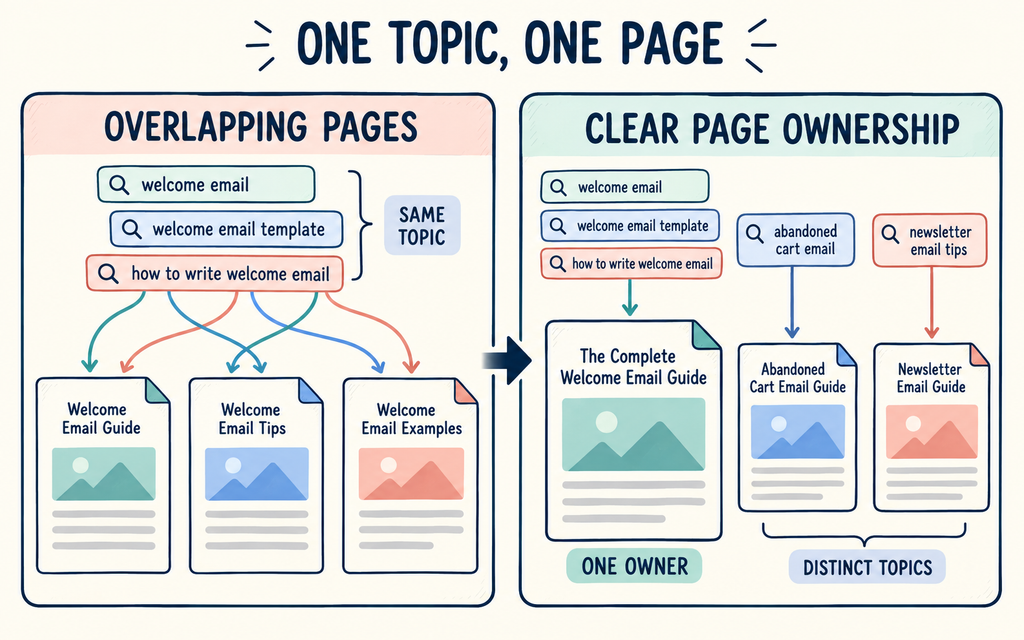
Related searches gain one clear page owner while distinct topics keep their own pages.
When two of your pages target overlapping queries, they split everything a page needs to rank: the clicks, the backlinks, the engagement signals, the clarity about which URL is the answer. Search engines respond by alternating between your pages, sometimes ranking one, sometimes the other, settling on neither. This is keyword cannibalization, and clustering is the cheapest place to prevent it, before the pages exist rather than after. Consolidating those searches into one page concentrates every signal on a single URL, which is why the ranking stops wobbling. The welcome-email example makes it concrete: one thorough page targeting “welcome email examples” and its variants collects every click, link, and mention the topic attracts, and competes only with other sites.
Fixing the same problem after publishing costs more. Merging posts means redirects, lost backlink targets, and retraining whatever both pages had earned. The cluster decision made at planning time costs a conversation with your spreadsheet.
It builds topical authority you can audit
A cluster is a complete map of one subtopic’s searches, so publishing cluster by cluster is how a site covers a subject systematically, while a list-driven site covers whatever the calendar happens to surface. Search engines evaluate whether a site covers a subject thoroughly, and clusters make that coverage something you can plan, count, and finish.
The auditability matters as much as the depth. Gaps that were invisible in a 600-row list become visible as unfinished clusters: three of five email marketing subtopics published, two still open. When a competitor covers all five and you cover three, the cluster view shows you exactly where the distance is, page by page, before the rankings announce it. Your content backlog turns into the remaining distance to complete coverage, which is a very different thing to manage than a queue of random keywords.
It gives internal links a spine
Clusters map naturally onto a pillar and cluster architecture. One pillar page covers the broad topic, email marketing in our running example, and each cluster page covers a subtopic in depth: welcome emails, segmentation, deliverability. Cluster pages link up to the pillar and sideways to siblings, and the pillar links down to every cluster.
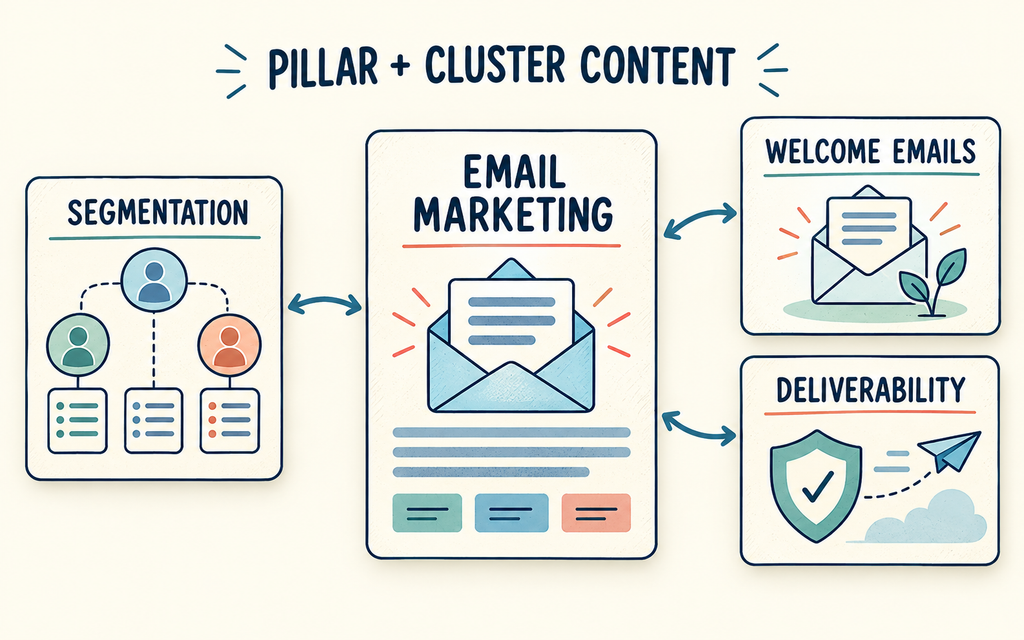
The broad email marketing pillar connects to three focused supporting pages.
Link equity concentrates where you want it, on the pillar pages competing for the biggest terms. When the welcome-email cluster page earns links, that authority flows up to the email marketing pillar and out to its sibling clusters, so one strong page ends up strengthening a whole section of the site. Readers get a path through related articles rather than a dead end. The internal linking decision itself also leaves your publishing checklist, because the structure already says what links to what.
The signals clustering uses: intent, semantics, SERP
Clustering judgment rests on three signals, worth knowing even in a value-focused article. Search intent separates audiences: “email marketing tips” and “email marketing software” want different pages. Semantic similarity groups the phrasings of one ask: examples, templates, and ideas for welcome emails belong together. SERP overlap settles the close calls, and it is the most persuasive of the three because the answer comes from Google itself: when the same URLs rank for both terms, the searches share a topic, whatever the wording suggests.
Running these checks by hand works at small scale and decays quickly as lists grow. Most teams eventually let a tool take the first pass and keep the judgment for themselves.
Clustering keywords in practice
The practical workflow compresses to three moves. Export your keyword research into one CSV. Run it through a clustering tool that groups by meaning and intent; SEMagi, which we build, does keyword clustering across an uploaded list and returns editable candidate clusters, never a black-box verdict. Then edit the candidates with your own context, because no algorithm knows that your audience says “automation” when the industry says “workflows,” or that two clusters look identical to a similarity score but serve different sales stages.
That review pass deserves real time. It is where a generic grouping becomes your grouping, and it is the reason the tool’s speed turns into planning depth rather than into fast mistakes.
From clusters to published content
A finished cluster is already most of a content brief. The primary keyword names the page, the supporting keywords suggest the sections, and the intent fixes the angle. What remains is the writing, which is where content plans usually stall: a plan of fifty clusters with writing capacity for a fraction of them.
This is the stage where drafting support earns its keep. Because the cluster contains the brief, you can draft each cluster into a structured article outline: the outline’s sections reflect the searches in the group, so a heading exists for every query the page is meant to answer. Adjust that outline while it is still cheap to change, promote a section, cut a weak one, and only then generate the prose. The first draft arrives shaped like the search demand rather than like a blank page, and the outline it came from doubles as your checklist for whether the finished page covers its cluster.
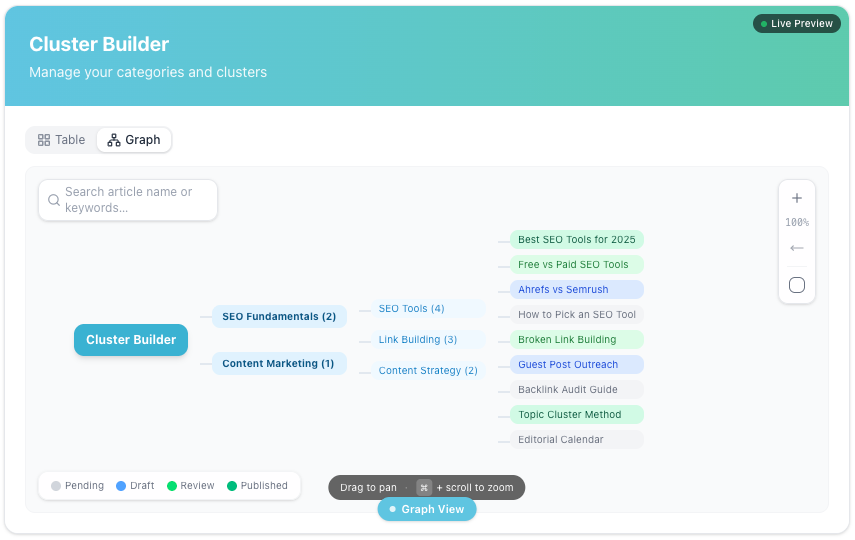
There is a batching benefit worth noticing. Clusters that share an intent can be drafted in one working session, and the voice stays consistent across the set because the briefs arrived in the same shape.
Editing stays human, deliberately. Verify the facts, put your own experience behind the claims, and cut the generic sentences a language model reaches for first, because those are the lines readers and search engines both skim past. A sentence like “timing matters in email marketing” earns nothing; your own sending data, or a hedged version of it, earns a reason to stay. Drafting support compresses the blank-page hours; it does not remove the judgment that makes content worth ranking. A team publishing four articles a quarter can work through a far larger plan on this pattern, honestly, with a human deciding what ships.
Conclusion
Handled this way, a keyword list becomes an architecture: one cluster per page, one pillar per topic, internal links that follow the structure, drafts that start from the cluster’s own brief. It is a modest amount of upfront work that every later stage inherits. The whole pipeline, from the first cluster to the published draft, is what we built semagi.com to run.


-

 Resources5 years ago
Why Companies Must Adopt Digital Documents
-

 Resources4 years ago
A Guide to Pickleball: The Latest, Greatest Sport You Might Not Know, But Should!
-

 Resources1 year ago
50 Best AI Free Tools in 2025 (Tried & Tested)
-

 Resources1 year ago
Get Paid $5000+ a month to write : Discover 30 Spectacular Websites That Reward Your Writing Effort