
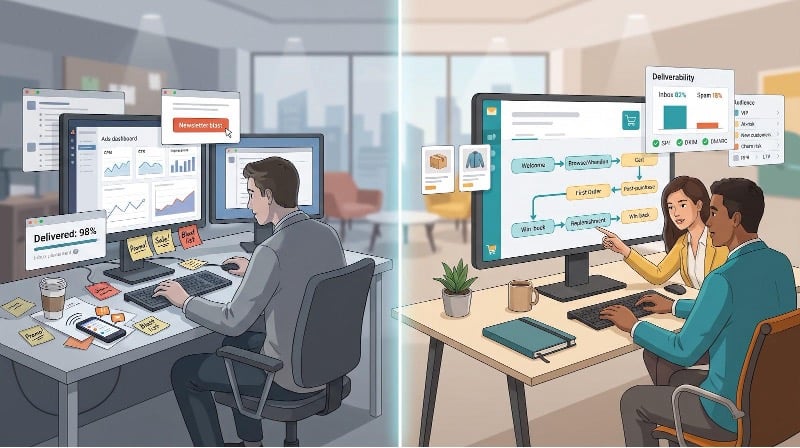
Your ads agency can blast newsletters, yet repeat orders lag and spam flags climb. Email now needs specialist care: airtight deliverability, AI-tuned timing, and a lifecycle strategy deeper than a promo calendar.
A dedicated retention shop masters six essentials: lifecycle mapping, inbox placement, behavior-based data, email-native production, transparent measurement, and a named team. Demand evidence: journey maps, seed tests, live segments, QA logs, and holdout results. The higher scorer earns the inbox.
InboxArmy centers on email and SMS, running automation, templates, migrations, and deliverability.
How to compare a specialist with your ads agency
You don’t need award logos or staged highlight reels; you need proof that a partner runs email as a profit engine every day.
Proof lives in hard artifacts: journey maps that trace every touch, inbox-placement logs that reveal where messages land, cohort reports that link sends to repeat orders, and team charts that show who owns each task. Anything less drifts into marketing theater.
Score evidence, not promises
Rate each provider 0 to 5 for every test (0 when a capability is absent; 5 when they share live examples you can open now). The higher total keeps the inbox.
Treat each test as a checkpoint. Award 0 when a capability is missing, 2 or 3 when it only functions, and 5 when the team screenshares live dashboards. Both your ads agency and any specialist start with the same blank grid; the higher tally wins custody of your customer inbox.
Ask for screenshots, timestamps, and a named owner for every task. Nothing else counts. Ignore the usual smoke screens:
- Partner badges without context
- Open-rate screenshots
- Logo walls
- “98 percent delivered” claims that skip inbox placement
Cold proof beats warm promises; documentation starts now. In Sinch Mailgun’s 2026 Email Impact Report, only a quarter of senders used seed mailbox tests to see where their mail lands, one reason to keep the bar high.
1. The lifecycle depth test
Why lifecycle depth drives repeat revenue
Picture two stores that send the same number of emails, yet one earns nearly double the revenue. The difference is not clever copy or steeper discounts; it is depth: automated flows that trigger when a shopper abandons a cart, places a first order, or approaches a replenishment window.
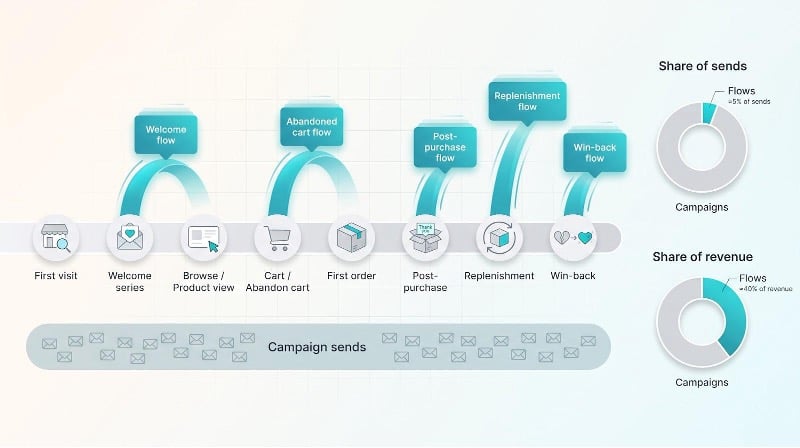
Klaviyo’s 2026 benchmark shows flows make up 5.3 % of sends but 41 % of email revenue. Omnisend, tracking 150 000 brands, echoes this curve: 2 % of email sends are automations, yet they drive 30 % of revenue and earn 16× more per send than campaigns. Both data sets point to one truth: without a mapped, evolving lifecycle (from welcome to win-back), you leave money on the table.
For more on re-engagement, see Startup.info’s guide to win-back email tactics.
What to ask for
- Current lifecycle map and flow inventory
- Revenue per recipient for flows vs. campaigns
- Date of the last optimisation for each core flow
- Plan to shorten time-to-second-purchase and lift repeat-order rate
Score 0 if no map exists, 3 if flows run but lack optimisation data, and 5 if the team can screen-share live journeys, metrics, and a testing backlog.
If a partner cannot map, build, and refine a full journey, your list leaks profit. This test forces each contender to prove depth in real time.
2. The inbox-placement test
An email that lands in spam is an ad that never loads; it earns nothing. Yet many agencies flaunt a “98 % delivered” banner. Delivered only means the mailbox accepted the message; it says nothing about the Primary tab.
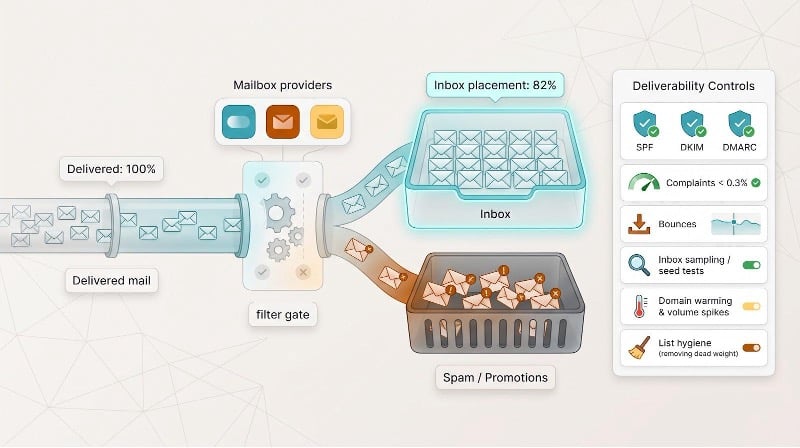
Sinch Mailgun’s 2026 Email Impact Report found that 40% of senders name staying out of spam as their biggest deliverability challenge, yet only a quarter run seed mailbox tests to see where mail actually lands.
Mailbox providers have tightened the screws. Google and Yahoo now require bulk senders to authenticate with SPF, DKIM, and DMARC, and Microsoft announced similar rules in 2025. Keep spam complaints under 0.3 % and offer one-click unsubscribe. Break the rules and reputation slips; revenue soon follows.
Ask every contender to open its deliverability toolkit:
- Live authentication audit with domain alignment
- Complaint, bounce, and reputation dashboards, each with a named owner
- Inbox-placement sampling or seed tests, not just acceptance rates
- Warming plan for new domains plus a volume-spike protocol
- List-hygiene policy that removes dead weight before mailboxes do
Score 0 if the reply is “we monitor deliverability,” 3 when sample dashboards appear, and 5 when the team shows the changelog from its last Gmail-reputation recovery. These points roll into the 100-point scorecard; fail here and the decision is already made.
3. The data activation test
Raw send volume rarely builds loyalty; context does. A specialist retention partner wires every insight your store provides (product views, purchase history, average order value, margin, subscription status, even open support tickets), then uses those signals to power live segments that refresh the moment behavior shifts.
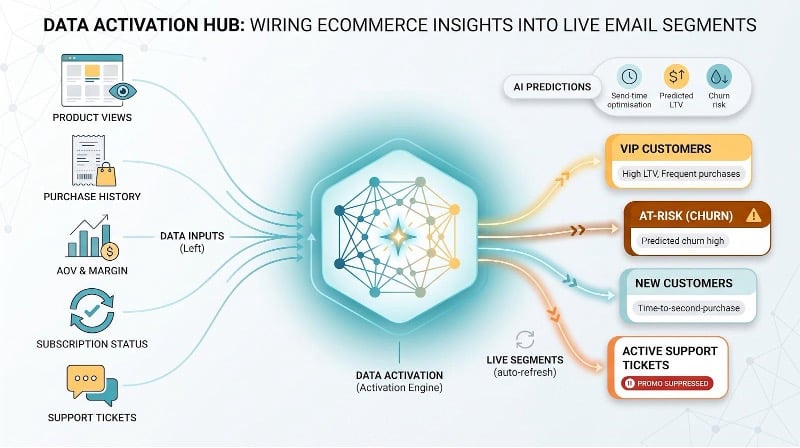
Klaviyo’s 2026 benchmarks show why relevance matters: flows earn more than three times the click rate of campaigns (5.58% vs. 1.69%), and AI product recommendations lift email click rates to 3.75% on average.
Contrast that with “Hi {first_name}” blasts filtered only by gender. Without behavioural filters, discounts swell, unsubscribes rise, and your logo fades into background noise.
What to ask for
- Five real-time segments built from store data, shown live, not in slides
- Revenue per recipient by segment versus the global average
- Suppression logic that pauses promos during open service tickets
- A roadmap for AI predictions: purchase timing, lifetime value, churn risk
Score 0 if segmentation stops at first name, 3 when behaviour-based lists exist but lack optimisation data, and 5 when the team shows live segments, performance deltas, and suppression rules that protect profit.
For broader retention and revenue metrics, see Startup.info’s guide to retention and revenue metrics.
4. The email-native production and QA test
Your ads-agency designer can crop a Facebook image in minutes, yet that skill will not stop Dark Mode from turning hero text invisible. Email lives in a picky ecosystem of rendering quirks, accessibility rules, and mailbox limits. Treat it like generic creative and you invite broken links, unreadable fonts, and spam-triggering code.
Speed adds danger: the faster a team ships, the more a missed Dark Mode render or a broken link costs. Fast cycles demand strict QA.
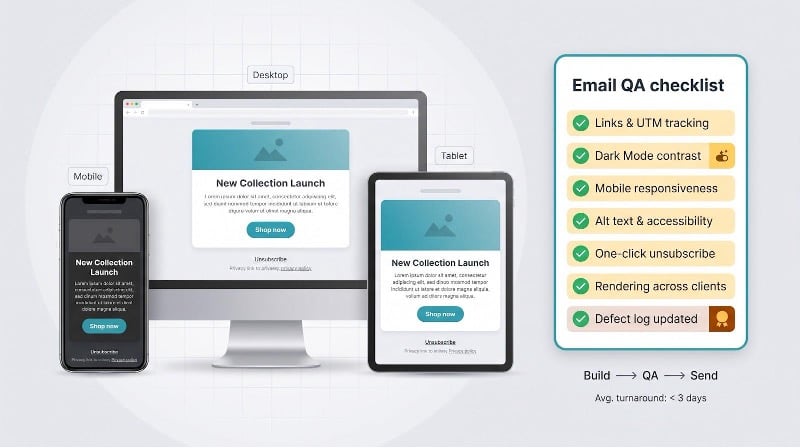
A specialist shop follows its own playbook. Copy, design, and HTML development sit shoulder to shoulder under a production lead who hunts defects before send. Every message clears a pre-flight of mobile responsiveness, colour contrast, live-text ratio, link tracking, one-click unsubscribe, and accessibility checks.
What to ask for
- Time-stamped renders in Gmail (light and dark) and Apple Mail
- The shared QA checklist showing who signs off on copy, code, links, and accessibility
- Average production turnaround and defect rate over the past quarter
- The fix log from the last rendering issue and the preventive change that followed
Score 0 if one multitasker juggles ten accounts, 3 when basic QA exists but lacks data, and 5 when the team shows live checklists, renders, and defect metrics that prove they can move fast without breaking the inbox.
5. The measurement truth test
Dashboards flatter. Shorten the attribution window or remove Apple-privacy opens and email’s “half-the-store” revenue claim can fall by double digits overnight. Finance will still ask: what profit did email actually create?
Klaviyo credits email with orders placed within an attribution window after an open or click; narrow that window and platform-credited revenue falls, so lock the window before you compare partners.
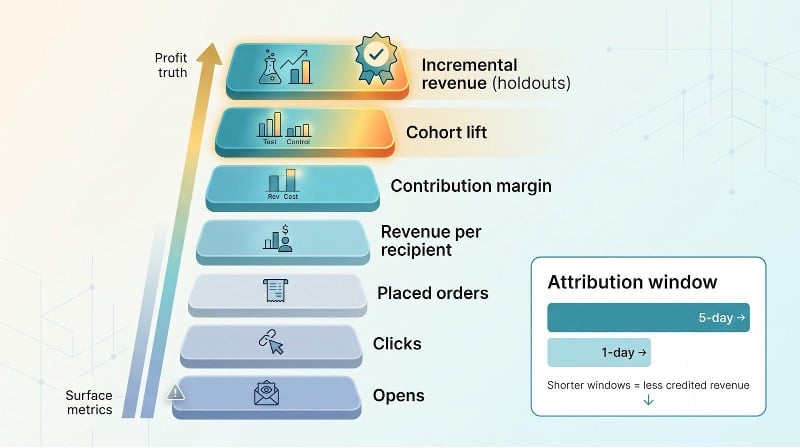
The measurement ladder
- Opens
- Clicks
- Placed orders
- Revenue per recipient
- Contribution margin
- Cohort lift
- Holdout-test incremental revenue
A specialist reports at every rung and explains which KPI protects profit, while a generalist stops at screenshots.
What to ask for
- Revenue per recipient and margin by cohort
- Attribution-window sensitivity analysis (a long window vs. a short one)
- Proof of holdout or other incrementality tests
- Reconciliation of ESP, store, and ad-platform revenue to avoid double credit
Score 0 when the reply is “that’s what the platform shows,” 3 when basic RPR exists, and 5 when the team opens live holdouts and margin-adjusted dashboards.
6. The team economics and accountability test
Retention depends on human hours, know-how, and disciplined weekly execution, not the retainer alone. Begin with the full equation:
Agency fee + software + your internal management time + ad-hoc freelancers + error risk = true channel cost.
The headline retainer can look small next to the hidden line items. Every hour your team spends briefing and correcting an understaffed partner belongs in that equation too.
What to ask for
- Staffing chart: names, roles, senior hours per month, backup coverage
- Campaign and flow capacity per week during peak season
- SLA for copy, design, and QA turnarounds plus escalation path
- Fully loaded cost per incremental dollar (show the math)
- Contract clauses confirming you keep ESP logins, domains, templates, data, and test results
Score 0 if the reply is “we’ll figure that out,” 3 when partial details surface, and 5 when the agency shows capacity models, cost math, and exit terms that leave you owning every asset.
When your ads agency’s email service is good enough
Specialisation is powerful, yet splitting channels is not always required. Sometimes your paid-media partner already delivers the depth email needs, and adding another retainer would only build a silo.
Keep email under the same roof when the evidence supports it:
- Automations hum and generate at least the 30 % of email revenue Omnisend’s 2026 report finds on average.
- Inbox placement stays strong in seed tests, with spam complaints well under 0.3 %.
- Repeat-purchase revenue climbs quarter after quarter.
- The agency assigns a lifecycle strategist, deliverability lead, and copy-design duo who meet with you weekly and show flow maps updated within the last 90 days.
Early-stage stores (think fewer than 10 000 subscribers or fewer than 1 000 orders a month) often gain more from one integrated crew that syncs creative, offers, and budgets in real time than from two firms trading tickets.
Run the six-test scorecard: if your ads agency scores 70 points or more and has a plan to close any remaining gaps, the switch cost can outweigh specialist upside. Use that saved energy on creative tests, product launches, or new markets instead of extra hand-offs.
Score both providers before you decide
Words can blur; numbers reveal. Duplicate the 100-point scorecard in your planning doc and rate each agency across the six tests.
| Factor | Weight | Your 0-5 rating | Weighted score |
| Lifecycle strategy | 20 | ||
| Deliverability | 20 | ||
| Data activation | 15 | ||
| Production & QA | 15 | ||
| Measurement truth | 20 | ||
| Team economics | 10 | ||
| Total | 100 |
How the math works: a rating of 3 for lifecycle earns 3 ÷ 5 × 20 = 12 points. Fill every cell, add the totals, and compare providers side by side.
Interpret the sum:
- 85 to 100 Owns the channel with confidence
- 70 to 84 Viable; document gaps in the contract
- 55 to 69 Consider a specialist audit or hybrid model
- Below 55 Email is likely an add-on; look elsewhere
Evidence drives this exercise. Award points only when you see screenshots, logs, and named owners for each task; badge walls and open-rate slides do not count.
Copy the scorecard above and put both teams on the clock. Your future revenue rides on honest numbers.
Questions to ask before signing
Smart contracts begin with sharp questions. They expose blind spots early, save weeks of back-and-forth, and set the tone for a transparent partnership. Use the six tests as your compass, press for specifics, and record every answer.
Lifecycle & data
- Who owns lifecycle strategy each week, and how many other accounts share that person?
- When was every core flow last rebuilt or A/B-tested?
- Which customer data powers segmentation, and who maintains those feeds?
Inbox placement & production
- How do you track inbox placement beyond delivery rate?
- Which email clients, Dark Mode, and accessibility checks appear in your QA cycle?
- What is your SLA for resolving deliverability incidents?
Measurement
- Which attribution model and time windows will we lock before reporting revenue?
- How will you measure incremental lift: holdouts, matched cohorts, or both?
Team & cost
- Show the roster: names, roles, senior hours per month, backup coverage.
- Which tasks are subcontracted, and how is quality audited?
- Who controls the ESP account, sending domains, templates, and raw data?
Performance & escalation
- Which leading indicators must improve by day 30, 60, 90, and what happens if they stall?
- What red flag would make you advise us not to hire you?
- Walk us through your escalation path during peak season.
Conclusion
Choosing an email partner is about proof, not labels. The six tests you just read (lifecycle depth, inbox placement, data activation, production rigour, measurement truth, and team economics) turn gut feel into numbers.
If your ads agency scores 85 or more on the 100-point card, enjoy the efficiency of one integrated crew. If it lands under 70, a specialist can strengthen lifecycle revenue, deliverability, or measurement before weak links erode margin.
Either outcome lifts email from “nice-to-have” to must-optimise, fueling smarter acquisition, stronger retention, and sustainable ecommerce growth.
Copy the scorecard above, schedule discovery calls, and put each agency on the clock. Your customers’ inboxes and your bottom line are waiting.

Author: Kokou Adzo
Kokou Adzo is the editor and author of Startup.info. He is passionate about business and tech, and brings you the latest Startup news and information. He graduated from university of Siena (Italy) and Rennes (France) in Communications and Political Science with a Master's Degree. He manages the editorial operations at Startup.info.