Blogs
Top Google Review Management Software for Growing Businesses

One unanswered bad review can drive away more customers than a dozen glowing ones bring in. For teams expanding across multiple locations – or the agencies managing them – keeping Google reviews current and responded to is a time challenge as much as a reputation one. Picking the right tool from the available top Google review management software options determines how quickly that reputation builds.
Why Google reviews matter for growing businesses
Google Business Profile is where most purchase decisions get confirmed or abandoned. According to a 2024 BrightLocal consumer survey, 98% of people read online reviews for local businesses, and Google is the first place they look. A stale profile with few reviews, or reviews left without a response, signals neglect. A live, well-managed profile signals the opposite.
The math gets harder as businesses grow past a single location. Every new location means more reviews, more response work, and more chances for an unanswered comment to sit in public view. That’s where AI-powered review management for Google stops being a nice-to-have and becomes a genuine operational necessity. The five platforms below cover a range of approaches, from lean automation tools to full enterprise reputation suites.
1. Reviewly AI
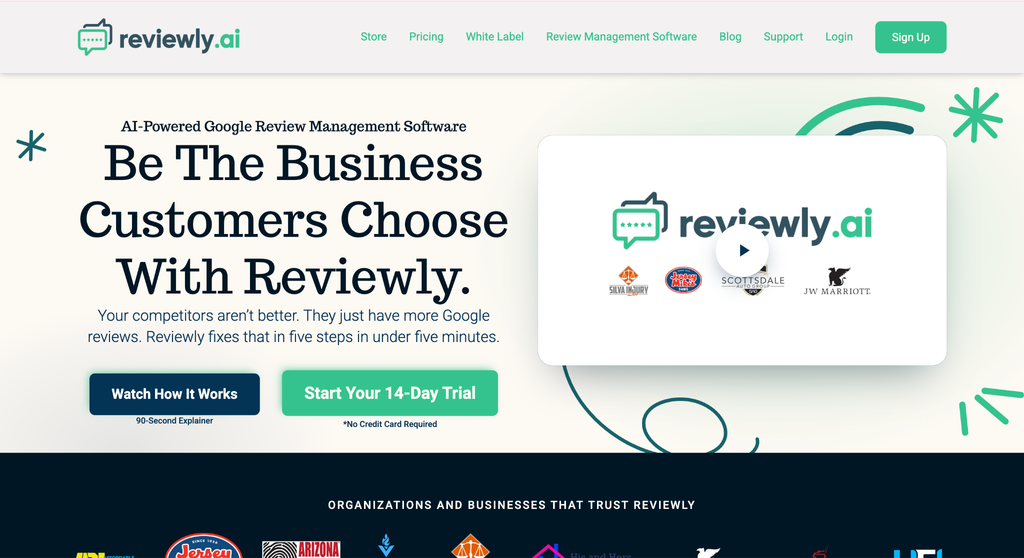
Reviewly AI is an SMS-first, Google-exclusive review management platform that automates both the request side and the response side of the review cycle, built for local service businesses and marketing agencies.
- What it does: Sends customers three AI-drafted review options by SMS through a dedicated Twilio number; company-reported SMS open rate is 97 to 98%.
- AI responses: Generates business response drafts that reference the specific service, location, and customer experience, not a generic acknowledgment.
- Agency layer: Full white-label at the base agency plan ($199/month for up to 50 client locations), including branded dashboard, subdomain, Stripe billing, and clone-and-deploy client setup, no white-label upsell required.
- Offline capture: NFC Reviewly Smart Cards and branded QR web channels handle walk-in customers who don’t always share a phone number at the door.
- Pricing: Starts at $99/month per location; 14-day free trial on the single-location plan. Three-click setup in roughly 90 seconds; one-way SMS review requests available in 100-plus countries after the Spring 2026 release, with automatic AI language detection. Integrations include Stripe, Zapier, HubSpot, GoHighLevel, QuickBooks, and Jobber; HIPAA compliance available for regulated verticals.
Consideration: Reviewly’s AI-powered review management for Google automatically categorizes and responds to customer feedback, helping businesses maintain a consistent brand voice across hundreds of reviews without manual oversight.
2. Rayyan
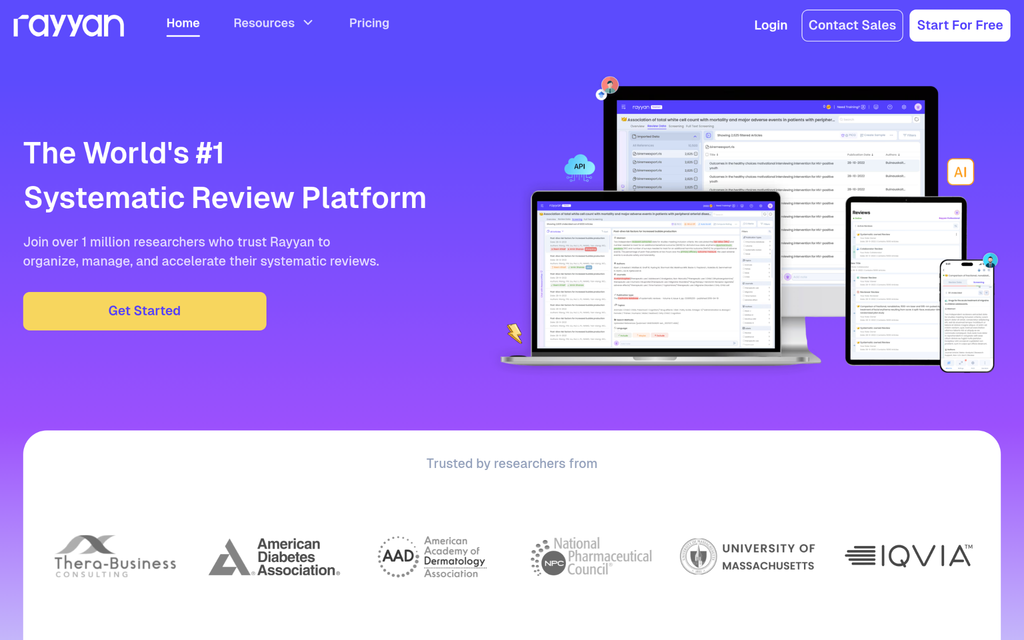
Rayyan is a collaboration platform built for systematic literature reviews, using natural language processing and machine learning to help research teams screen and extract evidence from published studies.
- What it does: Automated deduplication of references, PICO extraction (Population, Intervention, Comparison, Outcome), and AI agents that assist teams with article screening and data extraction. Used by over 300,000 researchers across 180 countries, with more than 700 million research articles reviewed on the platform. The platform reports reducing screening time by up to 90% for review teams.
- AI responses: Rayyan’s AI agents generate screening recommendations and data extraction outputs for academic literature rather than business-facing response drafts; no business response generation exists in the platform.
- Agency layer: Rayyan has no agency or white-label layer; it is a research collaboration tool for academic and evidence-based medicine teams.
- Offline capture: The platform functions as a SaaS web and mobile tool that works offline for article screening; it has no customer-facing offline capture mechanism.
- Pricing: Pricing details are not publicly listed; teams evaluating Rayyan should contact the vendor directly for current plan information.
Consideration: Rayyan’s core use case is systematic academic literature review, which sits in a completely different category from Google Business Profile reputation management. Teams evaluating it for Google review purposes won’t find it built for that workflow at all. It’s included here because its AI-assisted review processing capabilities reflect the broader sense of the term “review management.”
3. MagicReview
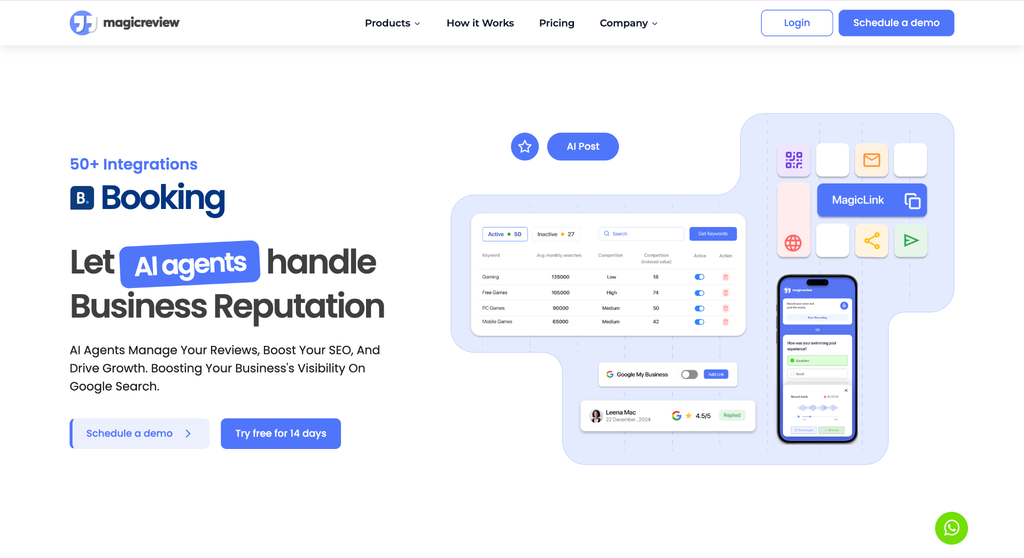
MagicReview is a review collection platform that combines QR-code-triggered flows with automated, SEO-friendly review suggestions, designed to funnel positive sentiment to Google while routing lower-rated feedback privately.
- What it does: Customers scan a Google Reviews QR code, select a rating from 1 to 5 stars; 4 and 5-star selections generate AI-drafted, SEO-friendly review suggestions the customer can post directly to Google. Ratings below 3 stars redirect to a private form sent to the business owner’s dashboard, keeping that feedback out of the public review stream. Founded in 2020 by Saurabh R. Patil and Abdul Nihaf; trusted by 30-plus businesses across multiple industries.
- AI responses: AI-drafted review suggestions are generated for customers selecting 4 or 5 stars; the platform does not publicly document AI-generated owner response drafts.
- Agency layer: No agency or white-label layer is publicly documented.
- Offline capture: QR codes serve as the primary offline capture mechanism for walk-in or in-person customers.
- Pricing: Detailed pricing, headquarters location, team size, and client case studies are not publicly documented. Businesses evaluating MagicReview should request a direct demo to confirm current feature availability and pricing tiers.
4. Repmanager
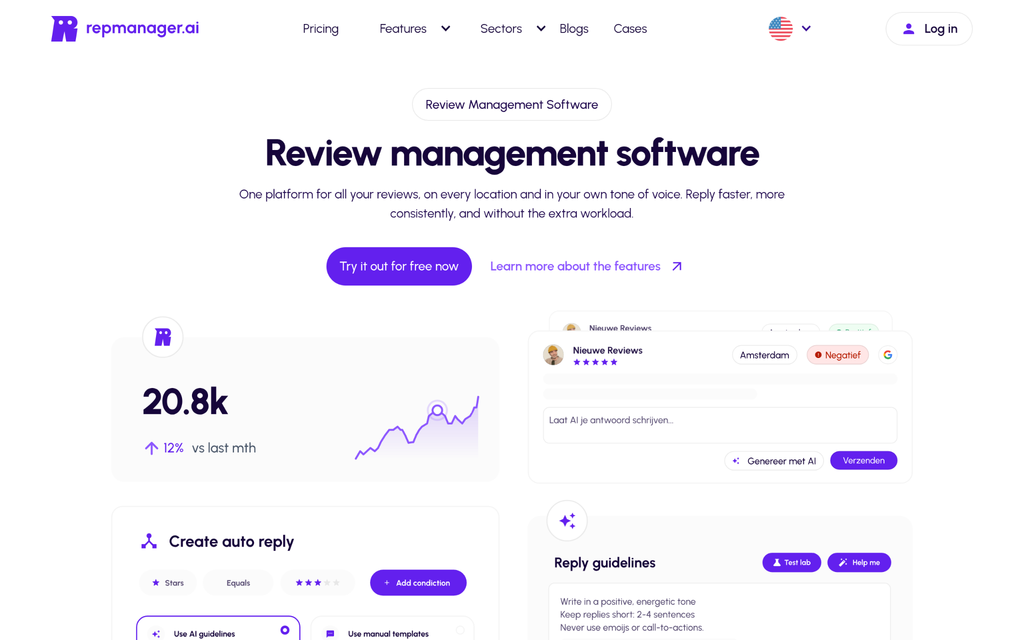
Repmanager is a Google review management platform for multi-location businesses, consolidating reviews into a single dashboard with AI-assisted sentiment analysis and customizable response drafts.
- What it does: Centralizes Google Reviews across all locations in one view; AI-based sentiment analysis categorizes incoming reviews and suggests response drafts based on tone and content. Target verticals include franchises, retail chains, automotive dealers, and hospitality businesses where local reputation is tied directly to foot traffic. Founded in 2024 and based in the Netherlands; beta access users rated it 4.8 out of 5 stars.
- AI responses: AI-based sentiment analysis categorizes incoming reviews and suggests response drafts based on tone and content.
- Agency layer: Pro tier supports multi-location businesses and agencies with performance comparison and actionable reports; no public documentation of white-label capabilities.
- Offline capture: No offline capture mechanism is publicly documented.
- Pricing: Starts at $10/month; Basic tier covers single-location management, Pro tier supports multi-location businesses and agencies. 7-day free trial providing access to 1 location and 25 AI replies; monthly subscription, cancellable anytime with no automatic renewals.
Consideration: Repmanager was founded in 2024, and the platform is still relatively early-stage, and its long-term enterprise track record is limited.
5. Reputation
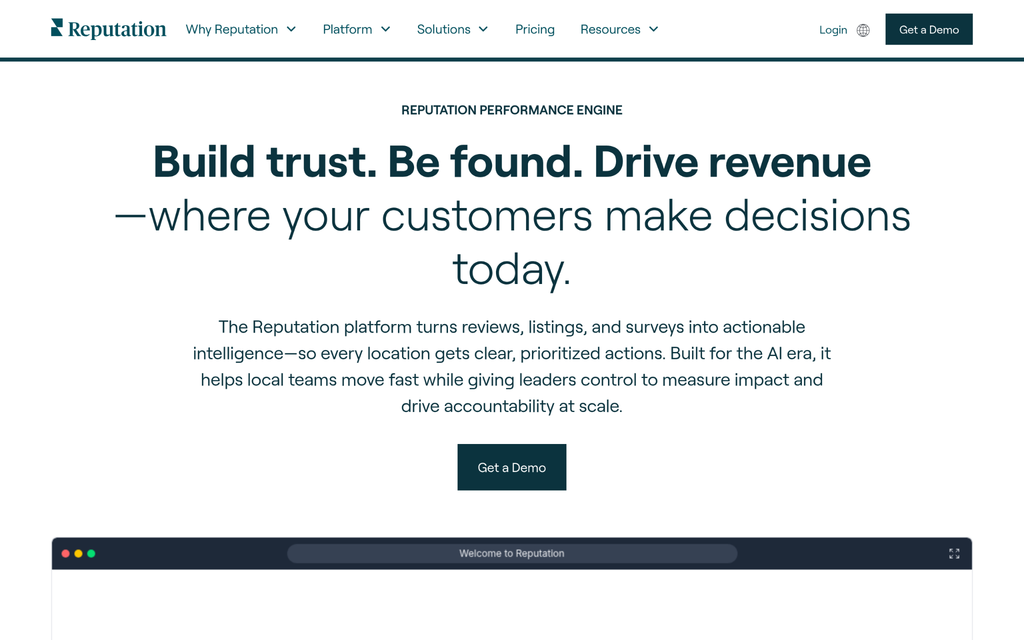
Reputation is an enterprise-grade online reputation and customer experience management platform serving large multi-location organizations, with tools spanning review monitoring, social media, surveys, and sentiment analysis.
- What it does: Serves major enterprise accounts including Banner Health, BMW, Ford Motor Company, Hertz, and General Motors; approximately 750-plus enterprise customers across 77 industries. Founded in 2006 (originally as ReputationDefender); headquartered in San Ramon, California; 716 employees.
- AI responses: AI-assisted response drafting and sentiment analysis are part of the platform’s review management toolset across enterprise deployments.
- Agency layer: No agency white-label layer is publicly documented; the platform is built for enterprise-scale deployments.
- Offline capture: No offline capture mechanism is publicly documented.
- Pricing: Pricing is contract-based; growing businesses with one to five locations may find the pricing and setup scope larger than their immediate needs warrant.
Consideration: Ranked #1 in 26 G2 reports, including Enterprise Grid for Online Reputation Management and Local SEO; holds 500-plus Leader Badges since 2018. Caraday Healthcare grew review volume by 200% and improved its Reputation Score by 217 points in one year; Intermountain Health tripled organic leads and grew review volume by 510% in one year. Growing businesses with one to five locations may find the pricing and setup scope larger than their immediate needs warrant.
What to look for in a review management platform
Not every platform fits every business stage. A few factors tend to separate the useful tools from the expensive ones.
- Google-specific depth vs. multi-source breadth. Some businesses genuinely need Yelp, Facebook, and TripAdvisor monitoring alongside Google. Others get 75% or more of their review volume from Google alone. Paying for multi-source aggregation when Google is the only channel that matters adds cost without adding visibility.
- How reviews are collected. SMS-based invitation flows typically outperform email; open rates in the 97 to 98% range vs. the 20 to 30% range for email are a meaningful difference in how many customers actually leave a review. QR codes and NFC cards work well in physical environments. The right answer depends on the business’s customer touchpoints.
- Response automation quality. Generic “thank you for your review” replies do very little for local SEO. Platforms that generate responses referencing the service type, location, and specific customer experience give Google’s systems more context to index and signal to prospective customers that the business pays attention.
- Agency and multi-location infrastructure. For agencies managing multiple clients, white-label access, centralized billing, and the ability to deploy new client accounts quickly can make the difference between a service line that scales and one that becomes manual work at volume.
- Pricing relative to the use case. Entry-level review tools start around $9 to $10/month. Purpose-built SMS collection platforms with AI response layers sit closer to $99/month per location. Enterprise platforms like Reputation.com price to contract. The right comparison isn’t cheapest vs. most expensive; it’s which cost structure fits the outcome the business is trying to produce.
Bottom Line
Growing businesses searching for top Google review management software don’t lack for options. The right platform comes down to location count, whether SMS collection or response automation is the bigger gap, and whether the buyer is a business owner or an agency juggling many clients. Enterprise tools like Reputation cover the widest surface area; newer entrants like Repmanager bring accessible pricing to smaller teams; and focused platforms serve businesses that want the SMS-and-response loop on Google tightened without paying for features they’ll never touch.



-

 Resources5 years ago
Why Companies Must Adopt Digital Documents
-

 Resources4 years ago
A Guide to Pickleball: The Latest, Greatest Sport You Might Not Know, But Should!
-

 Resources1 year ago
50 Best AI Free Tools in 2025 (Tried & Tested)
-

 Resources1 year ago
Get Paid $5000+ a month to write : Discover 30 Spectacular Websites That Reward Your Writing Effort