Resources
6 Best Digital Signage Software Options Built Specifically for Hall of Fame Displays

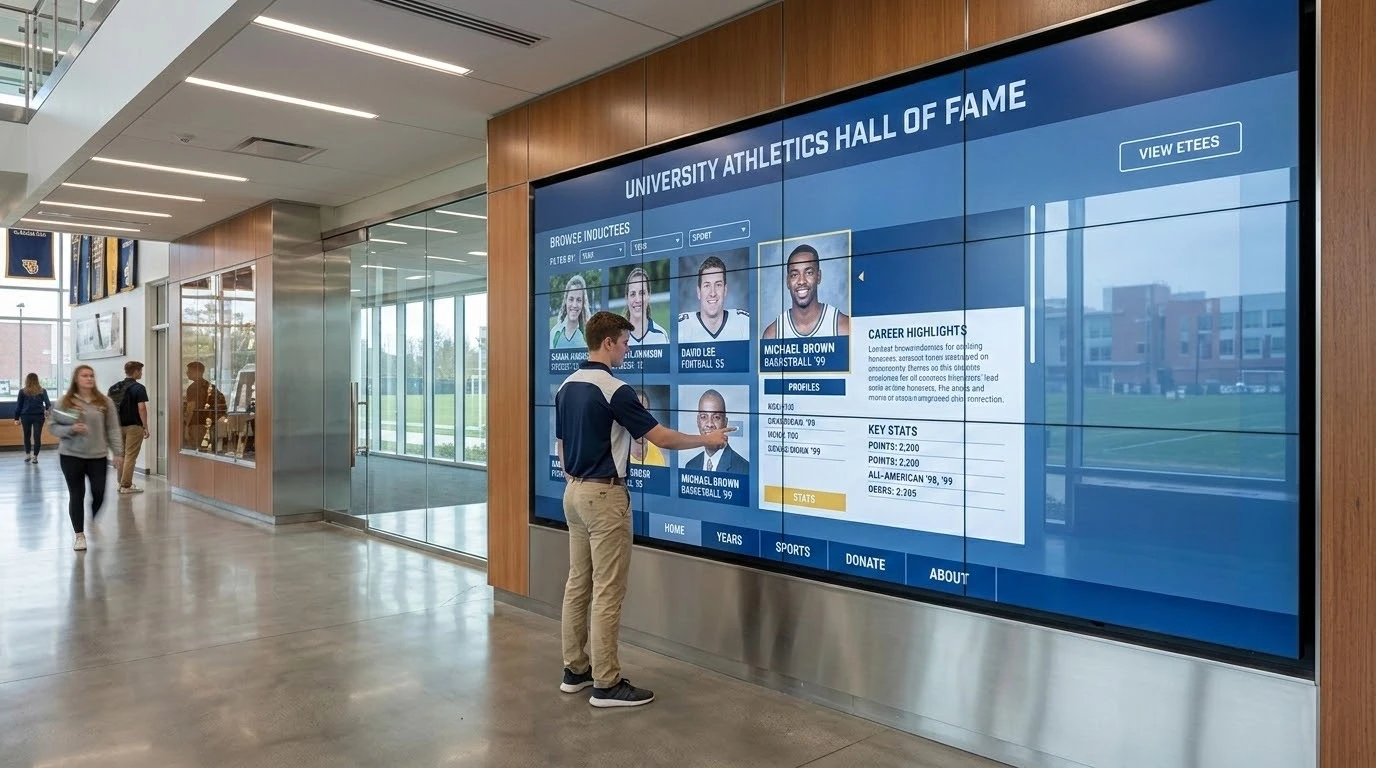
When an athletic director or alumni board decides to build a digital hall of fame, the first conversation is almost always about the physical hardware. Committees spend hours debating bezel width, wall mounts, and screen resolution. The software that actually runs the experience is treated as an afterthought.
I’ve seen this play out repeatedly. Six months later, the screen is installed, and the staff discovers that standard lobby signage software cannot handle a searchable database. Regular digital signage platforms are built to loop cafeteria menus, campus announcements, and weather feeds. They fail the minute you need to categorize 300 alumni by graduation year, sport, and induction class. A hall of fame is fundamentally a database, and you need software built to render that database intuitively on a touchscreen.
1. Touchstone Digital Solutions
This company operates entirely within the institutional recognition space. They are a family owned digital experience firm specializing exclusively in custom touchscreen software installations for schools, universities, and nonprofits.
Most software vendors sell you a blank interface and expect your internal department to figure out the layout. It’s an approach that works for digital agencies, but it usually overwhelms school staff. This vendor takes the opposite path by handling the custom design, structuring the database, and mapping the user interface around your specific history before handing over the keys.
Key operational realities:
- Provides a fully managed custom build process rather than a generic DIY toolkit.
- Features a backend system designed specifically for administrative staff, making it easy to add new honorees without touching code.
- Offers dedicated support focused on institutional recognition, avoiding the generic ticketing systems of larger software conglomerates.
This route makes sense for organizations that want a centerpiece installation but do not want to take on the burden of software design and database management themselves.
2. Norvision
Norvision positions itself as a specialist in bespoke donor recognition software. Their focus is specifically on helping organizations display giving programs through interactive walls.
Unlike the broader signage tools, they understand the mechanics of philanthropy. The platform scales cleanly for both large capital campaigns and smaller regional fundraising efforts.
Core capabilities:
- Delivers a managed software platform built around donor recognition logic.
- Handles complex giving tiers and campaign progress tracking naturally.
- Focuses narrowly on philanthropy rather than general alumni or athletic honors.
If your institution needs a dual-purpose board that handles a capital campaign alongside an athletic hall of fame, you might end up needing two separate systems to manage both effectively.
3. Intuiface
Intuiface is a robust interactive signage platform used by over 1,600 companies globally. It excels at combining video, high resolution images, and touch navigation into a single interface.
This is a horizontal tool built for digital agencies and AV integrators. There is no built-in alumni data structure or default donor tier system. You are purchasing the infrastructure to build an application, not a ready made product.
Platform characteristics:
- Provides excellent support for broad interactivity, including sensors and external data triggers.
- Requires internal design expertise or a third-party integrator to actually build the front-end experience.
- Carries ISO 27001 certification, satisfying stringent IT security requirements.
Schools often underestimate the maintenance required for an open ended platform. It is an incredibly powerful tool, but you need the right technical personnel to manage it long-term.
4. Rise Vision
Rise Vision is a familiar name in K-12 and higher education. They offer a cloud platform primarily used for hallway announcements, screen sharing, and emergency alerts.
They include basic hall of fame and donor wall layouts among their hundreds of general-purpose templates. Because recognition boards are just one small feature of a massive communications platform, the designs are standard and not deeply customized to an individual brand.
System features:
- Allows instant content updates from any web-connected device.
- Provides a low cost entry point, especially for schools already using the software for classroom alerts.
- Uses template driven designs that get a simple board running quickly without custom coding.
If you need a simple scrolling list of names, this works. Institutions wanting a distinctive, story driven tribute that honors major donors or historic athletes will find the out-of-the-box templates restrictive.
5. PandaSuite
PandaSuite is a Paris based platform launched in 2015 that allows non technical teams to build interactive apps. It is highly flexible and used across multiple commercial industries.
The trade off for this flexibility is that it is a general purpose builder. You start with a blank canvas. If your school wants an athletic hall of fame, your internal team has to design the honoree layout, build the donor tiers, and map out the navigation logic from scratch.
What to expect during deployment:
- Offers a high degree of drag-and-drop design flexibility for experienced creative teams.
- Operates as a self managed platform, meaning setup requires significant internal labor.
- Leaves ongoing content design and maintenance up to your staff or a hired contractor.
It works well if you have a dedicated designer on staff who wants complete control over every pixel. If your athletic director is the one updating the board on a Friday afternoon, this platform will likely demand too much time.
6. Digital-Trophy-Case.com
This vendor takes a distinct approach by packaging their software directly with fixed hardware. They sell interactive touchscreen kiosks, typically ranging from 43 to 65 inches.
The software centers around a searchable directory of honoree profiles. It is a cloud-based system that works reliably, provided you are happy with their specific hardware enclosures and standardized layouts.
Hardware and software bundle details:
- Includes a cloud-managed database for searchable honoree profiles.
- Relies on fixed hardware packages that simplify the purchasing process but limit custom sizing.
- Features a streamlined interface prioritizing basic directory functions over deep multimedia storytelling.
If you just need a functional, searchable kiosk in a tight hallway space, this gets the job done.
Assessing Your Long-Term Maintenance Plan
Buying software for a public-facing display is a long-term commitment. You aren’t just paying for the initial setup. You have to evaluate who will be updating the system five years from now when the original project team has moved on to other roles.
Too many organizations treat digital recognition displays as one-time hardware purchases. They fail to account for the software maintenance burden. An interactive display is a living database. Every year, new athletes are inducted, new donors hit milestone tiers, and alumni pass away, requiring biographical updates.
If you rely on a generalized platform, every update requires a designer to adjust the layout so the text still fits. If you use a purpose-built system, an admin assistant can simply type text into a form field, and the software handles the formatting automatically. If your internal team has high turnover, standardizing on a complex no-code builder guarantees future headaches. When a new admin steps in, they won’t know how the database connects to the front-end layout. In those environments, paying a specialized vendor like Touchstone Digital Solutions to handle the architecture ensures the board actually stays updated over the next decade.
Evaluate your internal resources honestly before signing a contract. A beautiful screen is useless if your staff doesn’t have the time or technical ability to keep the content accurate.




-

 Resources5 years ago
Why Companies Must Adopt Digital Documents
-

 Resources4 years ago
A Guide to Pickleball: The Latest, Greatest Sport You Might Not Know, But Should!
-

 Resources1 year ago
50 Best AI Free Tools in 2025 (Tried & Tested)
-

 Resources1 year ago
Get Paid $5000+ a month to write : Discover 30 Spectacular Websites That Reward Your Writing Effort