Tech
Six Traps in Every LLM Pricing Table

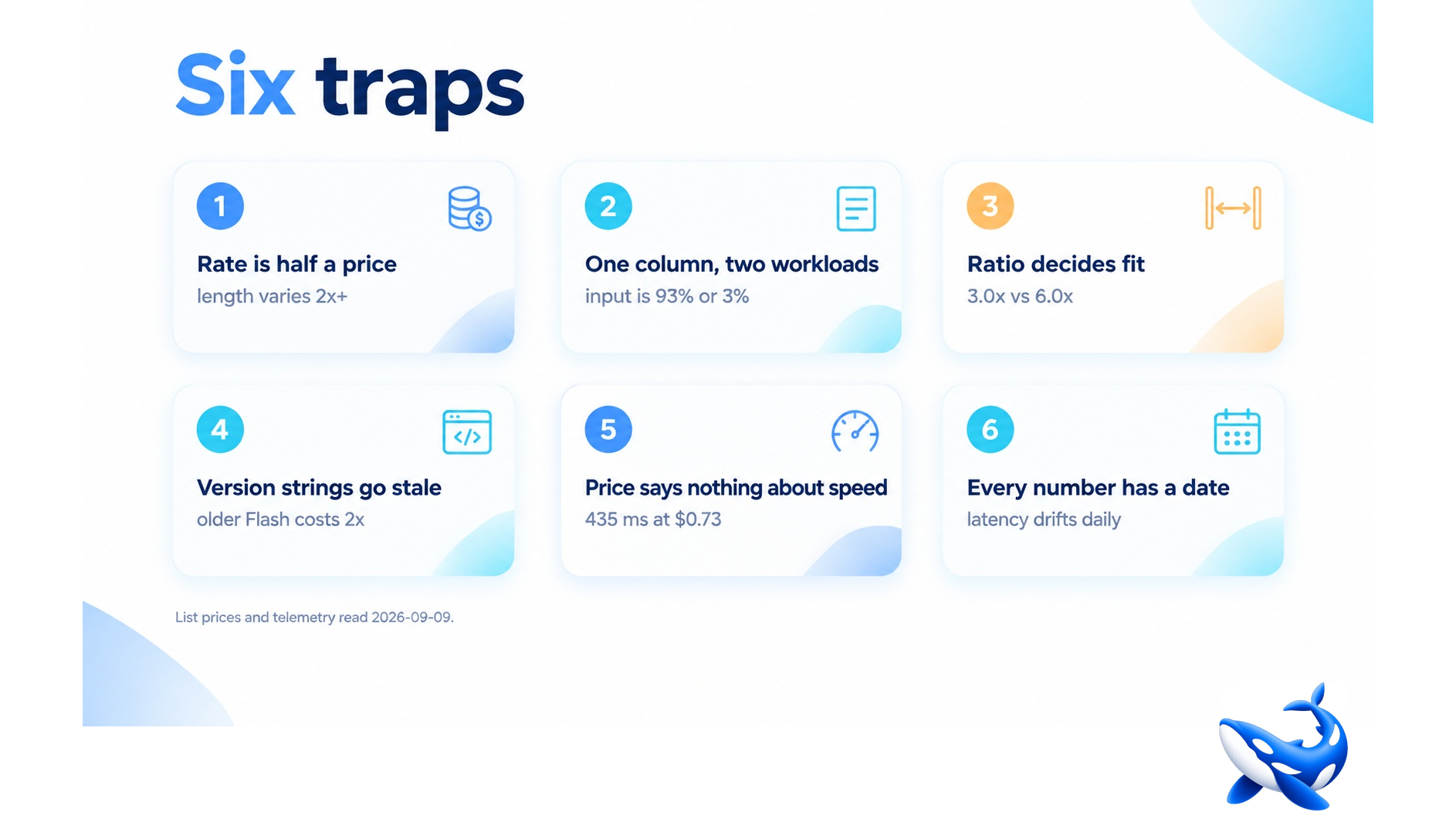
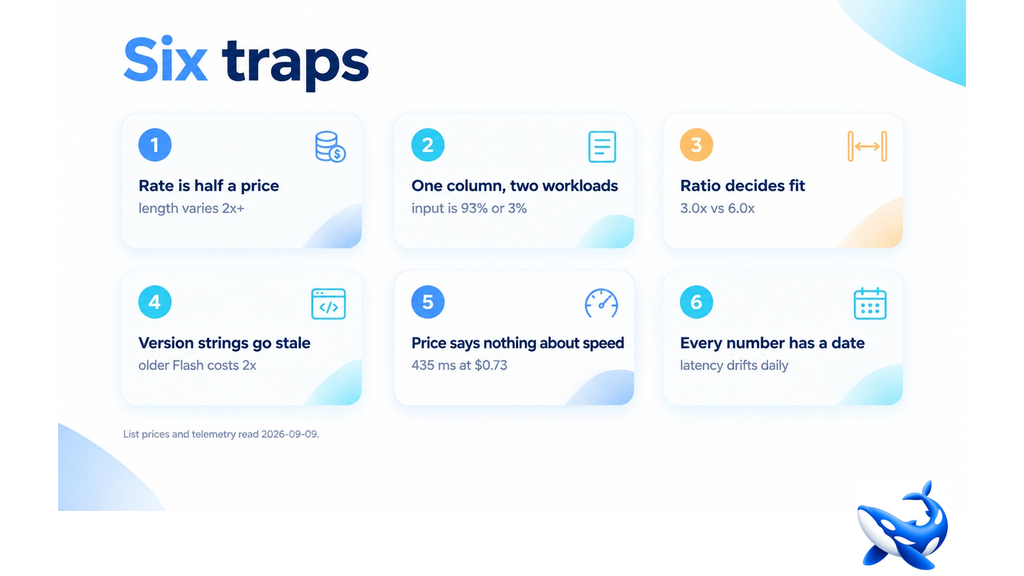
A pricing table publishes two numbers and your invoice is a function of five. OrcaRouter lists latency and context alongside price, and everything below comes from putting those next to the published rates for the same models — which is the only way an llm pricing comparison becomes a forecast rather than a rate card.
All figures read 2026-09-09 unless noted.
1. A rate is half a price
Output rate is per token; token count is a model property that varies by more than two to one for the same brief. Multiply and one pair at the top of the market swaps order:
| Rate /1M out | Tokens emitted | Cost per piece | |
| GPT-5.6 Sol | $20.00 | 8,548 | $0.171 |
| Claude Opus 5 | $25.00 | 6,003 | $0.150 |
The 20% cheaper rate produces a 14% higher bill. Lengths from EQ-Bench Creative Writing v3, an independent benchmark read 2026-09-08, on open-ended creative prompts — so treat the magnitude as indicative and the inversion as real.
The fix: log actual output tokens from the API response and compute `mean tokens ÷ 1e6 × rate`.
2. One table, two completely different workloads
Which published column matters is set by your traffic, not the vendor. On DeepSeek V4 Flash:
• 20,000 in / 500 out → input is 93% of the call
• 500 in / 6,000 out → output is 97% of the call
Same model, same rates, and the relevant column flips. Sorting by output price for a summarisation pipeline is sorting by the 7% term.
The fix: pull mean input and mean output tokens per call from your request logs, per endpoint.
3. The ratio decides what a model is cheap *for*
Output ÷ input runs 3.0x to 6.0x across models people actually shortlist:
| Ratio | Models |
| 3.0x | DeepSeek V4 Flash / Pro, Qwen3.8 Max, Grok 4.6 |
| 5.0x | Claude and GPT frontier models, Gemini 3.6 Flash |
| 6.0x | Gemini 3.5 Flash, GPT-5.5 Pro |
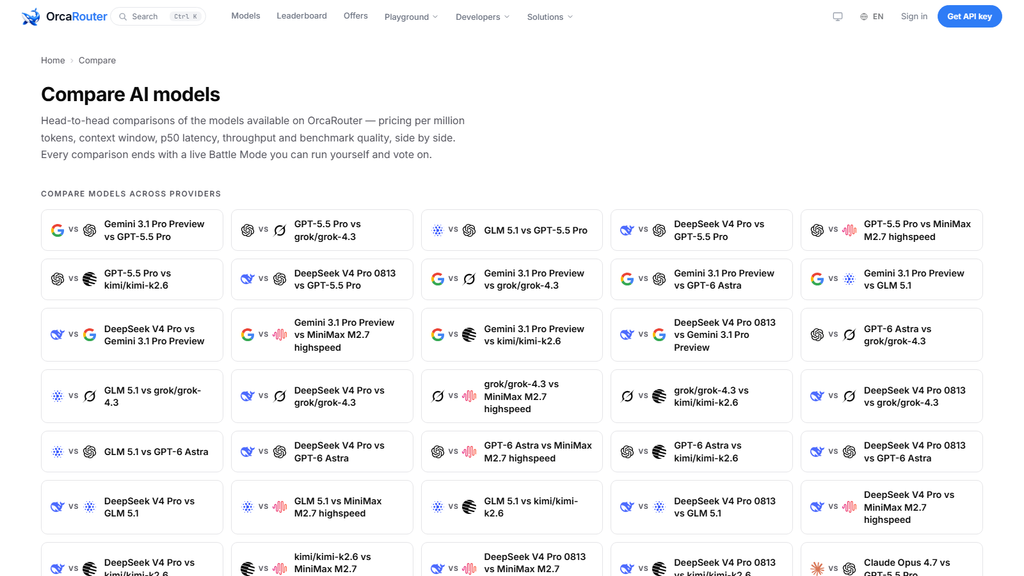
Low ratio suits generation; high ratio suits summarisation. Gemini 3.5 Flash’s $1.50 input rate is a bargain for reading and its $9.00 output rate is above Muse Spark 1.2’s $4.25 for writing — the same model, opposite verdicts.
4. Version strings outlive the pricing decision behind them
Gemini 3.5 Flash: $1.50 / $9.00. Gemini 3.6 Flash: $0.75 / $3.75. Same family, same tier name, lower version number, roughly double the price.
And the same inversion appears as latency at identical prices:
| Same price | p50 first token |
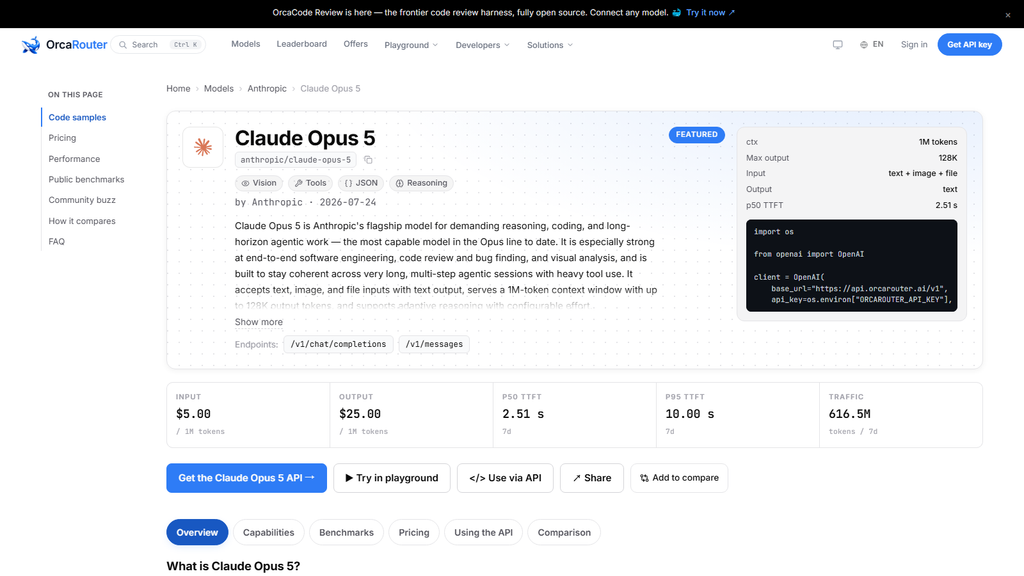
| Claude Opus 5 — $5 / $25 | 2.52 s |
| Claude Opus 4.8 — $5 / $25 | 4.38 s |
| Claude Fable 5.1 — $10 / $50 | 4.14 s |
| Claude Fable 5 — $10 / $50 | 6.70 s |
| Qwen3.8 Max (0902) — $2 / $6 | 2.82 s |
| Qwen3.8 Max — $2 / $6 | 4.09 s |
Vendors price tiers, not versions. Your config named a version.
The fix: list every model string your code sends — including the fallback and batch routes — and check quarterly whether a same-family successor is cheaper or faster. Then test quality before switching; free to try is not free to assume.
5. Price carries almost no information about speed
OrcaRouter production telemetry, same day:
| Model | Output /1M | p50 first token |
| DeepSeek V4 Flash | $0.73 | 435 ms |
| Claude Opus 5 | $25.00 | 2.52 s |
| GPT-6 Astra | $50.00 | 5.79 s |
| GPT-5.5 Pro | $180.00 | 5.00 s |
| GPT-5.6 Sol | $20.00 | 9.37 s |
| Qwen3.7 Flash | $0.13 | 9.79 s |
The fastest figure comes from near the bottom of the price ladder, and the cheapest model is among the slowest. Neither “cheap is slow” nor “expensive is fast” survives contact with this. What does hold is a family pattern — DeepSeek fast, GPT-5 generation slow.
6. Every number here has a shelf life
Two of the columns move on their own.
Prices drift, usually downward. A cut on a model you already use requires no work from you and quietly improves your margins.
Latency drifts daily. These are 7-day rolling windows; Claude Opus 5’s median went 3.09 s → 2.82 s → 2.52 s across three consecutive reads. The ordering held; the decimals did not.
And two figures in that data are not measurements at all: Grok 4.6 and Gemini 3.6 Flash both report 10.00 s, which is a reporting ceiling. Reading those as “slow” would be wrong — they are unmeasured.
The fix: attach a read date to every figure you quote, in the sentence carrying the number rather than a footer three screens away. A pricing comparison without a date is a snapshot somebody forgot to timestamp.
The two things I left out on purpose
Prompt caching. Where a provider offers it, repeated input prefixes bill at a fraction of the standard rate — which can outweigh every trap above for workloads with a long fixed system prompt. Availability and discount structure vary by provider and I have not verified them across this model set, so it is flagged rather than quantified. Check it first if it applies to you.
Reasoning tokens. On models with configurable effort, thinking billed as output can dwarf the visible answer — a ninefold multiplier from a setting rather than a model choice. Also provider-specific, also unverified here.
Both are real, both can dominate, and neither belongs in a table I cannot source.
The order to work in
Six traps is a checklist, and checklists are more useful in sequence. This is the order that resolves the most uncertainty per hour spent.
1. Turn on token logging if it is not on — prompt and completion counts, per call, tagged by endpoint and model. Everything else here depends on it, and it cannot be added retroactively.
2. Compute your read-to-write ratio per endpoint. This tells you which published column you are actually shopping in, and it is usually not the one you assumed. One query.
3. Constrain your output prompts. At generation this is a bigger lever than model choice and it is free. Do it before comparing models, because otherwise you are comparing unconstrained defaults and may migrate to recover a difference a prompt would have removed.
4. Compute cost per piece for your current model and two candidates, from measured token counts rather than benchmark figures.
5. Audit your model strings — primary, fallback, batch. Check each against the current price and its same-family successors. This is the step that finds the free wins.
6. Then, and only then, compare rates. By this point the rate card is the last input rather than the first, which is the correct order and the opposite of how most of these decisions get made.
Steps 1, 2, 4 and 5 are queries and lookups. Step 3 is prompt work. None of it needs a vendor conversation.
A closing note on sequencing. The reason this order matters is that steps 1 through 5 are cheap, reversible and produce data you keep, while step 6 — switching models — is the only one that costs anything to undo. Doing the cheap reversible work first is not a productivity trick; it is what stops a pricing review from turning into a migration you have to justify afterwards.
The takeaway
The two published rates are true and insufficient. Length turns a cheaper rate into a bigger bill; your read-to-write mix decides which rate you are even shopping for; the 3.0x-to-6.0x ratio decides which workload a model is cheap for; version strings quietly cost double; price predicts nothing about speed in either direction; and every number involved has a date on it. Five of the six fixes are a query against your own request logs, which is where the comparison you actually need has been sitting the whole time.
Sourcing note: Input rates, output rates, context windows and median time-to-first-token figures are the list prices, published specs and production telemetry OrcaRouter passes through, read 2026-09-09; only models verifiable on their own pages that day are included. Latency figures are 7-day rolling windows reflecting its traffic mix and regions; values of 10.00 s sit at a reporting ceiling and are not measured latencies. Output-length figures are from EQ-Bench Creative Writing v3, an independent LLM-judged benchmark, read 2026-09-08, on open-ended creative-writing prompts. Prompt-caching and reasoning-token billing vary by provider and were not verified across this model set. Note on the DeepSeek rows: on 2026-09-10 DeepSeek published DeepSeek-V4.1-Flash under the identifier `deepseek-flash`, turned `deepseek-v4-flash` and `deepseek-v4-flash-vision-exp` into legacy aliases routed to it, and stated that requests to `deepseek-v4-pro` will all be routed to V4.1 Flash from 2026-09-14. The DeepSeek figures here are therefore a 2026-09-09 snapshot of a line the vendor is in the middle of consolidating.



-

 Resources5 years ago
Why Companies Must Adopt Digital Documents
-

 Resources4 years ago
A Guide to Pickleball: The Latest, Greatest Sport You Might Not Know, But Should!
-

 Resources1 year ago
50 Best AI Free Tools in 2025 (Tried & Tested)
-

 Resources1 year ago
Get Paid $5000+ a month to write : Discover 30 Spectacular Websites That Reward Your Writing Effort