Resources
5 Smart Contract Audit Red Flags to Watch in Newly Listed Crypto Projects

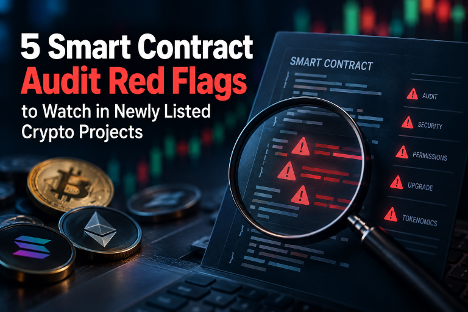
There are five major red flags:
- The audit does not match the deployed contract.
- Critical or high-severity findings remain unresolved.
- Developers keep excessive admin privileges.
- Upgradeable proxies or external dependencies fall outside the audit scope.
- Core token economics were not tested.
An audit reduces specific technical risks in specific code. It is not proof that a project is safe.
Key Takeaways
- An audit reviews particular code at a particular point in time. It is not a permanent security certificate.
- Contract addresses, commit hashes, audit dates, and remediation status matter as much as the auditor’s name.
- “Audited” does not mean the vulnerabilities were fixed.
- Admin keys, proxies, minting rights, and external dependencies can create risk even when the code has no obvious bug.
- Audit review works best combined with on-chain verification and broader due diligence.
What Does a Smart Contract Audit Actually Tell You?
A smart contract audit is an independent review of a project’s code by a security firm. Auditors typically examine:
- the source code, checked against known vulnerability patterns
- access controls
- business logic
- external interactions
- edge cases in testing
The results apply only to the audit scope, meaning the specific contracts and version reviewed. Findings are usually graded Critical, High, Medium, Low, or Informational.
Each finding goes through a lifecycle. The auditor discovers it, the team responds, the team fixes it, and the auditor retests the fix. Only that last step confirms the fix actually works.
This matters in practice. CertiK recorded 204 code-vulnerability incidents in H1 2026, which made code vulnerabilities the most common attack category by incident count. An “Audited” badge on a website won’t tell you which stage a project reached. The report will.
5 Smart Contract Audit Red Flags to Check Before Buying a Newly Listed Token
The Audit Does Not Match the Live Contract
A credible report names five things:
- the blockchain
- the audited contract addresses
- the source repository
- the version or commit hash
- the completion date
Several patterns should make you cautious:
- The project migrated to a new contract after the audit.
- The live contract address differs from the audited one.
- Major features were added after the review.
- Marketing implies a full-protocol audit when only one component was reviewed.
A reputable audit of outdated code tells you little about the contract that holds funds today. Before trading a newly listed token such as ATS coin, compare the contract address in the project’s official documentation with the address named in the audit report. If the two don’t match, the audit doesn’t describe what you’re buying.
Critical or High-Severity Findings Are Still Open
Reports typically label each finding with one of these statuses:
- Resolved: the issue was fixed.
- Partially resolved: only part of the issue was addressed.
- Acknowledged / Accepted risk: the team knows about the issue but may not have fixed it.
- Unresolved: nothing was done.
Prioritize open findings that involve:
- unauthorized transfers
- reentrancy
- accounting errors
- access-control failures
- price manipulation
- mint/burn logic
According to CertiK, a March 2026 exploit of Movie Token stemmed from flawed sell/burn accounting that could distort supply and price.
The strongest evidence of a real fix includes remediation notes, an updated commit, and an explicit “verified fixed” status after a retest.
Developers Keep Excessive Admin Privileges
Check whether a privileged wallet can do any of the following:
- mint tokens
- blacklist wallets
- pause transfers
- change fees
- withdraw assets
- swap contract logic
Who holds that control matters as much as the controls themselves.
| Control model | Who can act | How fast changes happen | Main risk | Suits |
| Single owner wallet | One private key | Immediately | Key theft or insider abuse | Very early testing only |
| Multisig | Several signers (e.g., 3 of 5) | Fast, once signers agree | Signer collusion or compromise | Teams needing quick emergency response |
| Multisig + timelock | Signers, with a delay | Hours to days | Slower response to exploits | Projects holding meaningful user funds |
| DAO governance | Token holders | Slowest | Governance capture by large holders | Mature protocols |
Admin functions are not automatically malicious, because emergency pauses can stop an active exploit. The red flag is a specific combination: powerful privileges, single-key control, no delay, and unclear governance.
Proxy Upgrades and Dependencies Are Out of Scope
Upgradeable contracts split the system in two. Users interact with a proxy, while a separate implementation contract holds the logic. Check that the audit covers:
- the proxy architecture
- the current implementation
- who can trigger upgrades
Also look at dependencies such as oracles, bridges, staking contracts, liquidity pools, and backend infrastructure.
Upgradeability involves a real trade-off. Teams can patch bugs quickly, but the audited code can also be replaced without a new review. Incidents in 2026 keep showing that failures often happen at system boundaries, such as cross-chain and infrastructure components, rather than inside the token contract itself.
Token Economics Were Not Properly Tested
Secure code can still behave badly economically. Look for testing of:
- mint/burn mechanics
- transfer fees and fee caps
- blacklisting and trading restrictions
- liquidity-pool interactions
- supply calculations
Phrases like “tokenomics not reviewed” or “economic security outside scope” don’t make an auditor weak. They simply define what the auditor isn’t claiming to have verified.
The problem arises when the excluded logic is central to the token. If an unaudited owner function can raise the sell fee to 90%, a clean review of standard ERC-20 code does little to protect you.
How Do You Verify an Audit Before Interacting With a New Token?
- Confirm the official contract address. Get it from the project’s own documentation and cross-check it against the exchange listing. Many exchanges, MEXC among them, list new tokens quickly. A listing is not a security endorsement.
- Match the address to the audit. Compare the address, contract name, version, commit hash, and date.
- Check a blockchain explorer. Confirm the source code is verified, see whether the contract is a proxy, and check whether ownership was renounced.
- Read the findings table. Start with Critical and High findings and their status.
- Identify who controls privileged functions. It could be a single wallet, a multisig, a DAO, or a timelock.
Once you’ve gathered that information, match your results to this framework:
| What you find | What it means | Suggested next step |
| Audit matches live code, serious findings resolved | Technical risk reduced | Continue broader due diligence |
| Important findings only partly resolved | Residual risk | Investigate before interacting |
| Scope excludes critical components | Incomplete security picture | Weigh the unreviewed parts heavily |
| Audit doesn’t match deployed contract | Audit largely irrelevant | Treat the token as unaudited |
| Unresolved critical flaw | Strong warning signal | Avoid until fixed and retested |
This checklist evaluates contract risk only. It says nothing about whether a token is fairly valued or commercially viable.
Why Can an Audited Project Still Be Hacked?
No audit guarantees a project can’t be exploited. Many attacks bypass contract code entirely:
- compromised private keys
- malicious signers
- phishing
- front-end hijacks
- cloud or server vulnerabilities
- governance attacks
Recent data shows the gap. Hacken reported that smart contract bugs appeared in 44 of 67 Web3 incidents in Q2 2026. However, compromised keys, signers, and infrastructure accounted for 88.3% of losses by value. Hacken also reported that six audited protocols were exploited in Q1 2026.
The takeaway: security is an ongoing process, not a one-time event.
How Much Weight Should You Give an Audit?
Treat an audit as evidence, not a safety badge. Work through six checks in order: scope, findings, remediation, privileges, deployment match, and dependencies.
If all six hold up, the audit meaningfully lowers technical uncertainty. If the deployment doesn’t match or critical issues remain open, discount the audit heavily.
An audit can’t validate future upgrades, operational security, or valuation. For newly listed tokens with short track records, it should be one layer of your decision, not the deciding factor.
FAQs About Smart Contract Audits
Does an audit mean a crypto token is safe?
No. An audit means the defined code was reviewed under a specific scope and methodology at one point in time.
How can I tell whether a crypto audit is legitimate?
Find the report on the auditor’s own website. Then confirm the contract addresses, date, commit information, findings, and remediation status.
Is an unresolved High-severity finding always dangerous?
Not always, because exploitability depends on context. Still, any unresolved serious finding warrants investigation before you interact with the contract.
Can a smart contract change after it has been audited?
Yes. Upgradeable contracts can replace their implementation. That makes upgrade permissions, timelocks, and follow-up audits especially important.



-

 Resources5 years ago
Why Companies Must Adopt Digital Documents
-

 Resources4 years ago
A Guide to Pickleball: The Latest, Greatest Sport You Might Not Know, But Should!
-

 Resources1 year ago
50 Best AI Free Tools in 2025 (Tried & Tested)
-

 Resources1 year ago
Get Paid $5000+ a month to write : Discover 30 Spectacular Websites That Reward Your Writing Effort