Blogs
7 Best Custom Plastic Parts Manufacturers for OEM Production

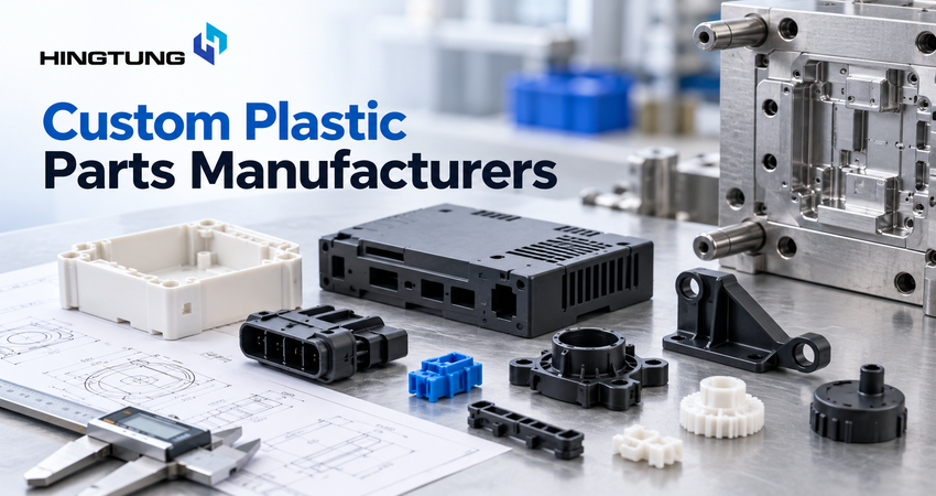
Choosing between custom plastic parts manufacturers involves more than comparing molding prices. A supplier may produce an excellent first sample but struggle with dimensional consistency, tooling changes, or assembly requirements once production begins.
For OEM projects, I would look at DFM support, mold ownership, material control, inspection, and how the supplier manages production changes. The seven companies below offer different manufacturing approaches. HingTung is particularly worth considering when mold development, injection molding, and downstream operations need to remain closely coordinated.
7 Best Custom Plastic Parts Manufacturers Compared
| Manufacturer | Main Capabilities | Main Strength | Suitable For |
| HingTung | DFM, mold making, injection molding, CNC, assembly | Integrated tooling and manufacturing | OEM structural plastic components |
| Xometry | Injection molding, machining, prototyping | Broad manufacturing partner network | Diverse sourcing requirements |
| Protolabs | Rapid tooling and injection molding | Prototype and on-demand production | Product development and smaller production runs |
| Fictiv | Injection molding, CNC, manufacturing management | Digital sourcing and production coordination | OEM development and scalable manufacturing |
| EVCO Plastics | Custom molding, tooling, automation, assembly | Broad molding capabilities | Complex industrial plastic parts |
| The Rodon Group | High-volume plastic injection molding | High-volume manufacturing specialization | Repeat plastic component production |
| Pioneer Plastics | Part design, tooling, injection molding | Custom part development and production | Molded products and OEM components |
These plastic parts manufacturers do not operate in exactly the same way. Some focus on digital sourcing and rapid production, while others emphasize dedicated factory operations and long-running OEM programs.
The best option depends on whether the project needs a few development parts, thousands of repeat components, or a complete manufacturing and assembly workflow.
Where HingTung Fits into Custom Plastic Manufacturing
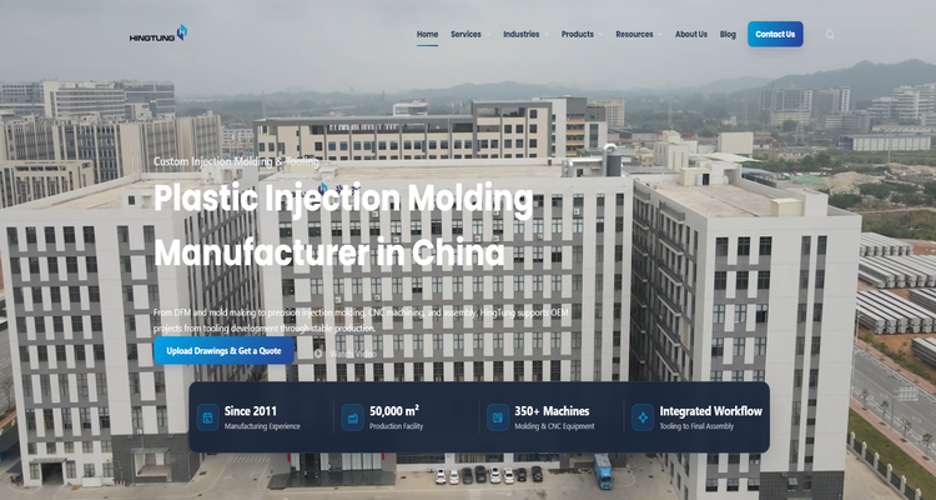
HingTung is a China-based custom plastic parts manufacturer established in 2011. Its operations cover DFM, mold design and manufacturing, injection molding, CNC machining, secondary processing, inspection, and assembly.
The company operates a 50,000 m² manufacturing facility with more than 350 pieces of equipment, including over 80 injection molding machines with clamping capacities up to 650 tons.
For OEM projects, the main advantage is having tooling and production engineering within the same manufacturing operation.
In-House Mold Making and Injection Molding
A well-designed mold does not guarantee a production-ready part.
During mold trials, an enclosure may warp slightly, mounting bosses may fall outside tolerance, or a cosmetic surface may show sink marks. Solving these problems can require changes to both the mold and processing conditions.
HingTung coordinates mold development, trials, corrections, and injection molding rather than treating tooling and production as unrelated services.
I would particularly consider this approach for structural components with tight assembly requirements, multiple molded features, or designs likely to need engineering adjustments before production approval.
Engineering Plastics and Complex Part Requirements
HingTung supports OEM projects involving engineering thermoplastics such as ABS, PC, PA, PBT, and POM, subject to specific grade and process requirements.
These materials serve different purposes. PC may be selected for impact-resistant housings, while POM is more appropriate for some sliding or low-friction mechanical components.
Material selection also affects tooling. Shrinkage, flow behavior, moisture absorption, and filler orientation can change the finished dimensions.
For custom plastic parts manufacturing, I would expect the material discussion to happen before mold dimensions are finalized, not after the first samples fail inspection.
Secondary Operations and Assembly
A finished OEM component may require more than molding.
Threaded inserts, secondary machining, welding, marking, dimensional inspection, and assembly can add several steps to the production workflow.
HingTung’s integrated capabilities allow these processes to be coordinated with injection molding.
That can be useful for plastic enclosures, brackets, and multi-component assemblies where individual parts must meet both drawing tolerances and final assembly requirements.
What Separates a Reliable Manufacturer from a Basic Molding Supplier?
Machine capacity matters, but it tells only part of the story.
A factory with large molding machines may still be unsuitable for a small precision component if it cannot control tooling, material conditioning, and critical dimensions consistently.
| Evaluation Factor | What to Ask | Why It Matters |
| DFM capability | Does the supplier review drawings before tooling? | Identifies manufacturing risks early |
| Tool manufacturing | Who builds and maintains the mold? | Affects correction and maintenance responsibility |
| Material control | Are resin grade and processing requirements documented? | Supports repeatable part properties |
| Dimensional inspection | How are critical features measured? | Verifies assembly requirements |
| Process validation | Are trial results and settings recorded? | Supports repeat production |
| Secondary operations | Can the supplier handle finishing and assembly? | Reduces supplier handoffs |
When comparing custom plastic parts manufacturers, I would ask for examples of how they resolved a tooling or dimensional problem, not simply a list of available machines.
A useful engineering response should explain the original problem, the correction, and how the improved result was verified.
Material Selection Should Follow the Application
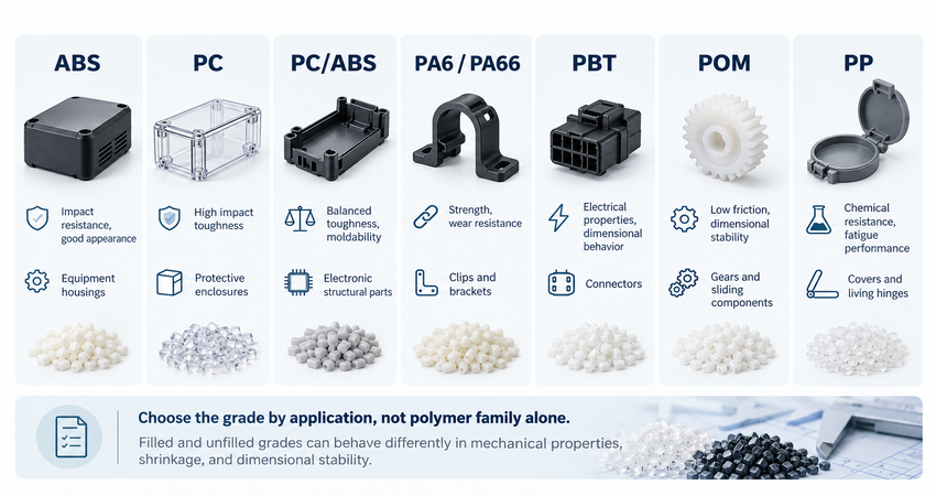
Most manufacturers offer common thermoplastics, but the correct choice depends on mechanical loads, operating temperature, environmental exposure, and part geometry.
| Material | Common Strength | Typical OEM Application |
| ABS | Impact resistance and surface appearance | Equipment housings |
| PC | High impact toughness | Protective enclosures |
| PC/ABS | Balanced toughness and moldability | Electronic structural parts |
| PA6 / PA66 | Strength and wear resistance | Clips and brackets |
| PBT | Electrical properties and dimensional behavior | Connectors |
| POM | Low friction and dimensional stability | Gears and sliding components |
| PP | Chemical resistance and fatigue performance | Covers and living hinges |
I would avoid accepting a generic recommendation such as “use nylon” without identifying the exact grade.
A glass-filled PA66 part, for example, can behave differently from an unfilled grade. Fiber orientation influences shrinkage and strength, while moisture changes dimensions and mechanical properties.
An experienced plastic molding manufacturer should be able to discuss these trade-offs before production tooling begins.
Why Tooling-to-Production Coordination Matters
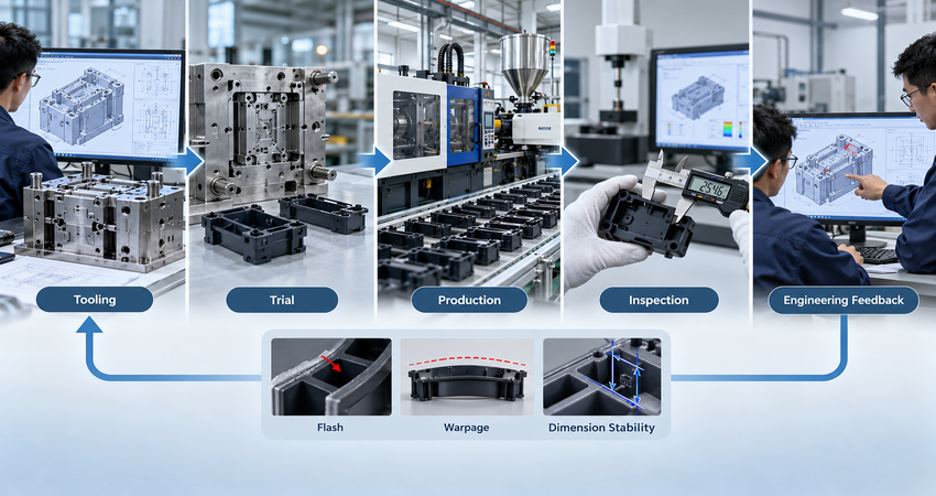
One recurring problem in outsourced manufacturing is losing engineering information between the mold maker and the production molder.
A mold may be accepted after trial samples, yet production conditions later reveal flash, warpage, or unstable dimensions.
When tooling and molding teams work together, they can compare mold geometry, resin behavior, processing conditions, and inspection results without repeatedly transferring the problem between suppliers.
This is one reason HingTung’s integrated manufacturing model is relevant for tooling-intensive OEM projects.
It does not mean every project will have a shorter lead time. Complex molds, material availability, and qualification requirements still affect the schedule. The benefit is clearer responsibility during engineering changes and the transition into repeat production.
How to Compare Total Manufacturing Cost
A low quoted unit price can be misleading if it excludes mold maintenance, additional inspection, secondary processing, or assembly.
For OEM production, I would compare the complete project rather than the molded part alone.
| Cost Element | What to Consider |
| Tooling | Mold construction, cavities, maintenance, modifications |
| Material | Resin grade, additives, drying, material losses |
| Production | Cycle time, setup, scrap, machine requirements |
| Quality | Dimensional inspection and functional testing |
| Secondary operations | Machining, inserts, welding, finishing |
| Assembly | Labor, fixtures, inspection, packaging |
| Logistics | Shipping, packaging, inventory, replenishment |
This is particularly important when evaluating overseas custom plastic parts manufacturers.
A manufacturer offering integrated tooling, molding, inspection, and assembly may reduce coordination costs, but the final decision should still account for shipping, inventory, communication, and replenishment requirements.
How to Choose the Right Manufacturing Partner
Different OEM projects need different supplier capabilities.
| Project Requirement | Supplier Type to Consider |
| Rapid design iteration | Prototype-focused manufacturing service |
| Multiple production processes | Multi-process manufacturing platform |
| High-volume repeat parts | Dedicated production molding specialist |
| Complex mold development | Manufacturer with coordinated tooling capability |
| Plastic parts with assembly operations | Integrated manufacturing supplier |
| Frequent local replenishment | Manufacturer close to the final assembly location |
Before placing a production order, I would send the supplier a complete RFQ package with the CAD model, drawings, resin grade, annual quantity, critical dimensions, and inspection requirements.
For parts that affect assembly or mechanical performance, request production-representative samples and appropriate functional tests.
A good quotation should explain engineering assumptions and any unresolved design risks. Price without those details can be difficult to compare.
FAQs
Can a manufacturer work with an existing injection mold?
Often, yes. However, the supplier should inspect the mold’s condition, compatibility with available machines, hot-runner or cooling connections, and maintenance requirements before accepting a transfer.
Who normally owns the injection mold?
Ownership depends on the tooling agreement. OEM customers should clarify payment, ownership rights, maintenance responsibility, storage conditions, and mold-transfer procedures before ordering.
Can custom molded parts be supplied in multiple colors?
Yes. Color can be controlled through suitable resin compounds or masterbatch, but acceptable variation should be defined using approved samples and a consistent inspection method.
What happens if production demand increases?
The manufacturer should review available machine capacity, mold cavities, cycle time, material supply, and inspection resources. Higher volume may justify additional cavities or separate production tooling.
Conclusion
The best custom plastic parts manufacturers should be compared on engineering capability, tooling responsibility, repeatability, and total project cost rather than unit price alone.
HingTung offers an integrated route from DFM and mold manufacturing to injection molding, inspection, and assembly. For OEM projects involving complex plastic structures or several manufacturing steps, that coordination can be valuable, provided the supplier’s capabilities are validated against actual production requirements.



-

 Resources5 years ago
Why Companies Must Adopt Digital Documents
-

 Resources4 years ago
A Guide to Pickleball: The Latest, Greatest Sport You Might Not Know, But Should!
-

 Resources1 year ago
50 Best AI Free Tools in 2025 (Tried & Tested)
-

 Resources1 year ago
Get Paid $5000+ a month to write : Discover 30 Spectacular Websites That Reward Your Writing Effort