Blogs
Best Combat Pants With Knee Pads 2026: Buyer’s Guide

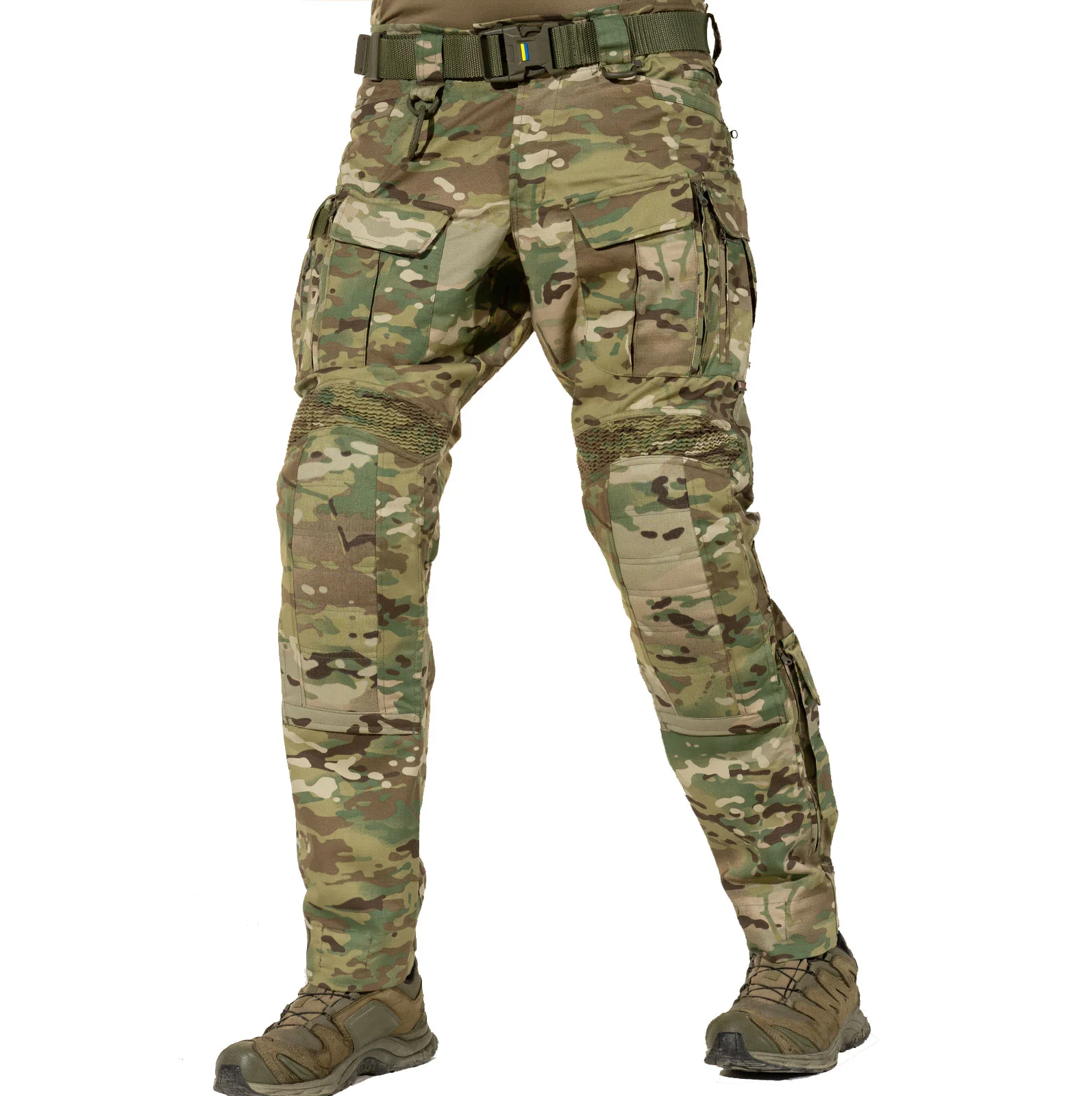
The best combat pants with knee pads are the ones where the pad is still on your knee after an hour of movement. Everything else — fabric weight, pocket count, stretch panels — is secondary to that one requirement. This guide covers what actually separates a working system from a set of trousers with pockets sewn near the knee: retention geometry, where reinforcement belongs, how blends behave near fire and infrared, and how to size trousers you will fight in rather than stand in.
The problem strap-on knee pads never solved
A strap-on knee pad is held by two elastic bands around a moving limb. Within minutes of rolling, crawling or transitioning between firing positions it rotates, slides down the calf, or ends up behind the knee. At that point it stops being protective equipment and becomes a distraction — a loose object flapping against the leg exactly when attention is needed elsewhere. This is not a marketing claim against the category; even manufacturers of strap-on pads advertise “non-slip straps designed to stay in place”, which tells you the failure mode is well known.
Built-in pads solve the retention problem structurally. The pad lives in a dedicated internal pocket, and the trouser itself holds it there. But not every “knee pad pocket” is a retention system. Many trousers offer only a pouch, which means the pad can still migrate inside it. What matters is how many points of adjustment the design gives you.
Three-point retention: height, lateral, and length
A pad stays over the patella when three things are controlled independently. First, height — an adjustment at the front of the thigh that sets where the pad sits relative to the kneecap. Second, lateral position — hook-and-loop panels on either side that stop the pad drifting inward or outward as the leg works. Third, trouser length — a boot hook anchoring the cuff to the footwear so the leg does not ride up and drag the pad with it.
The third point is the one most buyers overlook. In a deep kneeling or squatting position the trouser leg naturally rides upward by several centimetres. Without an anchor, the pad travels with it and ends up above the knee at the moment of contact with the ground. A boot hook, combined with a small length allowance, keeps the geometry intact. UATAC’s Gen 5.6 and Gen 5.7 combat trousers use all three: front height adjusters, lateral hook-and-loop retention, and a boot hook. UF PRO’s Striker XT Gen.3 uses a comparable logic with a multi-level height adjuster and boot hook, which is a fair comparison to make — this is the correct approach, and it is worth recognising where a competitor implements it well.
Coverage area matters alongside retention. A pad sized only to the patella leaves the area immediately below it exposed, which is precisely where contact occurs when dropping into a low kneeling position or crawling forward. A taller pad housing protects the joint and the area beneath it without adding bulk that interferes with movement.
Where reinforcement belongs — and why the main fabric is a frame
The single most useful mental model for combat trousers: the main fabric is a frame, and the reinforcement does the fighting. CORDURA 500D and 1000D are drawn nylon 6,6 textiles that outlast general uniform fabric by an order of magnitude in abrasion. Placing them at the seat, knees and pad housings means the garment fails last where it is worked hardest.
Building the entire trouser from 1000D would be a mistake, not an upgrade. A manufacturer of heavy workwear puts it plainly: 1000D across a whole trouser would be uncomfortable and rigid, and more denier does not automatically mean better. The main fabric therefore has a different job description. It must be dimensionally stable, breathable, abrasion-resistant enough for general wear, and — for military use — neutral in the near-infrared spectrum.
UATAC uses CORDURA 500d Brookwood USA on the abrasion zones across most colourways, stepping up to CORDURA 1000D on Pixel MM-14 and Khyzhak. Hardware is YKK, and construction uses German bonded thread.
Fabric: NYCO versus a cotton-dominant blend
The industry default at the premium end is NYCO 50/50 — nylon and cotton in equal parts. Crye Precision’s G3 uses mil-spec NYCO ripstop; Arc’teryx LEAF’s Assault Pant AR uses NYCO ripstop with CORDURA. There is a widespread assumption that nylon content automatically indicates a higher class of fabric. That belief deserves examination rather than acceptance.
NYCO genuinely leads on raw abrasion and tear figures at comparable density. That is a real advantage and should be stated as such. But three characteristics run the other way, and they matter in sustained field use.
Infrared behaviour. Nylon reflects strongly in the near-infrared band. NYCO fabrics achieve NIR compliance through treatment and dye chemistry, and that treatment degrades with abrasion, ultraviolet exposure and repeated laundering. A cotton-dominant blend starts closer to neutral as a property of the fibre itself, with treatments adding to a baseline rather than creating one. Over a hundred washes and two seasons, a property built into the fibre behaves more predictably than one applied to the surface.
Fire behaviour. Neither NYCO nor a cotton-polyester blend is flame-resistant, and this needs saying without hedging. A textile specialist who advised the US Army on combat uniform fabric described NYCO’s limitation directly: the cotton burns and the nylon melts, which makes the combination unsuitable near heat or flame. The relevant question is therefore not “is it fireproof” — it isn’t — but “what happens on contact with a spark”. Cotton chars; thermoplastics melt and can adhere to skin, deepening a burn rather than limiting it. A blend with cotton in the majority chars locally and resists sustained burning better than a polyester-dominant or fully synthetic fabric. It is damage limitation, not protection, and the distinction from genuine FR materials such as Nomex is absolute.
Water and drying. Cotton absorbs, which is a genuine drawback — but it is one that ventilation design can offset, and we return to that below.
UATAC’s combat trousers use a 65% cotton / 35% polyester ripstop — cotton-dominant by design, which is what drives both the infrared and the fire behaviour described above. This is worth stating precisely, because “polycotton” is used loosely across the market and the ratio direction changes the physics entirely. UF PRO’s unicolour Striker XT models, for example, run a polyester-dominant 67/33 blend, while their MultiCam versions use NYCO — the same product line, different fabric philosophies by colourway.
The summer-weight trade-off nobody advertises
Some manufacturers build summer models from ultralight fully synthetic fabric — around 90 to 110 grams per square metre, no cotton at all. These trousers genuinely feel dramatically lighter and dry very fast after immersion. That is a real engineering choice with a real benefit.
The cost is rarely stated on the product page. A 100% synthetic fabric does not tolerate sparks, heat or open flame. Under thermal contact it melts, and molten polymer on skin produces a larger and deeper burn than the original contact would have caused. For a hiking trouser this is a remote concern. For someone working near a rocket launcher’s backblast, a hot barrel, an ejected case or a stove in a dugout, it is not.
Where a soldier actually meets fire
Readers without a military background often assume “fire risk” means a burning building. The routine exposures are more mundane and far more frequent:
- A hot ejected case dropping into a collar, a boot or across the knee when firing prone
- A heated barrel resting against the leg
- Backblast from shoulder-fired rocket systems — RPG-7, AT4, NLAW and similar — where the rearward jet and its sparks travel toward the operator as the projectile departs, and reflect off walls in confined spaces
- Wood stoves in dugouts, cooking fires, and fuel handling
- Dry grass ignited by tracer rounds
Sparks from a rocket motor are the clearest case. They land on fabric and burn through at a point. On synthetic material that point melts. On a cotton-dominant blend it chars and stops.
Ventilation as a fabric strategy, not a comfort feature
Here is the design logic that ties the fabric choice together. Many manufacturers pursue breathability by making fabric thinner — which costs durability, because ultralight fabrics are rarely strong. The alternative is to keep a robust fabric and move air through the garment mechanically.
Through-ventilation running from the groin down to the lower leg creates airflow along the inside of the trouser as the wearer walks. Newer models add mesh panels in the pocket bags so air moves through rather than stalling. The practical result is that you can retain a denser, tougher fabric without cooking in it, and wet trousers dry while being worn. Breathability becomes a function of architecture rather than a tax on strength.
Comparison: what comes in the box
Specifications matter, but so does what you actually receive. Across the premium segment, knee pads and belts are usually separate purchases, which changes the real cost of a working setup considerably.
| Model | Main fabric | Knee pads included | Belt included | Boot hook | Price level |
|---|---|---|---|---|---|
| UATAC Gen 5.6 / 5.7 | 65% cotton / 35% polyester ripstop + CORDURA 500d (1000D on Pixel MM-14, Khyzhak) | Yes — protective pads in CORDURA housings | Yes, plus waterproof carry pouch | Yes | Mid |
| Arc’teryx LEAF Assault Pant AR Gen2 | NYCO ripstop with CORDURA | Soft foam only; hard caps sold separately | No | No | Top premium |
| Crye Precision G3 | Mil-spec NYCO ripstop with four-way stretch | No — AirFlex sold separately | No | No | Premium |
| UF PRO Striker XT Gen.3 | NYCO on camo; polyester-dominant PolyCo on unicolours; Schoeller stretch + CORDURA | Base padding only; impact pads sold separately | Yes, integrated | Yes | Premium |
| Helikon-Tex UTP | Polycotton ripstop with elastane | No — pockets for soft inserts only | No | No | Budget / urban |
Read that table as a total-cost picture rather than a scoreboard. Arc’teryx LEAF is exceptionally light and uses a genuinely superior no-melt NYCO — it is a better fabric, and it costs several times more, with distribution largely restricted to armed forces and law enforcement. Crye’s G3 is lighter than most of the field and offers the finest size granularity available. UF PRO’s retention hardware is excellent. The honest positioning statement is not that any of these are bad; it is that a complete working configuration from the premium brands costs multiples of a mid-segment kit that arrives complete.
There are NYCO fabrics that outperform a cotton-dominant blend across the full parameter list. They also cost several times more per metre. A manufacturer building for accessibility can reasonably decline to specify a very expensive fabric to reach a result the current blend already delivers — provided the blend genuinely meets the requirement, which for general combat use it does. The saving goes to the user rather than into a specification sheet.
Sizing: three rules that matter more than the label
Buy roomy, not fitted. Combat trousers are worn during rolls, transitions between kneeling and prone, deep shooting stances, climbing and crossing water obstacles. Tight trousers restrict all of that. Wet tight trousers cling to the leg and can tear in a deep position. Between two sizes, take the larger one — for combat trousers this is not a compromise, it is the rule.
Read the waist measurement, not your jeans size. These are high-rise trousers. They are designed to sit on the waist, above the hip bones, not low on the hips. A high rise is what allows a load-bearing belt to carry equipment correctly and keeps the trousers integrated with the rest of the uniform — combat shirt stays tucked, plate carrier does not press on the waistband.
Allow two to three centimetres of extra length. This is a manufacturer recommendation rather than a general tip. In deep firing positions and while climbing, the trouser leg rides up. That allowance is what keeps the knee pad over the knee at the moment it is needed, and it gives the height adjusters room to work.
Service life and how trousers actually fail
A realistic benchmark for a soldier in sustained combat operations is roughly one season for high-quality trousers. That figure varies enormously with operational tempo — trousers used primarily for training last considerably longer, and having a second set to rotate extends the life of both dramatically.
The instructive point is how failure occurs. Most damage is not wear. It arrives from outside: shrapnel, barbed wire, sharp obstacles on a course, debris in a position. Where that contact meets CORDURA, the reinforcement holds. Where it meets the main fabric, ripstop construction does its job — the puncture is contained within a single grid cell rather than propagating into a tear across the leg.
Care: the one instruction that protects camouflage
Wash inside out, at 30 degrees Celsius, on a gentle cycle, and never use detergent with colour enhancers.
The last point is the one almost nobody mentions, and it is the most consequential. Detergents with colour enhancers contain optical brighteners — fluorescent compounds that convert ultraviolet into visible light. Deposited on fabric, they can make infrared-neutral camouflage visible under night vision devices. The pattern looks fine to the eye and betrays the wearer through optics. The same gentle regime also preserves any water-repellent treatment far longer; UATAC’s Multicam Original fabric carries a Teflon treatment, while the MM-25 twill ripstop does not, but the washing recommendation is identical for both because a gentle regime benefits every variant.
MM-25 twill ripstop is worth a separate note. The hybrid weave combines a denser twill face with ripstop grid reinforcement, and according to the manufacturer it holds the highest colourfastness class against fading — which matters over a service life measured in seasons of ultraviolet exposure rather than in washes.
Frequently asked questions
Are built-in knee pads better than strap-on knee pads?
For dynamic work, yes. Strap-on pads rotate and slide down the calf within minutes of movement, and a pad that has left the knee distracts more than it protects. Built-in pads sit in a dedicated pocket and stay above the kneecap, provided the trousers offer height adjustment and lateral retention.
Is NYCO always better than a cotton-rich blend?
No. NYCO 50/50 leads on raw abrasion and tear figures, but nylon reflects strongly in the near-infrared and relies on treatment to stay NIR-compliant. A cotton-dominant blend is naturally closer to neutral and chars rather than melts. Premium NYCO does outperform, but at several times the price.
What does CORDURA reinforcement actually do on combat trousers?
CORDURA 500D and 1000D absorb abrasion in the seat, knees and pad housings, where fabric fails first. That lets the main fabric act as a frame rather than as armour, so the garment stays breathable and light instead of being built entirely from heavy 1000D nylon.
Do combat pants protect against fire?
Standard combat trousers are not flame-resistant and are not Nomex. A cotton-dominant blend chars locally and resists sustained burning far better than 100% synthetic summer fabrics, which melt and adhere to skin, deepening burns. Treat this as damage limitation, not protection.
What size should I buy in combat pants with knee pads?
Size up rather than down. Combat trousers are worn roomy for rolls, kneeling positions and deep shooting stances; wet fabric clings and tears under load. Choose by waist measurement, not by your jeans size, and allow two to three centimetres of extra length so the pad stays on the knee in deep positions.
Why should combat trousers sit high on the waist?
A high rise sits above the hip bones so a battle belt or load-bearing system rides on the waist rather than dragging the trousers down. It also keeps the combat shirt tucked and prevents the plate carrier from pressing on the waistband.
How should combat pants be washed to preserve the fabric?
Wash inside out at 30 degrees Celsius on a gentle cycle and avoid detergents with colour enhancers or optical brighteners. Those additives fluoresce and can make infrared-neutral fabric visible under night vision devices, and they shorten the life of any water-repellent treatment.
Choosing without overpaying
If budget is not a constraint and you have access to restricted distribution, the top-tier NYCO options are genuinely excellent fabrics. For everyone else, the decision comes down to three questions: does the pad have three independent points of retention, is reinforcement placed where abrasion actually occurs, and does the trouser arrive as a working configuration or as the first of three purchases. Ukrainian manufacturer UATAC builds to that last principle — trousers, protective knee pads, tactical belt and a waterproof carry pouch in one kit. The full range is available in the combat pants collection.



-

 Resources5 years ago
Why Companies Must Adopt Digital Documents
-

 Resources4 years ago
A Guide to Pickleball: The Latest, Greatest Sport You Might Not Know, But Should!
-

 Resources1 year ago
50 Best AI Free Tools in 2025 (Tried & Tested)
-

 Resources1 year ago
Get Paid $5000+ a month to write : Discover 30 Spectacular Websites That Reward Your Writing Effort