Tips and support
How to Choose the Right Web3 Live-Streaming Platform for Better Crypto Market Conversations

This guide evaluates live-content features and viewing habits. It does not recommend buying, selling, or holding any digital asset.
Crypto markets move continuously, but the information around them is often fragmented. A chart can show a price change, a news report can summarize an event, and a social post can capture the mood of a community. None of these formats alone gives a complete view of how people are discussing a development as it unfolds.
A Web3 live-streaming platform brings live video, creator perspectives, community conversation, and replay content into a more connected experience. The best choice depends on what you need to watch, how much interaction you want, and whether the platform gives you enough context to assess commentary without treating it as a guaranteed prediction.
For viewers, the goal is not to find the loudest or most confident voice. It is to find a reliable place to discover relevant discussions, compare perspectives, and return to useful content after a live session ends.
Note: Live streams, market information, and creator opinions are for general informational and educational purposes. They are not investment, trading, legal, tax, or financial advice.
Feature note: Platform features, creator availability, and replay access can change over time. Check the live page and the individual stream details before relying on any listed feature.
What Is Web3 Live Streaming?
A Web3 live-streaming service is a live-content environment built around topics such as cryptocurrency, blockchain, decentralized applications, digital assets, and online communities. It may support live video, chat, creator profiles, follows, notifications, topic categories, and replays. Some platforms are general-purpose services with a Web3 audience; others are designed around crypto and related communities from the beginning.
That distinction matters because the surrounding information environment shapes what users can discover. A general entertainment site may offer a much larger audience, but crypto discussions can be harder to find and may sit beside content with completely different expectations. A specialized service can make it easier to locate market conversations, blockchain explanations, and creators who consistently cover the same subjects.
A practical evaluation should begin with observable features rather than a platform label. Open one current stream and one replay. Check whether the topic, creator, live status, time, and discussion context are clear before deciding whether the service fits your needs.
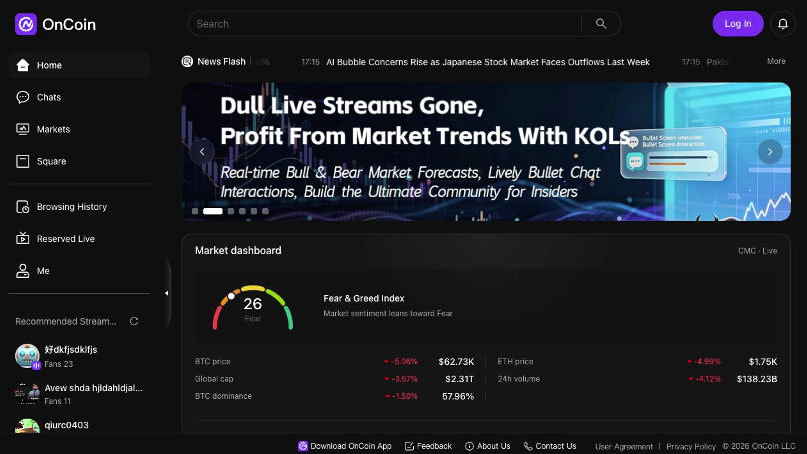
OnCoin is an example of a crypto-focused community where users can browse live streams, follow creators, join real-time conversations, review market information, and return to available replays. The platform is designed for discussion and discovery; it does not provide trading, wallet custody, asset management, or investment advice. A web3 streaming platform should make that purpose clear so viewers know what the service is designed to provide.
Why Live Crypto Content Is Different from Recorded Videos
Recorded videos can be edited, organized, and watched at any time. That makes them useful for tutorials, background explanations, and topics that do not change quickly. Live content serves a different purpose: it lets viewers follow a conversation while a market event, project announcement, or community question is still developing.
The live format can reveal uncertainty in a useful way. A creator may update an interpretation when new information appears, answer a question from the chat, or compare two possible explanations for the same price movement. Viewers can see not only the conclusion but also the reasoning process and the questions that remain unresolved.
Speed also creates risk. Early information may be incomplete, chat can amplify rumors, and a confident statement can sound more certain simply because it is delivered in real time. Live viewing is most valuable when it encourages better questions and independent checking rather than impulsive action.
What to Look for in a Crypto Streaming Platform
The right platform should make relevant content easy to find and give users enough context to judge what they are watching. These features are especially important for crypto audiences because topics, market conditions, and creator quality can vary widely from one stream to the next.
A useful review can be completed with a small, repeatable check: find a relevant category, open the stream details, sample the conversation, and then revisit the replay. This makes the decision based on the actual viewing experience rather than on a homepage promise or a single popular broadcast.
Clear Content Categories
A clear category system reduces the time spent searching through unrelated broadcasts. Useful categories might separate crypto market analysis, Bitcoin and Ethereum discussions, altcoins, blockchain technology, Web3 projects, gaming, and general entertainment. Categories do not guarantee quality, but they help viewers start with content that matches their purpose.
A useful crypto live streaming experience should also make it clear which sessions are live, which are scheduled, and which are replays. That simple distinction helps users choose between immediate discussion and content they can watch at their own pace.
Real-Time Chat and Moderation
Chat adds value when it helps viewers ask precise questions, request clarification, and compare experiences. It becomes less useful when repeated claims, promotional messages, or personal attacks overwhelm the topic. Look for visible moderation practices, reporting tools, and a community standard that keeps discussion constructive without suppressing reasonable disagreement.
Moderation is especially important around fast-moving market topics. A platform cannot verify every statement instantly, but it can make it easier to distinguish creator commentary, viewer opinion, and confirmed information. That separation helps users interpret the discussion with the right level of caution.
Useful Stream Titles and Descriptions
A title should tell viewers what the session is about without promising certainty. Specific wording is more useful than a vague claim that the market will move. A description can add the assets, event, time frame, or questions being covered. This information helps users decide whether a stream is relevant before they join.
Good titles also improve discovery after the broadcast. When a replay keeps its original topic and context, viewers can find it later through search or category browsing instead of relying only on a creator name or an unexplained thumbnail.
Replays That Remain Useful
A replay should do more than preserve a video file. It should retain the title, creator, topic, and surrounding context so that a viewer can understand what was discussed and when. This is important for a global audience because time zones make it impossible for everyone to attend a live session.
Replays also make accountability possible. Viewers can revisit an earlier claim, compare it with later developments, and evaluate whether the evidence and reasoning were sound. A useful archive therefore supports learning, not just endless consumption of new broadcasts.
A Range of Creator Perspectives
No single creator can cover every part of a market. One person may focus on charts, another on macroeconomic news, another on on-chain activity, and another on community or product developments. A healthy platform gives users ways to discover different perspectives without implying that one voice is always correct.
Compare how creators define their claims, cite sources, discuss uncertainty, and respond when new facts contradict an earlier view. This is more useful than judging a channel by popularity or by one prediction that happened to be correct.
How to Watch Crypto Streams Responsibly
Live discussion can improve market understanding, but the viewer still needs a process for separating facts from interpretation. A short checklist helps keep the format useful during periods of high emotion or rapid price movement.
- Identify the claim. Decide whether the speaker is describing a confirmed event, suggesting a possible explanation, or making a prediction about the future.
- Check the time frame and source. A statement about the next hour is different from a view about a project over several years, and a confident presentation is not a substitute for an original source.
- Compare the discussion with data. Look for an official announcement, market data, a chart, or another record that supports the specific part of the conversation you are evaluating.
- Consider alternatives. Ask what else could explain the move, whether chat is repeating an unverified claim, and what information would make the current interpretation less convincing.
- Revisit the replay when possible. Reviewing the original context makes it easier to see whether a claim depended on a timestamp, an incomplete fact, or a later correction.
- Keep the decision separate. Use the stream to discover questions and perspectives, then make independent judgments based on your own circumstances and risk tolerance.
The Role of Search and Discovery
Discovery determines whether a platform is useful before a viewer has built a following list. Search, topic pages, creator profiles, recommendations, and clear metadata all help connect a question with a relevant broadcast. The goal is not to maximize the number of thumbnails. It is to reduce the distance between the viewer’s information need and the right discussion.
For creators, discovery is equally important. A new analyst may have a strong perspective but little existing audience. Topic categories, descriptive titles, consistent schedules, and replay visibility can give useful content more opportunities to reach interested viewers. The platform should reward clarity and relevance, not only the largest existing audience.
Search also affects long-term value. A stream that can be found after the event becomes part of a knowledge archive. A stream that disappears from discovery as soon as it ends contributes less to education and makes it harder for users to review how a discussion developed over time.
Common Questions About Crypto Live Content
Are live crypto streams financial advice?
No. A live stream may include market opinions, explanations, or price predictions, but those statements are not guaranteed outcomes. Treat the discussion as information to review, verify important claims independently, and make decisions based on your own circumstances.
Is a Web3 live-streaming platform the same as a crypto exchange?
Not necessarily. A streaming service may provide live video, community chat, creator profiles, and replays without holding assets or processing trades. Check the platform description and terms so you understand whether it is a content service, a trading venue, a wallet provider, or something else.
Can I rely on a replay after a market event?
A replay can preserve what a creator and community discussed at a particular time, which makes it useful for review. It does not prove that every claim was correct. Check the timestamp, original sources, later updates, and the difference between an observed fact and an interpretation.
How should a beginner choose a stream?
Start with a specific topic rather than a broad prediction. Choose a stream with a clear title and description, observe whether the discussion distinguishes facts from opinions, and look for a moderated chat and an accessible replay. Begin with educational viewing and avoid treating urgency or popularity as evidence.
Live Streaming and the Future of Web3 Communities
Web3 communities are often distributed across social networks, chat groups, project pages, and market tools. Live streaming adds a shared place where these interests can meet. Viewers can listen to a creator, ask questions, compare reactions, and continue the conversation after the broadcast through follows, replays, or related discussions.
The strongest communities will likely combine specialization with openness. A crypto-focused platform can provide more relevant discovery and denser market context, while creators and viewers still benefit from links to primary sources, independent research, and broader communities. A good platform supports connection without asking users to surrender judgment.
This model can also help creators build a durable audience. Regular live sessions create a shared rhythm, while replays and topic pages let new viewers catch up later. Over time, the value of the community comes from the quality of its conversations, the usefulness of its archive, and the trust created by consistent, responsible participation.
Final Thoughts
Choosing a Web3 streaming service is less about finding a universal winner and more about matching the platform to the way you learn and participate. Viewers should look for clear categories, useful titles, active moderation, reliable replays, and a range of creator perspectives. Creators should also consider discovery, community tools, and whether the platform helps their work remain findable after a broadcast ends.
Live content can make crypto and Web3 discussions more timely and interactive, but speed is not the same as accuracy. The best viewing habit is to use live streams as a source of context, verify important claims independently, and treat predictions as opinions rather than promises. With that approach, a focused streaming community can become a practical part of ongoing research and learning.



-

 Resources5 years ago
Why Companies Must Adopt Digital Documents
-

 Resources4 years ago
A Guide to Pickleball: The Latest, Greatest Sport You Might Not Know, But Should!
-

 Resources1 year ago
50 Best AI Free Tools in 2025 (Tried & Tested)
-

 Resources1 year ago
Get Paid $5000+ a month to write : Discover 30 Spectacular Websites That Reward Your Writing Effort