Resources
EV Battery Contactor Selection: A Startup Procurement Checklist

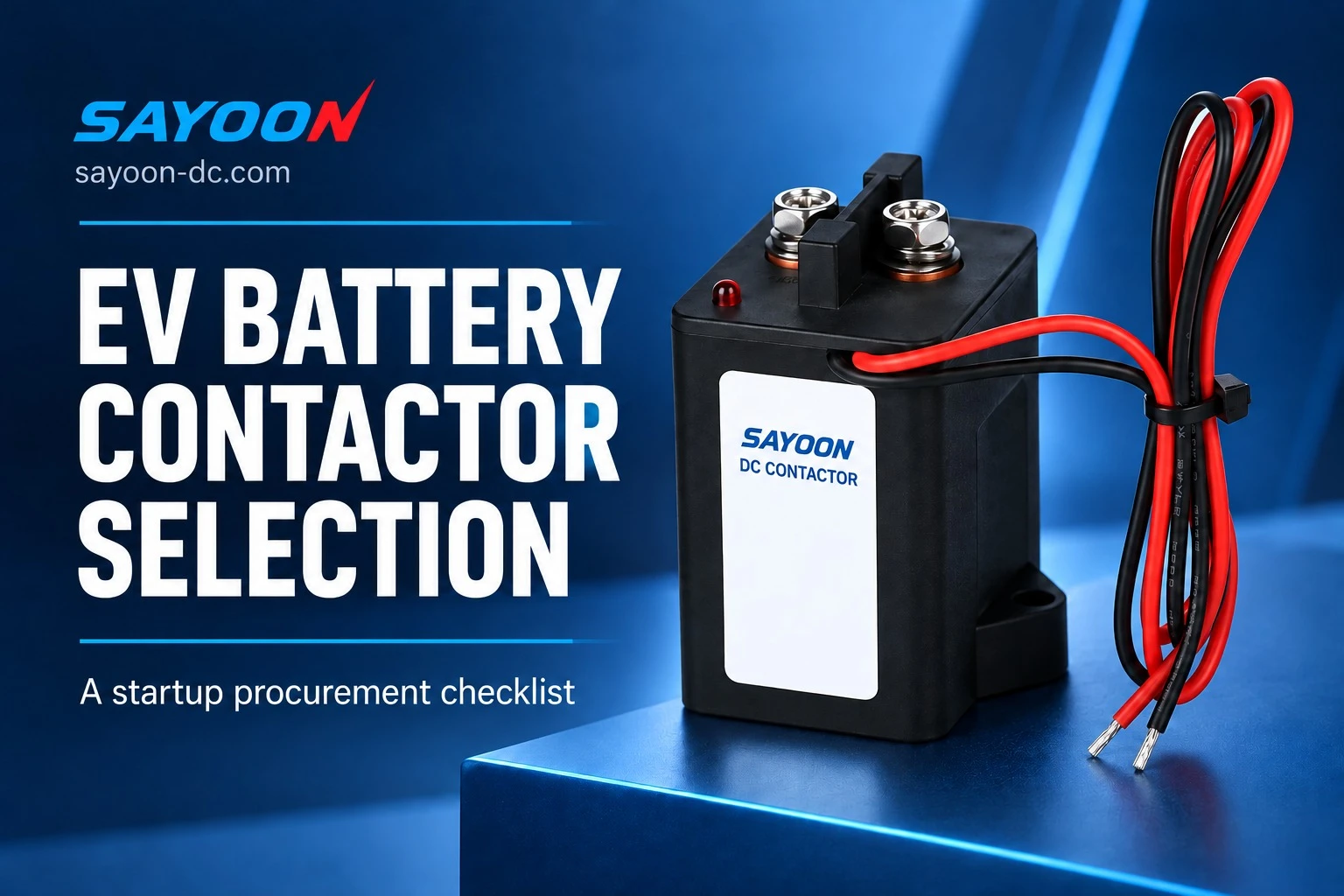
An electric vehicle startup can have a convincing battery prototype and still face difficult questions before its first production order. How will the battery connect to the inverter? What limits the current at startup? What happens if a switch fails to open? These questions belong in the product plan before the team freezes its enclosure, wiring harness and supplier list.
EV battery contactor selection is a system decision. A current rating alone cannot establish whether a device suits the pack. Founders and purchasing teams need an engineering brief that connects the battery, switching hardware, control software and validation work. The following checklist helps turn that brief into a useful supplier conversation.
1. Map the power path before comparing prices
Begin with a single-line diagram showing the battery, inverter, charger, protective devices and switching points. Identify which conductors must disconnect and how the system confirms the intended state. A common traction battery architecture includes positive and negative main contactors, together with a separate precharge path.
For teams learning how those functions fit together, SAYOON’s guide to positive and negative main contactors in an EV battery pack provides a starting point for the architecture discussion. The final arrangement still needs review against the vehicle’s own safety requirements.
Give each item on the diagram an owner. Someone must approve the contactor, someone must define the controller’s response, and someone must verify the assembled system. Leaving those responsibilities between suppliers makes it harder to resolve a failed test later.
2. Separate carrying current from switching current
A contactor can carry current for long periods, close onto a load, and interrupt a circuit under specified conditions. These are different duties. The team should describe all three rather than send a supplier only the battery’s nominal current.
Likewise, distinguish the low-voltage coil supply from the high-voltage power circuit. A coil voltage identifies a control requirement; it does not establish the voltage the main contacts may switch. Ask the engineer reviewing the part to confirm both circuits against the exact model documentation.
Prepare a requirements sheet before requesting quotations:
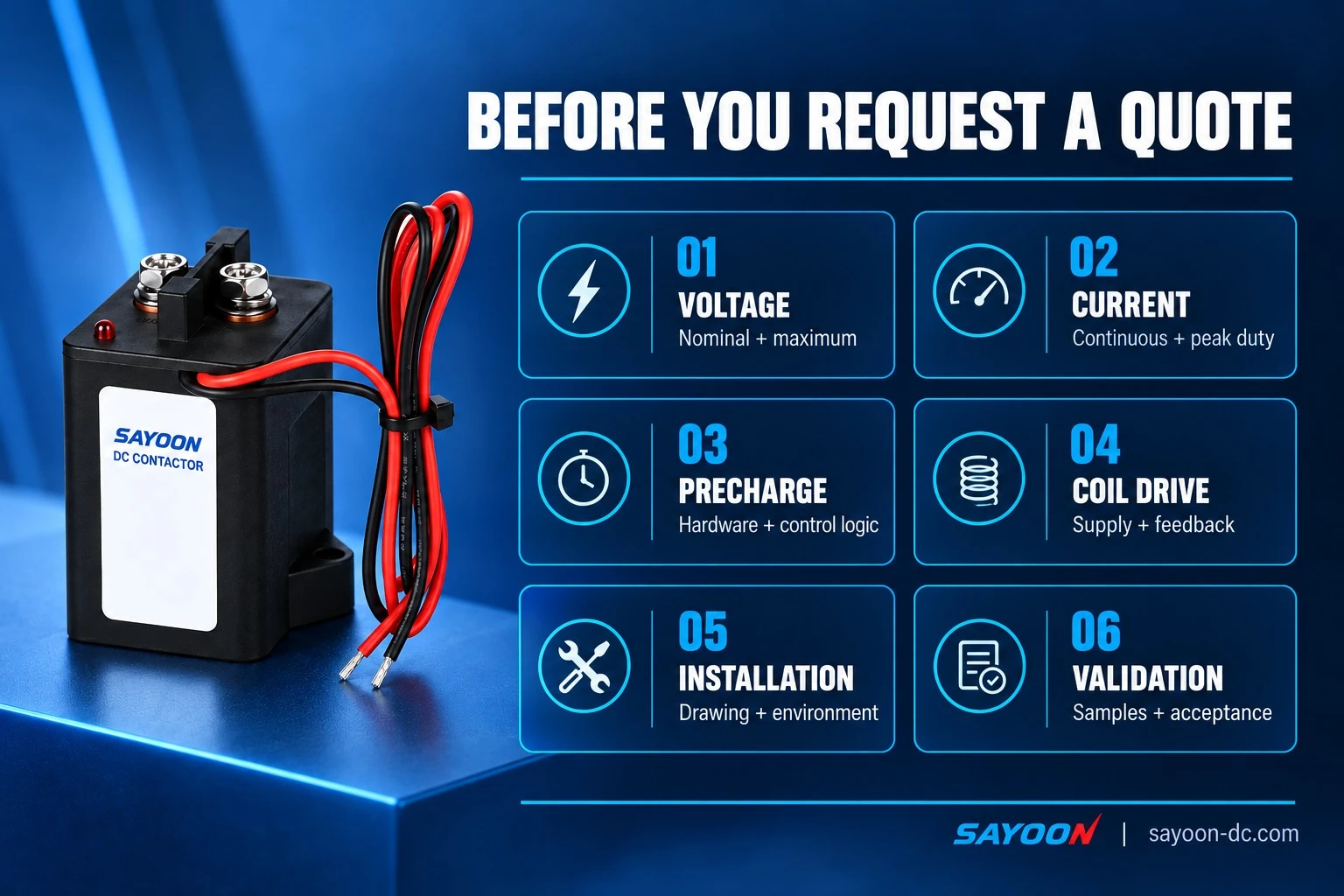
| Requirement | Information to provide | Evidence to request |
|---|---|---|
| Battery voltage | Nominal and maximum operating voltage | Model-specific voltage and switching limits |
| Load profile | Continuous current, peaks and duration | Applicable thermal conditions and duty limits |
| Current direction | Driving, charging and regeneration conditions | Approved polarity and bidirectional capability |
| Control interface | Coil supply range, driver and feedback needs | Coil option, wiring and response information |
| Installation | Space, terminal layout and operating environment | Drawing, mounting instructions and applicable ratings |
| Protection | Fuse strategy and expected fault conditions | Coordination information for engineering review |
Record where each requirement came from. A measured current trace, a controlled drawing and an estimate should remain distinguishable. If a value is unknown, assign it as an engineering action rather than filling the space with a convenient catalogue number.
3. Treat precharge as a planned function
The inverter’s DC-link capacitor creates a particular startup challenge. Charging it abruptly can produce a large inrush pulse. A precharge path limits that initial current before the main power connection is established, reducing the risk of damage to the switching path.
Texas Instruments’ reference design TIDA-050080, documented in design guide TIDUF73, explains the capacitor-charging principle and why component selection must account for the precharge pulse. It also distinguishes the precharge function from the discharge path used to remove stored capacitor energy.
For a procurement team, the practical task is to ask what is actually included. A main contactor quotation does not automatically include the resistor, precharge switch, sensing, discharge hardware or controller logic. Put those items on the bill of materials and assign responsibility for their interfaces.
SAYOON’s explanation of precharge and main contactor sequencing can help structure that discussion. Ask the engineering team to document the measured conditions for progressing through the sequence and the response when those conditions are not met. Do not adopt another project’s timing values without validation.
4. Make the supplier comparison specific
Compare quotations against the same requirement revision. Otherwise, a cheaper offer may simply cover a different coil option, mounting arrangement or operating duty. The purchasing team should be able to point to the exact drawing and part number behind every shortlisted price.
For a relevant product starting point, review SAYOON’s HEV series high-voltage DC contactors, then request confirmation for the intended application. A product family page helps identify candidates; it does not approve every member of that family for a particular vehicle.
Ask for documents that apply to the proposed model and configuration. Check the scope of any certification claim, the drawing revision, terminal identification, coil information and available test evidence. Keep unresolved questions visible in the comparison sheet so that a purchasing deadline does not silently turn an assumption into an approved requirement.
5. Define sample acceptance before placing the order
A sample evaluation should answer questions established in advance. Agree which measurements the engineering team will capture, what operating conditions it will cover, and who can approve the results. Include startup and shutdown behavior, the control interface, thermal performance and the fault responses required by the system design.
Define how the team will preserve the first evidence of a problem. Record the hardware revision, controller version and test conditions alongside the result. An intermittent failure is difficult to investigate if a replacement sample arrives before anyone records what happened.
High-voltage work requires qualified personnel, suitable equipment and controlled procedures for isolation and stored energy. This checklist supports planning and purchasing; it is not a wiring procedure or permission to energize a prototype.
6. Keep production changes connected to validation
Before the pilot build, agree how substitutions and revisions will be handled. A changed coil, driver, terminal arrangement or part revision should trigger a documented review of the affected interfaces. Identify which changes require further testing before the next shipment is accepted.
Commercial questions belong in the same release package: sample availability, agreed lead times, traceability, packaging and the process for investigating a returned unit. Request written answers for the proposed order rather than treating a general sales statement as a production commitment.
The useful outcome is a purchasing decision that engineering, software, quality and service teams can all explain. A reviewed power-path diagram, a complete requirements sheet and an agreed acceptance plan give a startup a stronger foundation for its first production order.



-

 Resources5 years ago
Why Companies Must Adopt Digital Documents
-

 Resources4 years ago
A Guide to Pickleball: The Latest, Greatest Sport You Might Not Know, But Should!
-

 Resources1 year ago
50 Best AI Free Tools in 2025 (Tried & Tested)
-

 Resources1 year ago
Get Paid $5000+ a month to write : Discover 30 Spectacular Websites That Reward Your Writing Effort