Blogs
Rikki Hackett: Why Startup Skills Won’t Get You to Nasdaq

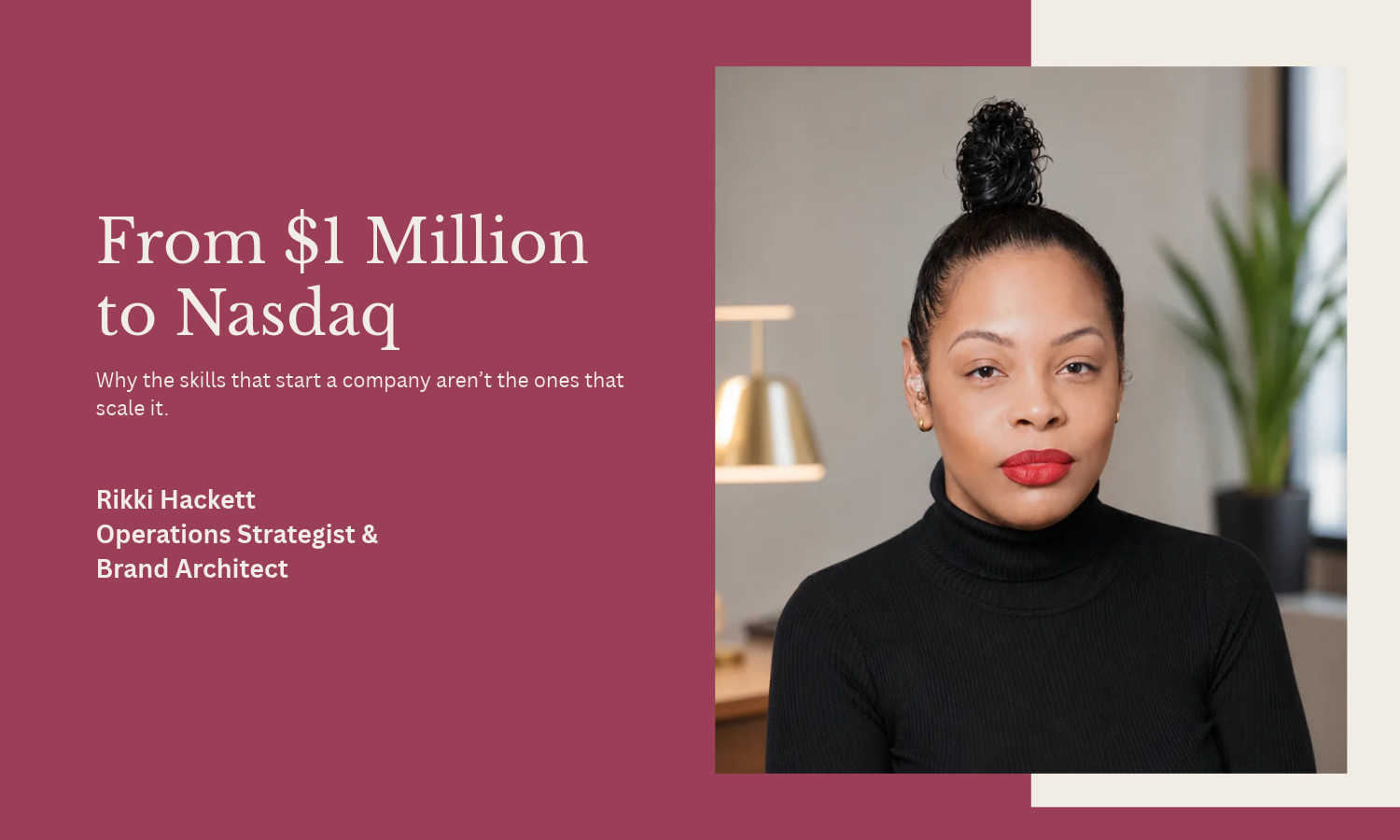
The instincts that help a startup survive its earliest days are often the same ones that eventually make scaling harder.
Rikki Hackett has spent nearly two decades building and scaling companies through the transition from scrappy startup to increasingly complex organization, including SurgePays, a Nasdaq-listed fintech company that grew from roughly $50 million in revenue in 2021 to $137 million in 2023.
An Entrepreneur, Operations Strategist, and Brand Architect, Hackett’s work sits at the intersection of business building, organizational psychology, and operational systems. She focuses on three connected areas: brand positioning, marketing, and operational architecture. Much of that work centers on removing founder bottlenecks, rebuilding the systems companies use to measure performance, and creating infrastructure that can support growth rather than simply survive it.
For much of her career, she did that work quietly.
“I’ve always been more interested in building the thing, than being known for building the thing,” Hackett says. “I would go in, solve what needed to be solved, build the infrastructure, help create the growth, and then disappear back into the work.”
That experience has shaped how she thinks about scale. To Rikki Hackett, it is less about size than whether the business can continue to perform as complexity increases.
Hackett says, “Startups are rewarded for figuring it out. Scale is where you find out whether you actually built anything repeatable.”
When Scrappiness Stops Working
Early-stage companies are incomplete by definition, and talented people often fill the gaps.
Someone remembers the process that was never documented. Another employee catches problems before they reach the customer. The founder can personally step into almost anything.
That flexibility is useful. It can also create the impression that the company has stronger systems than it really does.
“Some of the most dangerous processes in a growing company are the ones everyone thinks are working,” Hackett says. “Sometimes they are only working because a really capable person is quietly holding the entire thing together.”
The distinction becomes harder to ignore as the company grows.
More customers create more exceptions. More employees create more handoffs. More products create more decisions. The informal mechanisms that once made the business fast begin introducing inconsistency and risk.
What looked like agility starts to become operational fragility, and founder involvement can follow the same pattern.
Rikki Hackett does not see deep founder involvement as something that should disappear early. In the beginning, it can be one of the company’s biggest advantages.
Hackett says, “In the beginning, having the founder involved in everything can be a competitive advantage. Eventually, it becomes the ceiling.”
The problem is not that the founder is still involved. It is that the organization cannot function without that involvement.
A founder can delegate dozens of tasks and still remain the decision point for all of them. A leader can technically own a function while still needing approval for every consequential move. Responsibility can move without authority moving with it.
On that point, Hackett says, “If everything still has to come back to the founder, you haven’t scaled the business. You’ve scaled the founder’s workload.”
Her use of organizational psychology becomes especially relevant here. Scaling is not simply about documenting processes. It is about understanding how authority, information, accountability, and decision-making move through a company.
The real transition happens when individual capability becomes organizational capability without stripping away the speed and judgment that made the startup successful in the first place.
Infrastructure Should Follow the Stage
Rikki Hackett’s argument is not for more process. It’s for the right amount of process at the right time.
Too little structure creates fragility. Too much structure too early creates drag.
“Operational excellence isn’t about giving a startup more process,” says Hackett. “It’s about giving the company exactly enough structure for the stage it’s entering next.”
She frames that evolution simply:
Make it work.
Make it repeatable.
Make it measurable.
Make it accountable.
Then make it defensible.
Those stages reflect different business problems.
At first, the company has to prove that something works. Then it has to prove that the result can be reproduced without depending on the exact people who created it the first time.
After that comes measurement.
That is where Hackett’s work around KPI systems becomes important. Companies often accumulate metrics as they grow, but more reporting does not necessarily create better visibility. What matters is whether leadership can see what is working, where performance is breaking, and who owns the outcome.
Accountability becomes difficult when measurement is weak. Defensibility becomes impossible when the company cannot explain why decisions were made or demonstrate how the business actually operates.
Hackett expanded on this thought by saying, “The goal isn’t to make a startup operate like a public company before it needs to. The goal is to make sure today’s decisions don’t prevent it from ever becoming one.”
That perspective comes in part from operating inside businesses as the expectations around them changed.
More scale brings more stakeholders, more scrutiny, more financial consequences, and less tolerance for ambiguity. The company eventually has to become understandable to people who were not there when it was built.
The point is not to anticipate every future requirement. It is to make sure infrastructure evolves deliberately instead of being built only after something breaks.
Growth Is Not the Same as Health
Hackett says that one of the hardest times to recognize operational weakness is when the company appears to be succeeding.
Revenue is growing. Customers are arriving. The team is hiring. New technology is being added.
Those are usually treated as signs of health.
They can also hide problems.
Hackett puts it plainly: “A company can absolutely grow itself into trouble. Revenue is not proof that the operation underneath it is healthy.”
Growth can mask deteriorating margins, overloaded teams, inconsistent customer experiences, fragmented technology, or processes that require more manual effort every time volume increases.
The instinct is often to add resources.
That is where Hackett tends to slow the conversation down.
“Before I add a person, I want to know whether I’m adding capacity or adding another human workaround,” Hackett says.
Sometimes the company genuinely needs more people. Other times, headcount is being used to compensate for unclear ownership, unnecessary approvals, duplicated work, poor tooling, or a process that should have been redesigned first.
The same concern applies to AI and automation.
To that, Hackett says, “Automation doesn’t fix a broken process. It just gives the broken process the ability to move faster.”
For Hackett, technology creates leverage only after the company understands what the work is supposed to accomplish. Otherwise, it can add complexity while making the underlying problem harder to see.
That is also why she does not view operations, marketing, and brand positioning as isolated disciplines.
A company can create demand it is not operationally prepared to fulfill. It can make promises to customers that its systems cannot consistently support. It can scale acquisition faster than retention, fulfillment, service, or margin.
Sustainable growth requires those pieces to work together.
After enough years moving between companies and industries, the recurring problems become easier to spot.
“After enough years in operations, you stop seeing isolated problems and you start seeing patterns. Different company, different product, different personalities, same structural failure.” says Hackett.
That pattern recognition is now a large part of the value Rikki Hackett brings to founders.
The surface issue might be hiring, reporting, customer experience, or a founder who cannot get out of every decision.
The deeper question is often structural: what has the company outgrown, and what needs to exist next?
For someone who spent much of her career building rather than talking publicly about building, that distinction matters.
“I don’t believe being visible makes you an expert,” Hackett says. “The work has to exist when nobody is watching.”
The same principle applies to the companies she works with.
The real test is not whether the organization looks sophisticated from the outside. It is whether the business can continue producing the result when the founder is not in every room, the original employees are no longer carrying every exception, and growth makes improvisation too expensive to remain the operating model.
That does not mean losing the qualities that made the startup work. Speed still matters. Founder instinct still matters. Experimentation still matters. What changes is the company’s ability to support those strengths with systems that do not collapse as the stakes get higher.
That, ultimately, is the shift from building something that can grow to building something that can endure.
As Hackett puts it, “I don’t just build brands. I build the systems that allow them to last. If you can see it clearly, I can structure it, scale it, and make it sustainable.”


-

 Resources5 years ago
Why Companies Must Adopt Digital Documents
-

 Resources4 years ago
A Guide to Pickleball: The Latest, Greatest Sport You Might Not Know, But Should!
-

 Resources1 year ago
50 Best AI Free Tools in 2025 (Tried & Tested)
-

 Resources1 year ago
Get Paid $5000+ a month to write : Discover 30 Spectacular Websites That Reward Your Writing Effort