Resources
Moving Beyond the Prototype: Why Most Startup AI Projects Fall Short (and What to Do About It)


It’s 2 AM in an open-office space in Bengaluru. The caffeine has long worn off, but the energy in the room is electric. After three weeks of intensive data cleaning, hyperparameter tuning, and frantic troubleshooting, the lead data scientist hits execution on the final cell of a Python notebook. The screen blinks back a beautiful metric: Validation Accuracy: 94.2%.
The team cheers. High-fives are exchanged. They’ve done it. They have built a machine learning prototype that works like absolute magic in their local environment. The next morning, they proudly show the demo to the CEO. The interface looks slick, the predictions are sharp, and everyone is ecstatic. Then, the product head leans forward, smiles, and asks the ultimate, high-stakes question: “This is incredible. So… how do we roll this out to our live users?”
The room goes incredibly quiet.
This is the exact moment where the romantic honeymoon phase of data science ends, and the grueling, high-stakes reality of systems engineering begins.
DevOps vs. MLOps: Why Code Versioning Isn’t Enough
Many fast-growing startups make a fundamental mistake: they treat machine learning deployment exactly like traditional software deployment. But standard DevOps and AI-focused MLOps are entirely different beasts.
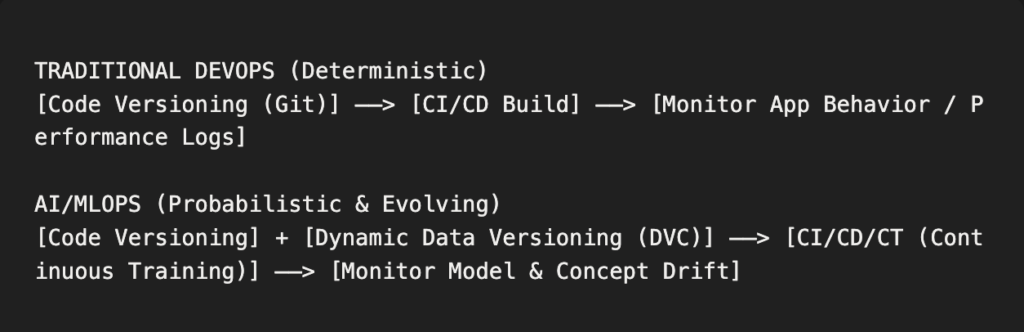
In traditional software systems, the operational loop is relatively straightforward. Your logic is deterministic. You version your code using Git, build your application, deploy it, and monitor how that code behaves under load in production. If the code doesn’t change, its output behavior remains predictable.
In AI systems, you are dealing with a living, probabilistic asset. You aren’t just deploying static code; you are deploying a combination of code AND evolving data. This dual dependency introduces entirely new operational challenges:
- Dual Versioning: While DevOps focuses solely on tracking code changes, MLOps requires you to version the exact, immutable data states used to train your models. If you can’t recreate the dataset training state, you can’t reproduce the model.
- Dual Monitoring (Code vs. Predictions): Traditional monitoring checks if your API is up and your memory usage is low. MLOps demands you monitor Model and Concept Drift—comparing real-world inputs against the baseline datasets your model was originally built on to catch silent validation decay before your users do.
The Anatomy of an AI Pipeline: Sandbox vs. Production
To understand why this transition catches so many teams off guard, we have to look at the structural difference between a research experiment and a living software product. A model inside a sandbox is an isolated calculation engine; a model in production is a multi-layered ecosystem that must continuously ingest data, handle live traffic, and monitor its own health.
Building a predictive asset or fine-tuning a small open-weights model inside a private playground is a brilliant opening act. But to unlock actual commercial value, that model has to leave the safe cradle of the local sandbox. It has to survive in the wild—facing a chaotic barrage of concurrent API calls, network fluctuations, and unpredictable data inputs from real human users, all while keeping server response times under 100 milliseconds.
Unfortunately, this is the exact bridge where most fast-growing software teams run into a brick wall. Let’s look at why so many promising startup AI features quietly stall out in prototype purgatory, and how tech leads can build an architectural foundation meant to scale from day one.
The Hidden Chaos at the Cloud Edge
When we build traditional web or mobile applications, the path to production is a well-paved, linear highway. You write the code, commit it to Git, run automated tests, containerize it, and deploy it to a server. It is entirely deterministic.
Machine learning completely disrupts this comfortable rhythm because it introduces an unpredictable, living third variable into the equation: dynamic data.
When you try to force a living, breathing statistical model into rigid, traditional software pipelines, the system begins to crack in highly specific ways:
1. The Laptop-to-Cloud Mirage
We’ve all heard the phrase, “But it worked perfectly on my machine!” In machine learning, this problem is magnified tenfold. A model might hum along beautifully on an engineer’s local workstation equipped with localized drivers and specific memory allocations. But the moment you containerize it and push it to a distributed cloud cluster, it can crash instantly or slow to a crawl. This is usually driven by hidden background dependencies, underlying CUDA driver mismatches, or silent structural differences between local CPU vectorization and the cloud host’s GPU acceleration layout.
2. The Nightmare of Data Shifting
Startups survive by moving at a breakneck pace. Code is constantly refactored, features adapt to user feedback, and models are continuously retrained on the fly. But if your team is modifying datasets without maintaining a strict, unchangeable historical log of truth, you are building on shifting sand. When a model suddenly starts delivering erratic predictions to your users three weeks after launch, debugging becomes a nightmare. Without data lineage, you can’t recreate the exact data state that trained that specific version of the model.
3. The Great Architectural Handoff Gap
Data scientists naturally excel at statistical analysis, hyperparameter exploration, and working inside loose, non-modular environments like Jupyter notebooks. Backend engineers, on the other hand, are obsessed with stateless system reliability, memory constraints, and structural maintainability. When a data scientist hands over a massive, unorganized script to a software engineer to “make it production-ready,” the manual translation process introduces deep technical debt, fragile code hooks, and unhandled runtime exceptions.
4. Chasing Metrics While Burning Capital
It is incredibly easy for an engineering team to fall into the rabbit hole of mathematical optimization. They will happily burn thousands of dollars in cloud compute budgets and exhaust weeks of development time trying to push a model from 92% to 94% accuracy. Meanwhile, they completely ignore production realities: Can the server handle a traffic spike? What is the execution latency per request? Is the cloud bill for running these massive matrix multiplications going to bankrupt the startup before month-end?
The Decoupled Stack for Production-Ready AI
To turn a volatile prototype into a dependable product feature, engineering teams must stop treating machine learning like a one-off research experiment and start managing it as an exact engineering discipline. Your data architecture must separate raw data preparation from the underlying application serving layer.
Building this decoupled framework safely requires deploying highly specialized systems across three fundamental infrastructure layers:
- Data Lineage & Feature Management: Utilizing tools like Feast (Feature Store) provides your systems with an isolated, low-latency data hub that completely prevents training-serving data skew. Pairing this with DVC (Data Version Control) allows teams to treat datasets like code repository commits, ensuring complete reproducibility across every single system state.
- Workflow Modularity & Automation: Replacing fragile, manual execution scripts with event-driven orchestrators like Dagster or Prefect enables your team to cleanly map, schedule, and automate complex data dependency graphs. Enforcing code layout rules via frameworks like Kedro ensures that individual code blocks remain clean, highly modular, and easily readable by any engineer who joins the project.
- Serving Environments & Model Repositories: Transitioning away from bulky, traditional server layouts toward asynchronous web engines like FastAPI allows developers to expose serialized models behind lightweight, low-overhead REST endpoints built to handle rapid request cycles. All concurrent test configurations and historical versions should be registered in a unified control dashboard like MLflow to maintain an unambiguous system record.
Shifting from Code Scripts to Living Systems
Choosing the right software packages is only half the battle; your engineering organization must align around an automated, continuous iteration loop. True system reliability is achieved by deploying end-to-end pipelines early in the development lifecycle—intentionally testing them to their breaking points, introducing synthetic traffic spikes, and continuously monitoring for model decay.
Cultivating this rigorous, systems-first engineering discipline is the primary core focus of the advanced architectural documentation and training tracks at 123 of AI. If your engineering goals extend beyond quick scripts and fragile wrapper APIs, their masterclasses provide zero-fluff, hands-on learning paths directly relevant to enterprise scaling. To explore their detailed, first-principles blueprints on robust data pipeline design, distributed container orchestration, and production-grade MLOps architectures, access their official repository at 123 of AI to learn how to deploy resilient software that performs flawlessly under intense, real-world conditions.
A Practical Playbook for Engineering Leaders
If you are leading a technical team, you don’t need to completely overhaul your entire infrastructure stack overnight. You can protect your startup from expensive deployment delays by guiding your developers through four progressive milestones:
- Enforce Modular Decoupling: Mandate that all loose data-cleaning and model scripts are immediately refactored into structured, reusable independent code modules using tools like Kedro.
- Isolate the Inference Logic: Keep your core machine learning configurations completely separate from your main application backend. Wrap your serialized models inside containerized microservices and serve them via independent FastAPI endpoints.
- Set Up a Shared System of Record: Launch a centralized MLflow server and ensure that every single experiment, hyperparameter, and metric run is automatically logged and transparently auditable by the entire team.
- Deploy Drift and Telemetry Guardrails: Don’t wait for user complaints to find out your model is failing. Implement basic real-time data validation to evaluate incoming inputs, comparison pipelines to check for baseline statistical changes, and alerting systems to catch silent concept drift before it skews your core application logic.
Real-World Resilience Trumps Academic Perfection
In academic environments and AI research competitions, success is measured strictly by fractional percentage gains on a static, immaculate test dataset. In the real world of competitive business, those numbers become completely secondary to structural health and systemic resilience.
When your platform experiences a sudden surge in concurrent real-world traffic, no customer cares how high your model’s validation accuracy was in the laboratory if the underlying server chokes on memory allocations and crashes under load. True production validation means looking closely at your operational realities: Can your API handle corrupted, chaotic user inputs gracefully without throwing a system-wide exception? If your lead developer leaves tomorrow, can a newly boarded software engineer clone the repository, audit the pipeline, and safely ship an update without breaking the live product?
Final Thoughts
At the end of the day, most startup AI initiatives fail not because the underlying code logic is flawed, but because the technical infrastructure beneath them is fractured. When repositories lack modularity, data tracking is non-existent, and live deployments rely on manual configurations, scaling your system efficiently becomes an impossible guessing game.
To successfully turn advanced prototypes into resilient, user-facing software features, teams must stop treating machine learning as an unconstrained research experiment and manage it as a definitive systems engineering challenge. Invest your time in the foundational layers, utilize automated pipelines, and build disciplined technical architectures. That is how you turn a volatile local demo into a highly scalable, rock-solid production system that performs under pressure.


-

 Resources5 years ago
Why Companies Must Adopt Digital Documents
-

 Resources4 years ago
A Guide to Pickleball: The Latest, Greatest Sport You Might Not Know, But Should!
-

 Resources1 year ago
50 Best AI Free Tools in 2025 (Tried & Tested)
-

 Resources1 year ago
Get Paid $5000+ a month to write : Discover 30 Spectacular Websites That Reward Your Writing Effort