Tips and support
Why DevOps Development Services Make Shipping Easy

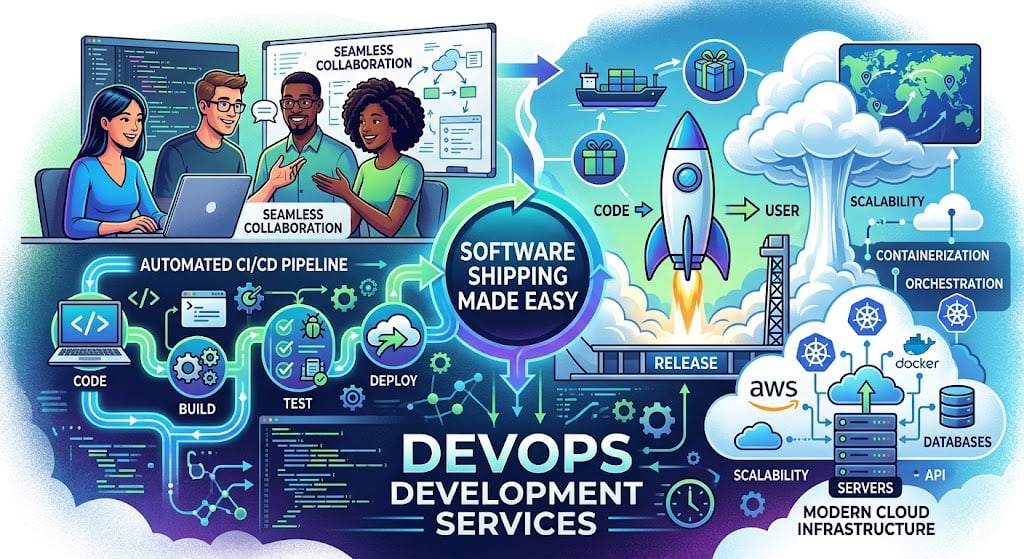
Shipping software should feel boring. In most teams, it feels like a gamble. Someone pushes a change on Friday, crosses their fingers, and hopes the weekend stays quiet. That tension is the clearest sign a team needs real devops development services. Good ones take the drama out of releasing, so a deploy is just another Tuesday.
And the cost of the drama is bigger than one bad night. Slow, scary releases make teams ship less often. Ship less often, and each release gets larger and riskier. The fear feeds itself.
What devops development services actually do
Strip away the jargon, and the job is simple. Get code from a developer laptop to live users quickly, safely, and often. The craft is doing all three without breaking things.
Good devops development services build the plumbing that makes this routine. Code gets tested the moment it is written. A release that goes wrong rolls back on its own. The server setup lives in files, so you can rebuild it from scratch in minutes, not days.
The parts that do the work
- Pipelines that build, test, and release code without hand-holding.
- Infrastructure written as code, so every setup is repeatable.
- Automatic rollback, so a bad deploy undoes itself in seconds.
- Monitoring that spots trouble before a customer has to report it.
Speed comes from safety, not shortcuts
People assume shipping fast means cutting corners. The opposite is true. Teams ship fast because they feel safe, not because they skip the checks.
When a pipeline tests every change and can undo a mistake in a click, a developer stops being scared. They push small changes often. Small changes are easy to review and easy to fix. The result is a team that moves quickly because nothing it does is risky enough to slow down.
Where data engineering for AI comes in
Now add AI to your product, and a new kind of release shows up. You are not just shipping code anymore. You are shipping models, and models run on data. That data has to arrive clean, fresh, and on time, or the model makes bad calls.
This is the job of data engineering for ai. It builds the pipelines that carry data to your models the same way a deploy pipeline carries code to production. Both need to be automatic. Both need to be watched. A broken data feed hurts just as much as a broken deploy, only it is harder to spot.
So the two belong together. Careful data work keeps the models fed, and the deploy discipline keeps the whole thing shipping. Treat them as one pipeline, and your AI features ship as calmly as any other feature.
What actually changes for the team
The real payoff is not a chart. It is how the week feels.
- A developer fixes a bug in the morning and sees it live by lunch.
- A release goes out mid-week, not squeezed into a scary Friday slot.
- A failure gets caught and rolled back before most users notice.
- Nobody spends the weekend on call for a deploy that went sideways.
None of this is magic. It is the quiet result of good setup. Once the plumbing is right, the fear goes away, and the team gets its evenings back.
How to choose the right partner
The partner you pick decides whether releases get calmer or just more automated chaos. A few signals help you tell them apart.
- They make deploys routine, not just faster versions of a risky thing.
- They build in rollback and monitoring from the start, not later.
- They understand data pipelines, not only code pipelines.
- They can point to live systems they keep running, not just slides.
A partner who plans for the day a release goes wrong is the one worth hiring. Trouble is a question of when, not if, and the good ones know it.
Frequently asked questions
What are devops development services?
They are the work of building the systems that move code from development to production safely and often. That covers pipelines, infrastructure as code, monitoring, and rollback.
How do devops development services speed up releases?
By making each release small, tested, and reversible. When a deploy is safe, teams ship often, so changes stay small and quick to review.
What is data engineering for AI?
It is the work of building the pipelines that carry clean, current data to your models. Done well, it keeps a model fed the way a deploy pipeline keeps code flowing.
Why do DevOps and AI data work belong together?
Both are pipelines that have to run automatically and get watched. A broken data feed hurts a product as much as a broken deploy, so the same discipline covers both.
How do we start without a big rebuild?
Begin with automated tests and one-click deploys on a single service. Add monitoring and rollback. Prove the calm, then extend it to the rest.
The bottom line
Shipping should be dull, and that is a good thing. Strong devops development services make a release feel routine, so teams ship small, ship often, and sleep through the night. And once AI enters the product, with its own hungry data pipelines, the same discipline keeps the models flowing too. Get the plumbing right, and the drama simply goes away.


-

 Resources5 years ago
Why Companies Must Adopt Digital Documents
-

 Resources4 years ago
A Guide to Pickleball: The Latest, Greatest Sport You Might Not Know, But Should!
-

 Resources1 year ago
50 Best AI Free Tools in 2025 (Tried & Tested)
-

 Resources1 year ago
Get Paid $5000+ a month to write : Discover 30 Spectacular Websites That Reward Your Writing Effort