Resources
Augment AI: How Businesses Can Empower Employees and Build Smarter Operations


Introduction
Artificial intelligence is changing how businesses operate, but its greatest value may not come from replacing human workers. Instead, it comes from helping people perform their jobs more effectively.
As organizations face increasing pressure to improve productivity, respond to customers faster, and manage complex workflows, augment AI is emerging as an important business strategy. Rather than treating AI as a standalone automation tool, companies can use it to strengthen human capabilities, support better decisions, and reduce the time employees spend on repetitive tasks.
This approach is particularly relevant for businesses managing large customer service teams, international operations, and information-intensive processes. Employees need to access accurate information quickly, understand customer needs, and make decisions without creating unnecessary delays.
By combining AI-powered tools with human expertise, businesses can improve operational performance while preserving the judgment, creativity, and empathy that technology alone cannot fully reproduce.
Understanding how to augment AI effectively is therefore becoming an important consideration for organizations seeking sustainable growth.
What Does Augment AI Mean in Business?
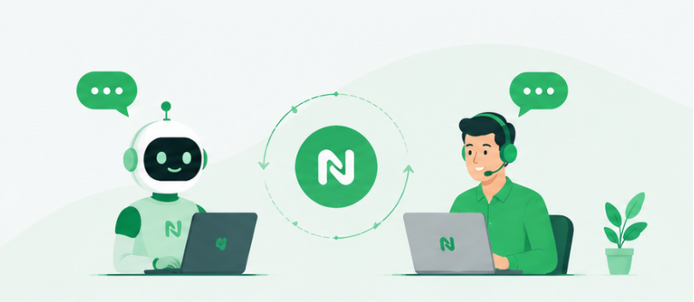
To augment AI means using artificial intelligence to enhance human capabilities, improve existing workflows, and help employees accomplish tasks more efficiently.
Unlike a fully automated process designed to operate without human involvement, an AI-augmentation model keeps people actively involved in decisions and outcomes. AI handles information processing, pattern recognition, content summarization, and other suitable tasks, while employees provide context, judgment, and accountability.
For example, a customer service representative may spend several minutes reviewing a customer’s interaction history before responding to an inquiry. An AI assistant can summarize previous conversations, identify relevant product information, and suggest possible responses. The employee then reviews the information and decides how to address the customer’s needs.
The technology reduces preparation time without removing the employee’s responsibility for delivering appropriate service.
AI augmentation can support a wide range of business functions, including customer engagement, sales, marketing, knowledge management, software development, and internal operations.
The objective is not simply to introduce more technology. It is to help people use their time, skills, and information more effectively.
Why AI Augmentation Is Becoming a Business Priority
Many organizations already use digital tools to manage daily activities. However, employees may still spend substantial time switching between systems, searching for documents, reviewing information, and completing repetitive administrative work.
AI augmentation offers a way to address these challenges without requiring every process to be redesigned from the beginning.
1. Improving Employee Productivity
AI can assist with drafting emails, summarizing documents, preparing reports, categorizing requests, and retrieving relevant information.
These capabilities allow employees to spend less time on routine preparation and more time on tasks that require specialized knowledge or direct interaction with customers.
For example, a sales team can use AI to summarize account histories and prepare meeting briefs. Sales representatives can then focus on understanding customer objectives and developing appropriate proposals rather than manually collecting information from multiple sources.
Productivity gains depend on the quality of implementation, the complexity of the work, and employees’ ability to verify AI-generated outputs. Businesses should measure actual improvements instead of assuming that adopting an AI tool automatically increases efficiency.
2. Supporting Better Decision-Making
Modern organizations generate large volumes of operational data, but having more information does not necessarily lead to better decisions.
AI can help employees identify patterns, compare information, summarize customer feedback, and highlight potential risks that deserve further investigation.
A customer experience manager, for instance, could use AI to analyze recurring complaints and identify which issues appear most frequently. The manager can then investigate the underlying causes and determine whether changes to product documentation, training, or service procedures are necessary.
AI supports the decision-making process, while human employees remain responsible for evaluating the findings and choosing the appropriate response.
3. Preserving Human Expertise While Scaling Operations
As businesses expand, maintaining consistent service quality becomes more difficult. New employees require training, experienced staff become responsible for more cases, and internal knowledge may remain distributed across different departments.
AI-powered knowledge assistants can help employees locate approved procedures, product information, and troubleshooting guidance when they need it.
This can reduce dependence on informal knowledge-sharing and make expertise more accessible across teams.
For international businesses, the same principle can support employees working across different languages, markets, and time zones. AI can assist with translation, summarization, and information retrieval, while local teams provide the cultural and contextual understanding needed for effective communication.
Key Applications of AI Augmentation Across Business Functions

AI augmentation becomes more useful when organizations connect it to specific employee needs and measurable operational outcomes.
| Business function | How AI augmentation works | Potential benefit |
| Customer service | Summarizes conversations and suggests responses | Faster case handling and more consistent support |
| Sales | Prepares account summaries and meeting briefs | More time for customer relationships |
| Marketing | Assists with research, content drafts, and audience analysis | More efficient campaign development |
| Human resources | Helps organize recruitment information and internal policies | Reduced administrative workload |
| Operations | Identifies workflow patterns and summarizes performance data | Better visibility into operational issues |
| Training and development | Provides access to learning materials and contextual guidance | Faster knowledge access |
| Management | Consolidates reports and highlights emerging trends | More informed planning and prioritization |
These applications should be selected according to business priorities. A company experiencing long customer response times may benefit more from AI-assisted support than from deploying a general-purpose content generation tool across every department.
How to Implement AI Augmentation Successfully
Successful AI augmentation requires a clear understanding of existing workflows, employee needs, and the risks associated with automated recommendations.
Step 1: Identify Tasks That Benefit from AI Assistance
Begin by examining how employees spend their time. Look for repetitive, information-heavy activities that consume resources without requiring extensive human judgment at every step.
Examples include searching for internal information, summarizing customer histories, categorizing incoming requests, and preparing routine reports.
Tasks involving complex ethical decisions, sensitive personal circumstances, or high-impact outcomes generally require stronger human oversight.
The goal is to identify where AI can remove friction while allowing employees to retain control over meaningful decisions.
Step 2: Establish Reliable Data and Knowledge Sources
AI tools are only as useful as the information they can access and the processes used to validate their outputs.
Businesses should organize internal documentation, standard operating procedures, product information, and approved customer service policies. They should also establish rules for keeping this information accurate and up to date.
Where possible, AI assistants should retrieve answers from trusted sources and provide supporting references so employees can verify important details.
This is especially important in customer-facing operations, where inaccurate information can damage trust or create additional service problems.
Step 3: Integrate AI Into Existing Workflows
Employees are more likely to benefit from AI when it fits naturally into the tools and processes they already use.
For example, an AI assistant integrated into a customer relationship management platform may help employees review customer histories without switching between multiple applications.
Similarly, a support assistant connected to an approved knowledge base can suggest relevant troubleshooting steps while an employee handles a case.
Integration should be guided by clear permissions and security requirements. AI systems should only access the information and perform the actions authorized for their intended purpose.
Step 4: Train Employees to Work With AI
AI adoption is not purely a technical challenge. Employees need to understand what the system can do, where it may fail, and when its recommendations require additional review.
Training should cover effective prompting, output verification, privacy protection, bias awareness, and escalation procedures.
Managers should also encourage employees to report recurring inaccuracies and suggest improvements. Their practical experience can help organizations refine AI workflows and identify use cases that deliver genuine value.
Step 5: Measure Business Outcomes
Companies should define success before expanding AI deployment.
Useful metrics may include time spent on routine tasks, case resolution rates, employee satisfaction, output accuracy, customer satisfaction, and the frequency of errors requiring correction.
The most appropriate indicators will vary by department. For example, an AI assistant for customer service should be evaluated on both efficiency and service quality, rather than response speed alone.
Regular reviews help businesses determine whether a particular application should be expanded, redesigned, or discontinued.
Augment AI in Customer Experience and Global Operations

Customer-facing operations are among the areas where AI augmentation can have a direct impact on both employees and customers.
Customer service teams often manage large volumes of inquiries while working with multiple systems, service policies, and communication channels. Employees may need to understand a customer’s history, identify the correct procedure, and respond in the appropriate language within a limited time.
AI can help by summarizing previous interactions, suggesting relevant knowledge articles, assisting with multilingual communication, and identifying cases that require specialist attention.
However, effective customer service depends on more than retrieving information quickly. Employees must understand customer expectations, recognize emotional context, and adapt their responses to individual circumstances.
This is why human expertise remains essential even when AI tools become more capable.
Nexlence operates in the broader field of AI-enabled customer experience and intelligent operations, where technology and human-led services can work together to support businesses serving customers across markets.
For organizations managing international customer interactions, an augmentation strategy can help service teams access information more efficiently, support consistent processes, and coordinate work across languages and regions.
The practical opportunity is to use AI to strengthen the people delivering customer experiences rather than treating automation as a substitute for every human interaction.
Challenges Businesses Must Consider
Although AI augmentation offers substantial opportunities, implementation requires careful management.
Data Privacy and Security
AI tools may process customer records, internal documents, and commercially sensitive information. Organizations should define appropriate access controls, retention policies, and approved use cases before employees begin using these tools.
Employees should also understand which information must never be entered into unapproved AI systems.
Accuracy and Reliability
AI-generated content may contain factual errors, incomplete explanations, or misleading recommendations. Businesses should implement verification processes for important outputs and ensure that employees can access authoritative sources.
Employee Trust and Adoption
Employees may hesitate to adopt AI if they do not understand its purpose or believe it will undermine their professional value.
Clear communication, practical training, and employee participation in implementation can help establish trust. Businesses should explain how AI is intended to support work and how its performance will be evaluated.
Overdependence on Automation
Relying on AI without sufficient human review can weaken decision quality and create operational risks.
Organizations should define which tasks AI can support independently, which require employee approval, and which must remain under direct human control.
A responsible approach balances efficiency with accountability, transparency, and professional judgment.
The Future of AI Augmentation
AI augmentation is likely to evolve from individual productivity tools toward more connected systems that assist with entire workflows.
AI agents may increasingly help employees gather information from multiple systems, prepare recommended actions, coordinate routine steps, and monitor progress. Human employees will still need to establish objectives, approve sensitive actions, and intervene when circumstances fall outside predefined rules.
Another important development is the potential to make specialized knowledge more accessible. Employees may be able to obtain contextual guidance from internal knowledge systems without needing extensive experience navigating complex documentation.
For growing businesses, this could support more consistent processes and make it easier to distribute expertise across teams.
Nevertheless, organizations should avoid measuring progress solely by the number of AI tools they deploy. The more meaningful question is whether these tools improve work quality, help employees make better decisions, and create measurable value for customers.
Businesses that combine AI capabilities with employee development, reliable information, and strong governance will be better positioned to build adaptable operations.
Conclusion
Augment AI represents a practical approach to integrating artificial intelligence into modern business operations. By helping employees process information, reduce repetitive work, and make better-informed decisions, AI can improve productivity without removing the human expertise that businesses depend on.
Realizing these benefits requires a structured implementation strategy. Organizations need appropriate use cases, reliable data, thoughtful system integration, employee training, and clear accountability for AI-assisted decisions.
For businesses operating across multiple markets, AI augmentation can also support more consistent customer interactions and help teams coordinate complex workflows.
Ultimately, the most effective AI strategy is not necessarily the one that automates the most tasks. It is the one that enables people to do better work, make more informed decisions, and deliver greater value to customers.
Frequently Asked Questions (FAQ)
1. What is the difference between AI augmentation and AI automation?
AI augmentation helps people perform tasks more effectively while keeping humans involved in decisions and outcomes. AI automation focuses on allowing predefined tasks or workflows to run with less direct human intervention. Many businesses combine both approaches depending on the complexity and risk of each task.
2. How can small businesses use AI augmentation without a large budget?
Small businesses can begin with affordable AI tools for document summarization, customer inquiry assistance, internal knowledge retrieval, and routine administrative work. Starting with one clearly defined problem, measuring the results, and expanding only when the benefits are demonstrated helps control costs and implementation risks.
3. How can businesses ensure employees use AI responsibly?
Businesses should establish clear usage policies, provide practical training, restrict access to sensitive information, and require human review for important decisions. Regularly evaluating accuracy, security, and business outcomes helps organizations identify problems early and maintain accountability.
Website:www.nexlence.com
Nexlence:https://www.nexlence.com/about-us
Office: #17-02B, Suntec Tower 3, 8 Temasek Boulevard, Singapore 038988
Email: contact@nexlence.com


-

 Resources5 years ago
Why Companies Must Adopt Digital Documents
-

 Resources4 years ago
A Guide to Pickleball: The Latest, Greatest Sport You Might Not Know, But Should!
-

 Resources1 year ago
50 Best AI Free Tools in 2025 (Tried & Tested)
-

 Resources1 year ago
Get Paid $5000+ a month to write : Discover 30 Spectacular Websites That Reward Your Writing Effort