Lifestyle
Choosing an Ebike for Southern Roads

Choosing an Ebike for Southern Roads
A short ride in the South can cover a surprising amount of ground. One minute the street is smooth and shaded; the next it is patched, busy, or edged with loose sand. There may be a bridge on the way home, a grocery bag on the rear rack, and an afternoon storm building faster than expected.
That mix is part of the appeal of riding here, but it also makes shopping for an electric bike more complicated than comparing motor sizes. The better choice is the bike that suits the trips already on your calendar: work, errands, coffee, a park loop, or a weekend greenway.
Start With Tuesday, Not Vacation
It is easy to picture the occasional long ride. A more useful test is an ordinary Tuesday. How far is work? Is the grocery store close enough to ride but annoying to walk? Does the route include brick, rough pavement, a steep overpass, or a stretch with frequent stops? Where can the bike be locked once it arrives?
Answering those questions makes the choice among e-bikes much less abstract. A rider covering a few paved miles around town does not need the same setup as someone who regularly turns onto gravel. A bike that lives in a garage can also be larger and heavier than one that has to come through an apartment door every evening.
Trace two or three likely routes before shopping. Look beyond mileage. Notice the intersections, narrow shoulders, shaded sections, rough surfaces, and places where traffic tends to bunch up. Those details say more about the bike you will enjoy than a single top-speed figure.
Pick Tires for the Roads You Actually Have
Around older Southern neighborhoods, a ride may include patched asphalt, brick, driveway cuts, and tree roots pushing up from below. Newer areas often bring smoother pavement but longer distances between useful stops. Trails add their own mix of packed dirt, gravel, puddles, and the occasional washout after rain.
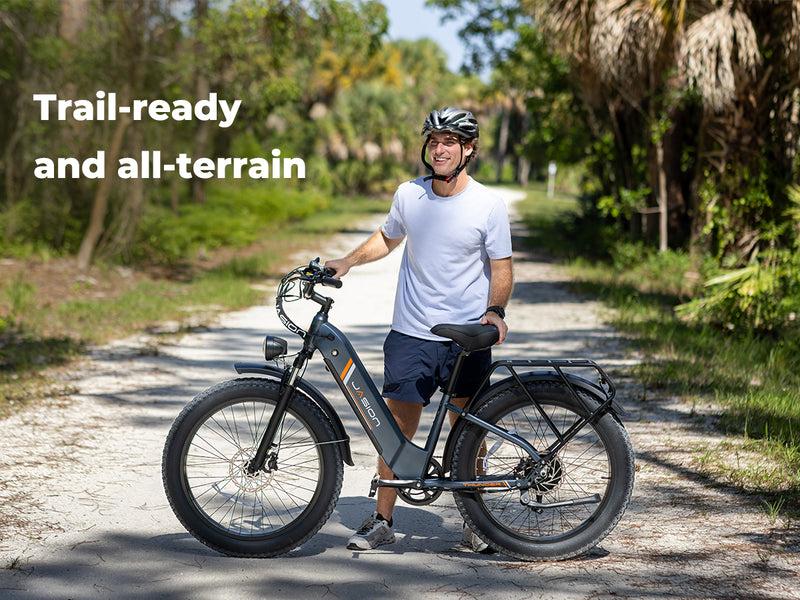
Moderately wide tires work well for riders who spend most of their time on pavement but still want some cushioning. More tire volume can be welcome on gravel or sandy shoulders, though wider tires add weight and can feel less nimble. Riders who regularly cross loose surfaces can compare fat tire ebikes, but the extra width should solve a problem that actually appears on the weekly route. Suspension helps on genuinely rough roads; on smooth streets, it may be extra hardware that a rider never really needs.
Wheel size changes the feel, too. Smaller wheels can be handy in tight spaces and on compact bikes. Larger wheels tend to carry momentum more smoothly over broken pavement. This is one of those choices that makes more sense during a test ride than it does on a comparison chart.
Jasion Thunder fat tire ebike for mixed pavement and rougher surfaces. Image courtesy of JasionBike.
Build Around Heat, Rain, and Daily Cargo
Pedal assistance is especially useful when the goal is to arrive without turning every trip into a workout. It can take the sting out of a bridge, a headwind, or the ride home late in the day. The rider still pedals, but the effort is easier to manage.
For workdays and errands, commuter ebikes earn their keep through ordinary equipment. A rack keeps a laptop bag or groceries off the rider’s back. Fenders are useful when the road stays wet after a quick shower. Lights matter on an early start or a dinner run that lasts longer than planned. An upright position can also make it easier to watch traffic and look over a shoulder.
Range estimates deserve some skepticism. Wind, hills, cargo, tire pressure, speed, temperature, and the chosen assist level all change how far a battery will go. Instead of buying around the longest advertised number, measure the longest normal round trip and leave a comfortable margin.
Think about charging at the same time. If the bike will be parked away from an outlet, a removable battery may be easier to live with. Batteries and chargers should be kept away from excessive heat and water and used according to the manufacturer’s instructions. A hot shed or a damp porch is not an ideal long-term charging station.
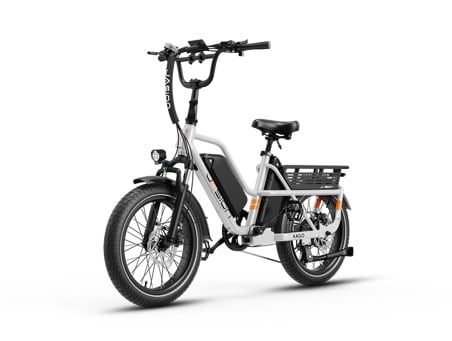
Jasion Kago cargo ebike configured for everyday hauling. Image courtesy of JasionBike.
Do the Hallway Test
Storage is where otherwise sensible purchases go wrong. A bike can feel perfect on the road and still become a nuisance if it blocks the entryway, will not fit in an elevator, or is too heavy for the stairs.
For an apartment, RV, or car-assisted weekend trip, folding electric bikes may be easier to fit into daily life. Still, “folding” does not automatically mean “easy to carry.” Check the full weight, the folded dimensions, and where your hands go when lifting it. If possible, pick up something of similar weight before deciding that a staircase will be no problem.
A full-size bike is often the simpler answer when secure, ground-level storage is available. It may offer more room for racks, baskets, and different frame sizes. Either way, decide where the bike will sleep before it arrives.
The same goes for parking away from home. Budget for a solid lock, look for visible places to secure the frame, and remove accessories that detach easily. Save the serial number and purchase information somewhere safe. None of this is exciting, but it determines whether the bike is convenient enough to use several times a week.
Pay Attention at Walking Speed
Shopping conversations tend to drift toward speed and power. In town, low-speed manners are often more important. The bike should feel steady when starting at an intersection, making a tight turn, or walking beside a storefront. The brakes should come on predictably, and the controls should be easy to reach without shifting the hands into an awkward position.
Fit is part of that confidence. A rider should be able to start, stop, turn, and look behind without feeling stretched or unstable. A step-through frame can make mounting easier, particularly with cargo on the back. Adjustable seats and handlebars help, but they cannot make the wrong frame size disappear.
On a test ride, skip the straight-line sprint. Start on a slight incline. Make a slow turn. Stop and restart. Roll over a rough patch and try the bike with less assistance. These small moments reveal whether the bike will feel friendly on a busy afternoon rather than merely impressive for five minutes.
Leave Room for the Weather to Change
A Southern ride can begin under clear skies and finish on wet pavement. Carry water, use working front and rear lights, and keep a simple rain plan. A properly fitted helmet and visible clothing are more useful than another gadget on the handlebar. Riders should also check the rules for the streets and trails they use, since access and equipment requirements vary by location.
A quick check before leaving is worthwhile: tires firm, brakes working, battery secure, and nothing loose on the rack. Electric bikes are often heavier than conventional bicycles, especially once bags or groceries are added, so tires and brakes should not be afterthoughts.
There is no single Southern setup. One rider needs a rack-and-fender commuter for the trip to work. Another needs a compact bike that can ride in the trunk to a greenway. Someone who lives beside rough county roads may gladly trade a little nimbleness for more cushioning.
Choose around the route, the storage space, and the errands that happen every week. A bike that clears the hallway, carries the grocery bag, and feels manageable at the busiest intersection is far more likely to leave the garage on Tuesday, not just wait there for the perfect Saturday.



-

 Resources5 years ago
Why Companies Must Adopt Digital Documents
-

 Resources4 years ago
A Guide to Pickleball: The Latest, Greatest Sport You Might Not Know, But Should!
-

 Resources1 year ago
50 Best AI Free Tools in 2025 (Tried & Tested)
-

 Resources1 year ago
Get Paid $5000+ a month to write : Discover 30 Spectacular Websites That Reward Your Writing Effort