Resources
AI and Rule Based Automation in Crypto Trading: Where Each Approach Works Best


The automated crypto trading market is changing alongside trading infrastructure itself. Perpetual market volumes are growing, an increasing share of activity is moving to DEXs, and traders have to work simultaneously with multiple venues, technical indicators, order books, positions, and on chain data.
Against this backdrop, startups are developing products that combine different layers of automation within the same technology stack. One example is Origami Tech, a startup launched in 2025 for automated crypto trading. The platform connects CEX and DEX markets, rule based crypto trading bots, market data, and strategy development tools. Origami Tech later added AI tools for Web3 research and the generation of Lua strategies from natural language prompts.
This reflects a broader market trend. AI and traditional algorithmic automation are increasingly being used within the same workflow, while performing different functions.
The scale of the market helps explain why. According to CoinGecko, the ten largest centralized perpetual exchanges processed $86.2 trillion in trading volume in 2025, up 47.4% from the previous year. Growth was even faster on DEXs. Volume across the ten largest perpetual DEXs increased from $1.5 trillion in 2024 to $6.7 trillion in 2025, while the DEX to CEX volume ratio rose from 2.5% to 7.8%.
By January 2026, combined monthly perpetual volume across CEXs and DEXs had reached $7.24 trillion, compared with $4.14 trillion in January 2024. The DEX share increased from around 2% to 10% over the same period.
AI Is Expanding the Research Layer of Crypto Trading
One of the most natural applications of AI is information processing.
When evaluating a market, a trader may need to consider price, volatility, order book data, funding, technical indicators, positions, blockchain activity, the state of DeFi protocols, and news simultaneously. These inputs come from different sources and in different formats.
Bank for International Settlements research demonstrates a similar approach in traditional financial markets. In a study published in 2025, a system analyzed more than 100 daily market indicators, identified potentially significant changes, and then used an LLM to analyze related news.
Crypto markets add another substantial source of information to this process: on chain data. AI can be used to work with information about tokens, protocols, DeFi, and blockchain activity before a trading decision is made.
Origami Tech integrated Web3 LLM at this stage of the workflow. AI functions as a research tool for accessing information about blockchain ecosystems, tokens, decentralized applications, and DeFi. In practice, this layer operates before strategy development and execution.
This application differs from the idea of a fully autonomous crypto AI trading bot. The model helps collect context and research the market, while the results can then inform the development of specific trading logic.
Generative AI Shortens the Path From an Idea to a Strategy
The second application is crypto trading bot development.
A trading idea alone is not yet an algorithm. For a strategy to operate automatically, it needs defined data inputs, order conditions, position sizing rules, position management logic, and exit conditions.
Generative AI can shorten the distance between a trader’s description of an idea and formal trading logic.
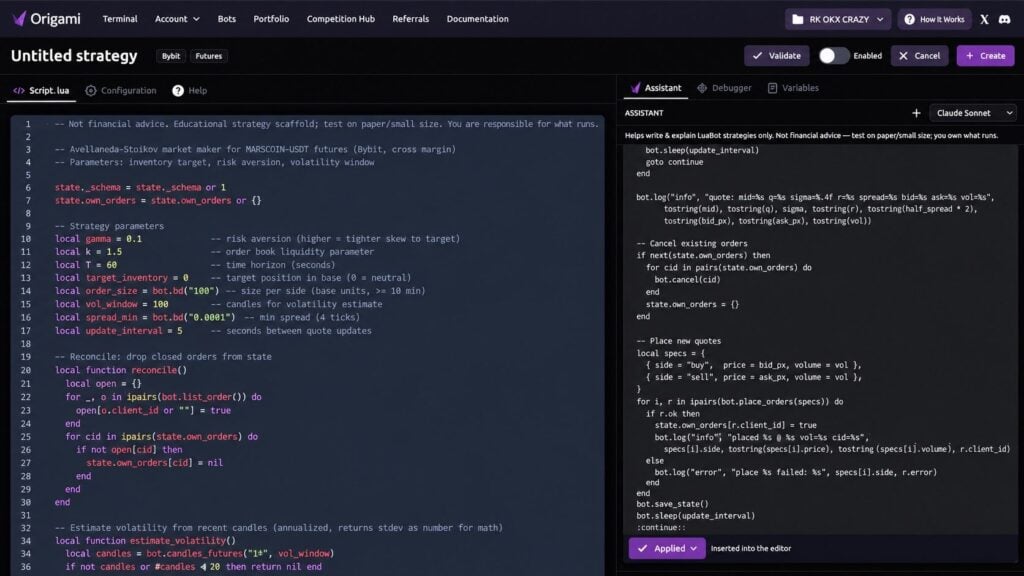
Instead of writing the entire structure manually, a user can describe the intended strategy in natural language. AI can then turn that description into an initial version of the code, which the trader can review and modify.
Origami Tech applies this approach in Lua Bots. Its AI Assistant generates Lua code from a natural language prompt. A strategy can incorporate parameters such as liquidity, volatility, inventory, risk preferences, position size, and quote update intervals. The generated code remains available for review and editing before deployment.
Image 2
Here, AI serves as an intermediate layer between a trader’s idea and an executable strategy.
Rule Based Automation Remains the Core of Execution
Once a strategy has been created, the technical requirements change.
A crypto trading bot must work with specific values and conditions. The system determines order price, volume, direction, position limits, leverage, position adjustment rules, and exit conditions.
This layer of automation has traditionally relied on deterministic logic. For example, a strategy might create a buy order when RSI falls below a specified level, calculate position size as a percentage of available balance, and close the position when another condition is met.
More complex crypto bot trading strategies can combine several indicators with volatility, liquidity, balance, position data, and additional execution parameters.
Origami Tech uses a similar architecture in its core automation layer. Strategies can use 20+ built in technical indicators, formulas, variables, and market data functions. Trading logic can be reused across supported exchanges, while a specific bot is connected to a selected account and trading pair.
The value of rule based automation comes from reproducibility. When a defined set of conditions occurs, the strategy performs a predetermined action. Individual rules can be analyzed, tested, and adjusted.
AI can help create this logic. The execution layer applies it consistently in live markets.
Why Multi Exchange Infrastructure Is Becoming More Important
The growth of DEXs is also changing the architecture of automated crypto trading.
Several years ago, a crypto trading bot was often built around one exchange and a relatively narrow group of strategies. Today, liquidity is distributed across a growing number of venues.
In 2025, Hyperliquid processed around $2.9 trillion in perpetual volume, while Lighter processed approximately $1.3 trillion, according to CoinGecko. DEXs are beginning to capture a meaningful share of a market that was previously dominated by centralized exchanges.
For automation platforms, this creates a need to work with different APIs, market structures, account models, and execution environments.
Origami Tech is developing as a multi exchange crypto trading bot platform. By 2026, the company reported support for 14+ exchanges, including CEX and DEX venues. Users can connect exchange accounts, create separate crypto trading bots for different markets, and manage them from a single workspace.


-

 Resources5 years ago
Why Companies Must Adopt Digital Documents
-

 Resources4 years ago
A Guide to Pickleball: The Latest, Greatest Sport You Might Not Know, But Should!
-

 Resources1 year ago
50 Best AI Free Tools in 2025 (Tried & Tested)
-

 Resources1 year ago
Get Paid $5000+ a month to write : Discover 30 Spectacular Websites That Reward Your Writing Effort