Blogs
6 Packhelp Alternatives for Growing Brands: Same Die Cut on the Third Order?

First packaging order looks perfect, the second still solid. Then the third arrives thin, dull, and late. Sound familiar? You’re already searching for Packhelp alternatives for growing brands before the next launch. Packhelp is popular, but even reliable platforms can stumble as volumes rise: board specs shift, tooling fees surface, lead times stretch. This guide compares six proven suppliers, each “best for” a specific growth scenario, so you can lock dimensions, freeze color, and trust that order three matches order one for every drop, release, and season.
The six Packhelp alternatives at a glance

Finding a packaging partner is not about scrolling endless “top pick” lists. You need a single-screen snapshot that shows which supplier leads on MOQ, tooling, and speed, so you can shortlist in seconds.
| Provider | Best for | Public MOQ * | Tooling model | Core production region | Published production window † |
| Zenpack | Managed, multi-SKU growth | Quote-qualified | Conventional; confirm die and plate retention | U.S. offices, Asia hubs | 15–24 weeks design to production (FAQ) |
| Packwire | No-tooling short runs | 10 units | Digital (no dies/plates) | North America | 10–20 production days |
| noissue | Sustainable global breadth | Low; confirm per SKU †† | Digital + hybrid | Global network | Varies by product |
| EcoEnclose | U.S. recycled-content depth | 100 boxes | Conventional plates + dielines | Colorado, U.S. | Starts at proof approval |
| PackMojo | Premium offshore economics | 100 | Hybrid, dies at volume | China | Quote-specific |
| Packlane | Self-serve prototype speed | 1 box | Digital, dies at scale | U.S. plants | 7–12 business days plus transit |
Lowest advertised quantity for a standard E-flute mailer; always confirm at SKU level.
† Figures cover factory production only. Add transit, customs, and warehousing for delivered lead time.
†† Lower minimums apply to accessories (e.g., tissue or stickers).
Keep this grid handy. The next sections will unpack real-world strengths, caveats, and repeat-order safeguards for each provider.
How we evaluated the alternatives
We scored each supplier against a six-factor framework shaped by the pain points you raise most often: repeat-order drift, hidden tooling fees, and surprise freight.

| Criterion | Weight | What earns full points |
| Repeat-order consistency, QA and tooling transparency | 25 percent | Locked dieline, board code, golden sample, and factory-change notice |
| Production scalability and operations | 20 percent | Stable lead times at 10 000 + units, multi-SKU warehousing, multi-3PL feeds |
| Landed-cost clarity | 20 percent | One quote covering tooling, freight, duties, storage, and defect allowance |
| MOQ and experimentation flexibility | 15 percent | Low technical MOQ and an economic break-even that won’t drain cash flow |
| Sustainability and compliance evidence | 10 percent | SKU-level FSC or recycled-content documents, not generic “eco” claims |
| Customer evidence and support | 10 percent | Normalised rating, recent volume, and documented complaint resolution |
Every brand starts at zero. Missing data pulls scores down, and marketing fluff cannot replace hard evidence. Review impact is capped when fewer than ten independent reviews exist, to prevent tiny samples from skewing results.
Zenpack: best for managed, multi-SKU growth
Your line sheet now covers five box sizes, three inserts, and a seasonal kit. Growing brands can lose up to 30 percent of their operational bandwidth managing separate design agencies, brokers, and factories, a headache a Zenpack packaging partner removes with a single, integrated workflow. It pairs U.S.-based project teams with five ISO 9001/14001-certified production hubs, primarily in China and Taiwan, delivering design-to-delivery support at any volume.

Zenpack one-stop packaging partner workflow screenshot
What makes it stand out
- Single point of contact across structural design, dielines, sampling, mass production, and staged delivery to multiple 3PLs.
- Proven track record: 5.0 average from 13 Clutch reviews praising reliability, quality, and responsiveness.
- No rigid factory minimums; projects qualify on budget, structural complexity, and brand goals, with an overall project budget of $10 000 or more.
Check these details before you sign
- Confirm who owns each cutting die and how long Zenpack stores it.
- Ask Zenpack to lock the producing plant for repeat orders and document change-control triggers.
- Verify when a new pre-production sample is required (artwork change, board change, or annual QC).
If those points align with your needs, Zenpack can operate like an outsourced packaging department, ideal for brands moving from scrappy DTC lines to multi-channel scale without sacrificing spec consistency.
Packwire: best for no-tooling short runs and frequent changes
Need a new box size next week or a holiday graphic on only 50 units? Packwire skips metal dies on its short-run work. Its CAD digital cutting tables and digital presses mean no tooling costs.
What that looks like
- Order from 10 boxes (or a single printed sample); enter dimensions, upload art, and see instant pricing.
- Standard corrugated mailers ship in 10–20 production days with the same zero setup cost.
- Digital files repeat exactly, reducing third-order drift. Confirm color targets and which press runs your reorder.
Things to check
- Review depth: only 8 independent Trustpilot reviews (4.3/5) to date, so run a paid sample before a big launch.
- Volume crossover: ask when your run would shift to flexo or litho and whether new tooling fees apply.
For agile brands iterating fast, Packwire works more like software than print: upload, iterate, reorder, and avoid a tooling tax.
noissue: best for sustainable global breadth
Need boxes, tissue, tape, and stickers, each with recycled content, in one cart? noissue delivers that single-checkout experience.
- Low MOQs: accessories such as tissue and stickers start at small runs; check the exact box minimum in the live configurator.
- 4.7 TrustScore from 2 300+ reviews on Trustpilot, with buyers praising smooth reorders and diligent design checks.
- Global production network: ask which region prints your order and whether storage or call-off delivery is available.
Before you buy
- Confirm recycled-content percentage on your exact SKU because claims differ.
- Check whether the run is digital (no plates) or conventional at higher volumes.
- Ask for lead times on mixed orders; boxes and tissue may ship from separate facilities.
Handle those details and noissue becomes a scalable sustainability engine: coordinated kits, fewer vendor emails, and carbon data you can share with customers.
EcoEnclose: best for U.S. sustainability evidence
Need recycled-content facts in black and white? EcoEnclose publishes recycled-content specs for its custom shipping boxes: 100 percent recycled fiber, 95 percent post-consumer waste. Artwork guidelines and product specs are public before you place an order.
- MOQ: about 100 boxes, higher than digital players yet low for a conventional U.S. converter.
- Tooling: conventional printing, so ask about plate fees and how long plates are kept for reorders.
- Customer evidence: 4.5 TrustScore from 61 reviews on Trustpilot.
Before you order
- Confirm plate-retention time and replacement cost.
- Ask whether quoted lead time includes ground shipping from Colorado.
- Verify board-strength specs if you move beyond e-commerce mailers into shipping shippers.
For brands ready to unite recycled content with transparent tooling math, EcoEnclose offers peace of mind at a still-accessible scale.
PackMojo: best for premium customization and offshore economics
Rigid boxes with magnetic flaps, foil accents, or molded inserts call for a specialist. PackMojo, which produces in China, offers 40+ packaging types with MOQs from 100 units; confirm the rigid-box minimum on your quote.
Why it works
- Online configurator lets you set dimensions, finishes, and FSC-certified materials, then shows pricing that often undercuts U.S. quotes once volumes climb.
- Production in China lets you ship packaging straight to your cut-and-sew factory. Ask for DDP terms so freight, duties, and customs appear on one invoice.
Watch-outs
- Independent review evidence is limited: no Trustpilot profile and only sporadic case studies. Budget for a printed sample to vet color and fit.
- Transit time swings with mode; ocean saves cost, air saves time. Build that into launch calendars.
- Before the PO, confirm the same plant and tooling will run both the 100-unit test and the 5 000-unit reorder, clarify die ownership, and ask about material-price surcharges.
Handle those details and PackMojo can convert offshore complexity into a premium, scalable packaging engine for brands seeking a luxury unboxing moment without domestic price tags.
Packlane: best for self-serve visualisation and test orders
Need a printed prototype by next Friday? Packlane’s browser-based 3D editor lets you design and price a custom mailer box from a single unit.
- Pure self-service: choose a style, upload art, get instant cost, and check out.
- Boxes are made in the USA, with standard production of 7–12 business days plus transit. Duplicate projects to test new sizes or artwork without extra calls.
Watch-outs
- Trustpilot 3.7 from 456 reviews (10 in the past year). Recent negatives mention crushed mailers, off-centre print, and proof delays.
- Larger runs may move to different presses, so lock your material spec and colour targets before scaling.
- Confirm whether the same print technology runs at 5 000 units, board strength (ECT/BCT) for fulfilment, and any plate fees if production shifts to conventional methods.
For prototypes, influencer drops, or design sprints, Packlane provides the fastest reality check your artwork can get.
Side-by-side comparison: where the numbers land
We pulled each provider’s lowest published minimum for a plain E-flute mailer and noted the most common sample paths. Use these figures as baselines; your exact SKU may shift them.

| Provider | Corrugated mailer MOQ | Folding carton MOQ | Rigid box MOQ | Plain structural sample | Printed prototype |
| Zenpack | Quote-qualified (no fixed floor) | Quote-qualified | Quote-qualified | Part of its 4–8-week sampling phase | Production sample before mass run |
| Packwire | 10 units | 500 units | 500 units | Same workflow | Yes, no extra tooling |
| noissue | Confirm in configurator | Confirm in configurator | Confirm in configurator | Sample kit | Digital proof first |
| EcoEnclose | 100 units | Not listed | Not standard | Sample available | After proof approval |
| PackMojo | 100 units | 100 units | Confirm on quote | White sample | Printed pre-production sample |
| Packlane | 1 unit | Via Packlane Plus (quote) | Via Packlane Plus (quote) | Same checkout | Identical path |
What this means
- Digital-first players (Packwire, Packlane) still win the single-box race.
- Zenpack quotes by budget; clear the roughly $10 000 project floor and unit minimums become flexible.
- EcoEnclose offers the deepest recycled content but starts higher, so plan cash accordingly.
- Rigid boxes remain premium; expect higher minimums than mailers from every provider.
Lock these figures into your RFQ sheet so vendor talks start with facts, not guesses. Next, look at why the numbers on order three drift from order one.
Why the third order can differ from the first

Dieline, die and plate are not interchangeable
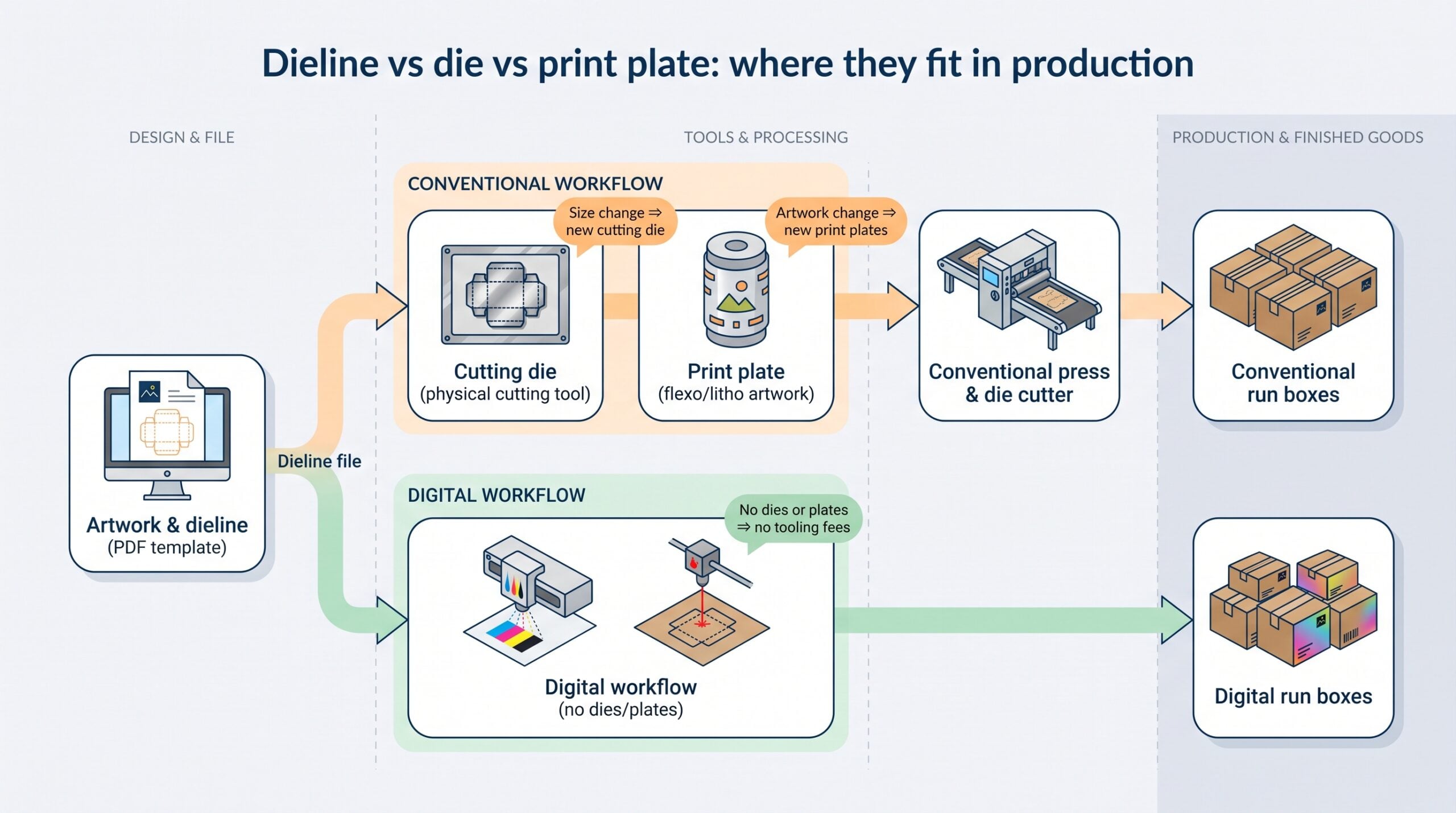
Your designer sends a dieline. Sounds perfect, right? Not quite. A dieline is only the digital template that shows where to cut and fold. Turning that PDF into real boxes takes two additional tools, and mixing them up is the quickest way to wreck a reorder.

- Cutting die – a steel-rule tool that stamps out the box shape on conventional runs. Change the box size by even one-eighth inch and the die is scrap.
- Print plate – a flexographic sleeve or litho plate that carries your artwork. Switch from a one-colour logo to full CMYK and you need a new set.
- Digital workflow – suppliers such as Packwire digitally cut and digitally print, eliminating both dies and plates. That is why digital works at tiny or ever-changing quantities.
On the first job every vendor looks identical: crisp sample, punctual tracking email. The cracks appear on order three when the supplier swaps board, remakes the die, or changes print tech without warning. Know which tool lives where, and who owns it, and you can lock specs so the pallet that lands at your 3PL still matches the golden sample.
Eight hidden reasons your third order drifts
Your dieline never changed, yet the next pallet arrives thinner, duller, or off-centre. Here is what usually goes wrong:
- Factory swap without notice – peak season overload sends jobs to a different plant with other presses and crews.
- Board substitution – mills rotate stock; a new flute or liner alters caliper, crush strength, and ink absorbency.
- Print-process switch – digital at one hundred units, flexo at five thousand; new plates and colour curves mean new risk.
- Cutting die remade – worn steel rules are recut; a fraction-millimetre change can loosen every closure.
- Operator or machine variability – press tension, pressure, and dryer settings shift tone and gloss.
- Environmental drift – humidity swings change paper moisture and cure times between Colorado winters and coastal summers.
- Ink or coating reformulation – VOC or pigment tweaks push Pantone targets warmer or cooler.
- Spec creep sold as “improvement” – lighter board or a new “eco” varnish saves cost but breaks consistency.
Write a consistency clause into the purchase order: the supplier must match the golden sample and notify you of any factory, material, or process change before production. One sentence can save a truckload of rework.
Prelaunch or fewer than 100 units
Samples are in hand and a wait-list is growing, but you still have zero proof of reorder velocity. Cash flow matters, so every dollar tied up in packaging is one you cannot direct to ads or inventory.
Stick with stock boxes: order them from ULINE or your 3PL, then layer branding on top with custom tape, logo stickers, a printed sleeve, or a rubber stamp. The unit price looks high, yet total spend stays low because you are buying tens, not hundreds.
Why not jump straight to custom? Early customers will unbox, return, and suggest tweaks. Dimensions often change, and a tooling fee today can lock you into a size that no longer fits in six weeks.
When does a custom mailer make economic sense? As a rule of thumb, break-even lands at roughly 150–200 monthly shipments. Below that, keep packaging flexible and iterate quickly.
Early traction and recurring small runs
Sales are steady, reviews are positive, and you can forecast about 200 orders a month. A simple tape-and-sticker combo now feels underdressed.
This is the sweet spot for digital custom packaging. Platforms such as Packwire and Packlane lock dimensions to the millimetre, print full CMYK, and let you reorder in 50 to 500-unit batches without new tooling. Unit cost stays higher than offshore flexo, but inventory cash stays low, and artwork can pivot for every drop.
- Treat each box size as its own SKU in your ERP, track velocity, and reorder when stock reaches a two-week buffer.
- Use digital print’s zero plate fee to tweak Pantones or add seasonal graphics at no extra setup cost.
- Watch for surface scuffing on heavy shipments; add a matte aqueous or soft-touch varnish or move to a coated white-top board, a small cost that protects the unboxing moment.
Graduate from this stage when any single mailer size clears about 2 000 pieces per quarter. Beyond that point, conventional presses start to beat digital on landed cost.
Predictable volume and several SKUs
You are running four or five box sizes every month, each topping about 2 000 units. Digital convenience now costs more than a conventional press, so it is time to balance flexibility against unit economics.
Start by mystery-shopping the same dieline with EcoEnclose, PackMojo, and Packwire’s volume team. Ask:
- At what quantity does production flip from digital to flexo or litho?
- Does that flip require a new cutting die or new print plates?
Budget a tooling hit of $500 to $1 500, but per-box cost can fall 30 to 50 percent when spread across a 10 000-unit run. Spread the same fee over 1 000 units and you lose money.
Next, consider storage. Ten thousand flat E-flute mailers occupy about 40 cubic feet, roughly one standard U.S. pallet. No space? Pay for call-off storage or split the run: two pallets ship to your 3PL, eight stay at the converter. Carrying fees usually beat leasing extra square feet at peak rates.
Finally, add a change-control clause to your purchase order: any shift in board weight, factory, or ink set triggers a new golden-sample sign-off. One sentence now can save every reorder later.
Multi-channel or international growth
Your boxes now move between Amazon FBA, a European distributor, two U.S. 3PLs, and perhaps a Tokyo pop-up. At this scale, inconsistent packaging is more than annoying; it can trigger compliance fines.
- Central governance – keep dielines, golden samples, and colour targets in one shared system, whether that is a managed partner such as Zenpack or your own product-data folder. Grant marketing view-only rights, give packaging ops edit rights, and lock final approval at director level.
- Dual sourcing – keep one domestic converter for rush jobs and one offshore partner for bulk. Both must run the same cutting die and board spec, even if that means duplicating tooling. The duplicate is inexpensive insurance when a hurricane or customs delay hits peak season.
- Landed-cost visibility – ocean freight, duties, and local surcharges swing widely by lane. Hard-code Incoterms on every purchase order and set a quote-validity window. A surprise fuel surcharge after promo pricing is locked can erase margin.
Put governance, dual sourcing, and cost discipline in place, and packaging shifts from bottleneck to global brand asset.
Apparel and DTC packaging checklist
Run through this list before you send an RFQ (request for quotation).
- Confirm folded-garment dimensions: measure the bulkiest size on a humid day; a puffer jacket can add cubic inches in August that are not present in January.
- Design for returns: add a second adhesive strip or a tear line so customers can reseal the mailer without extra tape.
- Align inner wraps: polybags, tissue, and insert cards should match the box footprint; otherwise warehouse staff fill voids with dunnage that spoils the unboxing moment.
- Pre-print barcodes or size stickers: saves pick-pack seconds and cuts miss-ship rates.
- Check humidity and crush data: ask for edge-crush or burst strength at 95 percent RH; E-flute that looks sturdy in the plant can collapse after two days in a Florida trailer.
- Map the supply-chain hand-off: decide whether boxes ship to the garment factory (pack-at-source) or your 3PL; Incoterms, lead times, and damage liability all change with that choice.
Packaging supplier decision checklist
Copy these five sections into every RFQ. If a vendor cannot fill in each line, keep looking.
- Structural spec: internal dimensions, flute, caliper, ECT or burst rating, and tolerances.
- Commercial terms: line-item unit price, tooling, samples, freight, duties, storage, payment schedule, Incoterms, quote validity, and cancellation penalties.
- Repeat-order safeguards: tool ownership, storage period, golden-sample retention, and a written change-notification clause for any plant, material, or process shift.
- Sustainability proof: FSC certificate or recycled-content letter tied to the exact SKU; ignore generic “eco-friendly” claims.
- Service and risk: named account manager, escalation ladder, defect allowance, reprint timeline, and a backup plant for peak season.
Suppliers that return a complete table earn an invite to quote, and everyone else filters out to save weeks of email back-and-forth.
Frequently asked questions
What is the best Packhelp alternative for a growing brand?
“Best” depends on your pain point. Need low MOQs and constant tweaks? Packwire fits. Need SKU-level recycled-content proof? EcoEnclose. Rolling out multi-SKU kits with warehousing and QC? Zenpack. Rank your priorities (MOQ, sustainability, scale, or speed), then choose the provider that tops that column.
Which alternative has the lowest true MOQ?
Packlane lists a single box and Packwire starts at 10 mailers, but one digitally printed, full-bleed mailer can cost $10 to $15 delivered. Below a few dozen units, stick with stock boxes plus branded tape.
Do I pay a cutting-die fee on a reorder?
Not if nothing changes. Reorder the identical size and structure and most converters reuse the die at no cost. Change the box by even one-eighth inch and you pay for a new die. Artwork-only updates keep the die but can trigger new print plates on flexo or offset runs. Digital printers skip both fees, which is why they dominate small, fast-changing jobs.
How long does custom packaging take door to door?
Count backward from your launch date:
| Stage | Digital | Conventional |
| Artwork & proof | 1–2 days | 3–5 days |
| Production | 5–10 days | 10–15 days after plates |
| Freight (U.S. ground) | 2–5 days | 2–5 days |
| Freight (Asia ocean) | 20–35 days port to port | 20–35 days |
| Customs buffer | +3 business days | +3 business days |

Add a one-week cushion. If the math still misses your in-hand date, downgrade finishes, pay for air freight, or shift the launch.
Next steps
- Finalise your product spec: lock the largest garment size, fold, and accessory load so box dimensions stay stable during quoting.
- Send the same RFQ to two or three shortlisted suppliers: include every line from the decision checklist so vendors cannot skip details.
- Approve a physical sample and tooling passport before volume production: keep one golden sample on your shelf, one at the factory, and require written sign-off for any future change.
Follow these three steps and your third order, along with every one after it, will look, feel, and ship exactly like the first.


-

 Resources5 years ago
Why Companies Must Adopt Digital Documents
-

 Resources4 years ago
A Guide to Pickleball: The Latest, Greatest Sport You Might Not Know, But Should!
-

 Resources1 year ago
50 Best AI Free Tools in 2025 (Tried & Tested)
-

 Resources1 year ago
Get Paid $5000+ a month to write : Discover 30 Spectacular Websites That Reward Your Writing Effort